

Summary
Finding a truly special recruit in College Football 27 can completely change a Dynasty program. The problem is that the game does not currently produce "generational" recruits in exactly the way many players expected. Instead of getting a freshman who immediately arrives as one of the best players on the roster, most CPU-generated prospects are better described as having generational attributes.
That can mean a running back with 99 speed, a quarterback with exceptional throwing power, or a defensive player with unusually strong physical ratings. The key is learning how to identify those prospects before spending valuable scouting resources. To streamline your scouting process, buy CUT 27 Coins and unlock premium tools.
The method below focuses on using the Playing Time deal breaker, archetype, position, location, and physical attributes to narrow down the prospects worth scouting.

What Counts as a Generational Recruit in CFB 27?
Before searching for these prospects, it is important to understand what the game actually gives you.
Look for Generational Attributes
The most impressive CPU-generated recruits usually stand out because of one or more exceptional attributes rather than an immediately massive overall rating. For example, 99 speed can make a running back or receiver extremely valuable even if that player does not arrive with an elite overall rating.
The source also points out that the highest non-modded recruit seen was only 77 overall, showing why overall rating alone should not determine whether a prospect is special. A 76-overall five-star with excellent physical attributes can still become one of the best players on your roster.
Focus on the Right Programs
This approach works best for established programs, particularly teams around three-star prestige or higher. Smaller programs generally have less freedom to target specific prospects because they need to prioritize players who are realistically willing to join them.
Once your program has enough recruiting power, however, you can start hunting for specific archetypes and physical traits instead of simply taking whichever prospects fit your board.
Step 1: Filter Your Prospect List by One Archetype
The most important part of the method is keeping your recruiting board consistent.
Open the prospect list and filter by star rating and position. If you are looking at four-star prospects, keep the board limited to four-star players. Do not mix four-star and five-star recruits when comparing their Playing Time deal breakers.
Then select a single archetype.
For example, when searching for an elite running back, the source uses four-star East-West Playmakers. Every recruit added to the board belongs to that same archetype. This matters because different archetypes operate around different overall-generation thresholds.
Mixing archetypes can make the comparison unreliable because a particular Playing Time grade may correspond to different overall ranges depending on the archetype.
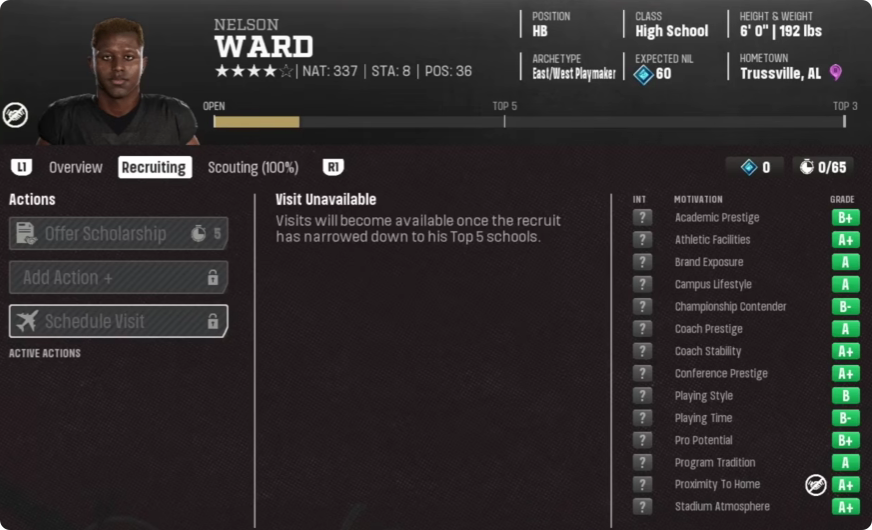
Step 2: Use the Playing Time Deal Breaker as a Shortcut
Once your prospects are grouped correctly, check their Playing Time deal breaker.
The basic idea is simple: a higher Playing Time grade generally indicates a higher overall prospect within that archetype. A recruit with a B or B-minus can therefore deserve more attention than someone with a D, especially when the archetype's key attributes are tied closely to overall rating.
However, this is a filter—not a guarantee.
A Low Grade Does Not Mean the Player Is Bad
Do not automatically eliminate a recruit because he has a D Playing Time deal-breaker.
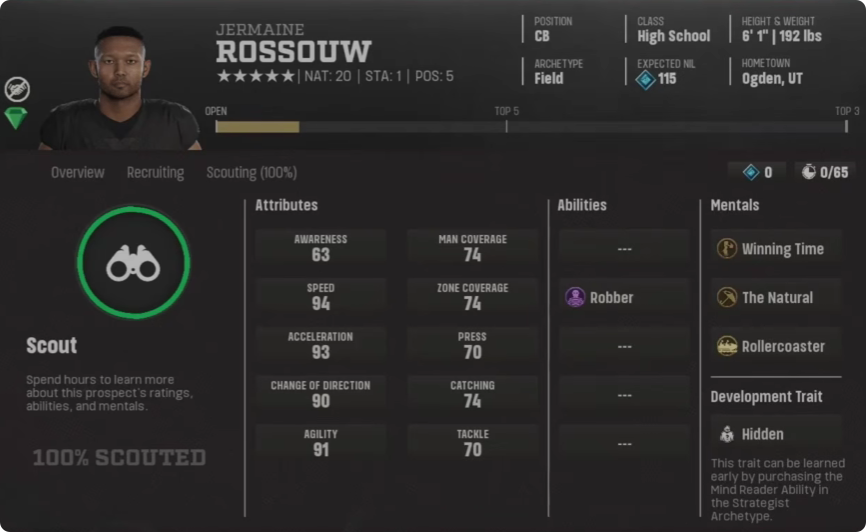
The source gives an example of a running back with a D who still had a 90 speed rating and a Gem development result. Another recruit with a higher Playing Time grade could have better overall attributes without necessarily having a better development trait.
The important distinction is that the Playing Time deal breaker can help predict overall, but it does not guarantee a Gem or Elite development trait.
Step 3: Match the Deal Breaker With the Archetype's Key Attribute
The next step is understanding what actually drives the archetype.
For East-West Playmaker running backs, speed and agility are particularly important. Because speed contributes heavily to the archetype's overall rating, a recruit with a strong Playing Time grade is more interesting when his physical profile also suggests high speed.
This is where the method becomes much more useful than simply sorting recruits by overall.
For example, a Louisiana running back with a B-minus Playing Time deal breaker stood out because the source also considered his location and archetype. After scouting, that player revealed 99 speed and became the kind of rare recruit this method is designed to find.
Step 4: Consider a Recruit's State
Location is another clue used in the method.
The source specifically identifies Florida, California, and Louisiana as states to watch when searching for faster players. This does not guarantee a high-speed recruit, but it provides another factor to consider when several prospects appear similar.
For example, if two running backs have comparable Playing Time grades, the player from one of these states may deserve additional attention when your goal is finding exceptional speed.
Think of this as another part of the numbers game rather than a hard rule.
Step 5: Apply the Same Method to Speedster Receivers
The process also works particularly well for Speedster receivers.
Start by filtering to one-star rating and add all the Speedster receivers to your board. Then compare their Playing Time deal-breakers and locations.
For this archetype, speed and acceleration are extremely important. A prospect with a stronger Playing Time grade and a favorable physical profile should move higher on your scouting priority list.
The source provides examples ranging from 95 speed and 93 acceleration to an especially strong receiver with 98 speed and 94 acceleration. The 98-speed prospect was also from California, matching another clue used in the method.
Never Mix Archetypes When Comparing Grades
This is one of the most important rules.
A Speedster receiver and another receiver archetype can have different overall-generation ranges. Therefore, comparing their Playing Time deal breakers directly can produce misleading results.
Keep the board focused on one archetype at a time. That allows the Playing Time grades to provide a more meaningful comparison between otherwise similar prospects.
Step 6: Use Physical Attributes for Offensive Linemen
The same concept can be applied to other positions, but you need to identify the attribute that matters most for the archetype.
For Raw Strength offensive linemen, strength becomes the key physical rating. The source demonstrates this by filtering four-star tackles and comparing their Playing Time grades before scouting.
Prospects with A+ or A-minus grades can become priority targets, but the final strength rating still determines how impressive they really are. One A+ prospect reached 90 strength, while another lower-rated prospect reached only 86.
This shows why the method should be used to reduce the number of prospects you scout, not replace scouting completely.
Step 7: Watch for Rare Archetypes
Some of the most unusual recruits can be identified through their archetype or physical profile.
One example is the 6'6 receiver archetype. According to the source, only one or two 6'6 receivers may appear in a class, making them particularly interesting. These players are not necessarily extremely fast—the example shown had 84 speed and 80 acceleration—but their size and other attributes can make them valuable.
Outside linebackers provide another example. Taller Signal Caller linebackers can sometimes reach 6'5, while the tallest middle linebackers may be around 6'3. A particularly tall outside linebacker can therefore be valuable even if his overall rating does not immediately look extraordinary.
Step 8: Do Not Ignore Athlete Quarterbacks
Finally, keep an eye on rare Athlete quarterbacks, particularly five-star prospects.
These players can sometimes become valuable at positions other than quarterback. Depending on their attributes after arriving on campus, an Athlete quarterback could potentially work at cornerback, linebacker, or safety.
The important limitation is that you cannot always determine exactly how useful they will be before they reach campus. Their defensive potential is randomized, so this is another situation where you are looking for upside rather than certainty.
Use the Method as a Numbers Game
The biggest takeaway is that there is no guaranteed formula for finding a generational recruit in CFB 27.
Instead, use a combination of same-star filtering, same-archetype comparisons, playing-time deal breakers, key physical attributes, state, and rare physical profiles to identify the prospects most worth scouting.
Start with a large group, eliminate weaker candidates, and spend your scouting resources on the players who stand out.
That approach can make recruiting much more efficient, especially once you have a strong enough Dynasty program to pursue specific prospects. It will not reveal every generational player automatically, but it gives you a practical way to improve your odds without fully scouting every recruit on the board. To further boost your recruiting efficiency, CUT 27 Coins can unlock premium scouting tools that help you.