

Summary
In CFB 27, simply using Auto Reorder on your Depth Chart can leave valuable players sitting on the bench. Overall rating is useful, but it does not always tell you who fits your scheme best. A lower-rated player with elite speed, acceleration, blocking, or pass-rush ability can sometimes be more useful than a higher-rated starter.
The key is to study your roster before playing and build your Depth Chart around the attributes that matter most for your style. To refine your roster more effectively, buy CUT 27 Coins and unlock premium scouting.
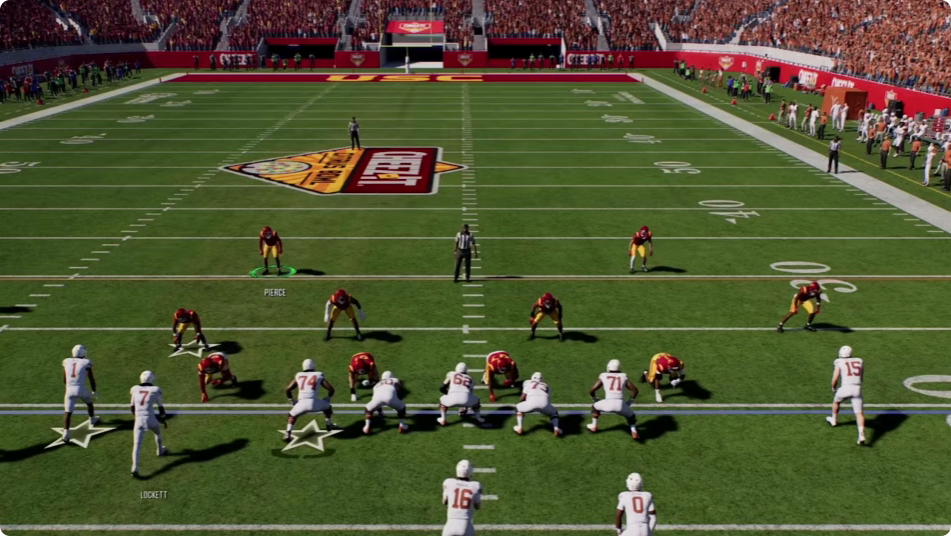
Why You Shouldn't Rely on Auto Reorder
Auto Reorder generally puts players in order based on Overall, but that doesn't account for how you actually play.
If you like throwing the ball, for example, a receiver's route running may matter more than a small difference in Overall. If you play aggressively on defense, speed and acceleration can be more valuable than coverage ratings.
You should also know your second- and third-string players. Injuries, fatigue, and specific packages can force backups onto the field, and those players can sometimes be hidden gems.
Look Beyond Overall
When comparing players, look for the attributes that directly support their role.
Speed and acceleration: Important for skill players and defenders.
Route running: Helps receivers consistently create separation.
Catching: Especially valuable for receiving backs and reliable targets.
Block shedding: A major priority for defensive linemen.
Pass-rush power and finesse: Helps identify different types of pass rushers.
Strength: Particularly important for defensive tackles and linemen.
Awareness and play recognition: Useful for defenders who must react quickly.
Your goal is not to find the highest Overall player. It is to find the player who gives you the best combination of attributes for the job.
How to Set Your Offensive Depth Chart
Quarterback: Prioritize Throwing Ability
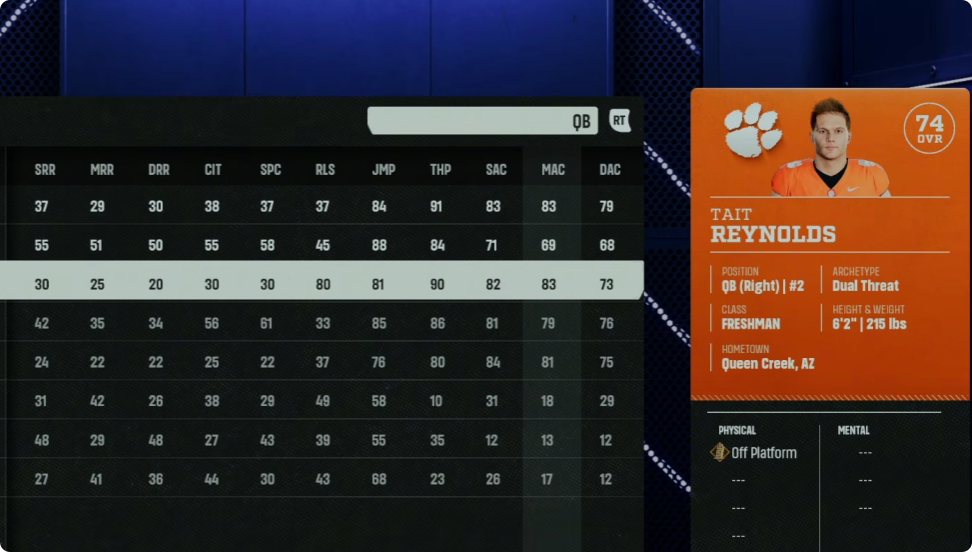
At quarterback, throw power and accuracy should be your first considerations.
Elite teams may already have an obvious starter, but backups can still be valuable. For example, a lower-rated quarterback might have excellent throw power and solid short and medium accuracy, making him a reliable emergency option.
Know what your backup can and cannot do. If his deep accuracy is weak, don't expect him to consistently make difficult downfield throws. Build your play calling around his strengths instead.
Running Back: Use a Two-Back Rotation
Don't automatically give every snap to your highest-rated running back.
Look for explosiveness, speed, agility, change of direction, and catching. A quick back with strong movement abilities can be your home-run threat, while another back may be better as a receiving option.
A two-back rotation can also help manage wear and tear. Keep your explosive starter fresh by giving meaningful snaps to a reliable backup.
For third-down situations, catching becomes particularly important. A running back who can run routes and catch passes out of the backfield can provide more value than his Overall suggests.
Wide Receiver: Speed vs. Route Running
At wide receiver, the top players are usually easy to identify. The real decisions come when choosing your fourth and fifth receivers.
Start comparing route running, speed, acceleration, agility, and catching.
Route running is especially valuable against man coverage because your receiver needs to create separation before he can make the catch. However, elite speed can compensate for weaker hands or route running by creating separation naturally.
A very fast receiver does not necessarily need to be your full-time starter. You can also manufacture touches with screens, slants, drags, or other quick routes to get the ball into his hands.
Tight End: Athleticism Can Win
For tight ends, speed should be one of your first checks.
A tight end often faces linebackers and safeties, so an athletic player who can stretch the field can be extremely useful. Catching and Sure Hands are valuable, but they should not automatically outweigh a significant athletic advantage.
Look for a tight end with a good combination of size, speed, and route-running ability who can get away from defenders after the catch.
How to Find Hidden Gems on the Offensive Line
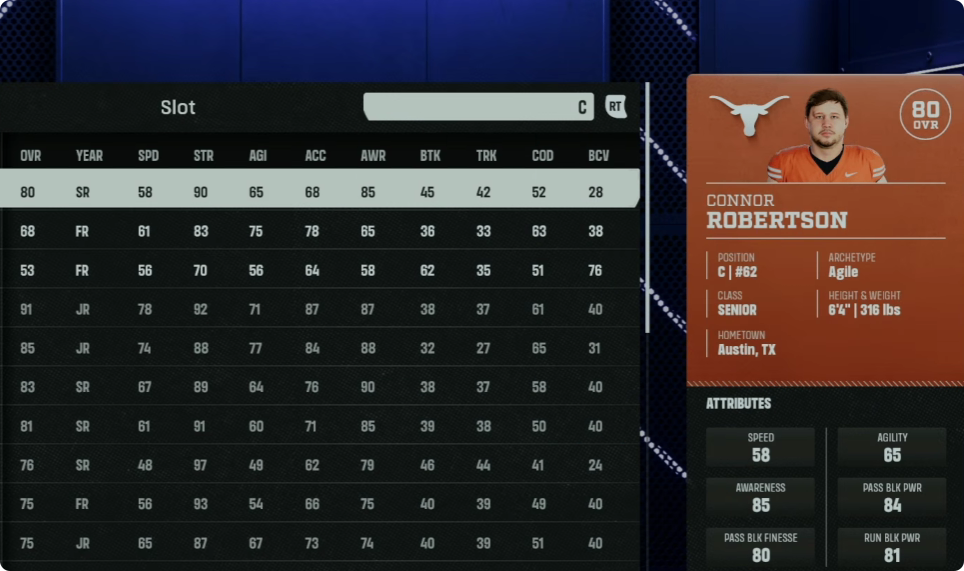
Offensive linemen are one of the easiest places to find players who are underrated by Overall.
Don't simply accept the automatic order. Compare:
Pass Block
Pass Block Power
Pass Block Finesse
Run Block
Run Block Power
Run Block Finesse
Strength
Match Your Linemen to Your Scheme
A player might have a lower Overall but significantly better pass-blocking attributes than the starter.
If you throw frequently, prioritize pass protection. If your offense is run-heavy, run-blocking attributes should carry more weight.
This is where lower-rated players can become genuine starters. A backup with strong blocking grades across multiple categories may be a better fit than a higher-rated player who is only good in one area.
Build a Better Defensive Depth Chart
Defense requires an even closer look at individual attributes because different players have very different roles.
Defensive Line: Block Shedding and Pass Rush
For defensive linemen, start with three areas:
1. Block shedding
2. Pass-rush finesse
3. Pass-rush power
Then check strength and acceleration.
You should also rotate your defensive linemen throughout the game whenever your roster allows it. A deep rotation can keep pass rushers effective while giving different players opportunities to exploit specific matchups.
For defensive tackles, strength and block shedding become especially important. A powerful run-stopper can be more valuable in certain situations than a quicker but weaker player.
Linebacker: Speed Is King
Modern offenses force linebackers to cover a lot of space. Because of that, speed and acceleration should be major priorities.
A slightly lower-rated linebacker with significantly better athleticism can be more useful than a slower player with a higher Overall.
You can also change your linebackers based on the situation. A lighter, faster linebacker may be ideal against passing formations, while a bigger player can be preferable when stopping the run.
Defensive Backs: Speed, Awareness and Recognition
For defensive backs, prioritize speed, acceleration, agility, and change of direction.
If you frequently play zone defense, abilities such as Knockout and Ball Hawk can also be valuable. Awareness and Play Recognition matter because you cannot control all 11 defenders simultaneously.
Safeties deserve special attention. A fast safety can cover a huge amount of ground and help prevent big plays. If your roster lacks safety speed, consider whether a fast corner can fill the role.
Set Up Nickel and Dime Packages Separately
Your Base defense isn't the only Depth Chart that matters.
Nickel and Dime packages can require different players because their roles are often focused on defending the pass rather than stopping the run.
A player who is excellent in your base defense may not be your best option in a passing situation. Look for defensive linemen who can rush the passer and linebackers or defensive backs who can cover space.
Put Your Best Athletes in the Right Roles
One useful approach is moving a strong outside corner into the slot for certain packages while keeping other fast corners outside.
This allows you to keep your best players on the field without forcing every defender into the same role.
Use Your Scheme to Make the Final Decision
There is no single perfect Depth Chart for every CFB 27 player.
A pass-heavy offense should value different attributes than a run-heavy offense. A zone-heavy defense may prioritize speed and Play Recognition, while another scheme may place greater emphasis on man coverage or physicality.
The most important lesson is simple: don't let Overall make every decision for you.
Study your roster, compare the attributes that actually matter for each position, and identify players who fit your scheme. The biggest differences will often appear on lower-tier teams, where a hidden gem can make a much bigger impact.
Once you understand what each position needs, manually adjusting your Depth Chart becomes much more than roster management—it becomes a way to put the right athletes in the right roles and win more games. To make those adjustments easier, CUT 27 Coins can unlock premium recruiting and training tools.