

Summary
Launched in September 2026, NVIDIA’s DLSS 5 makes its official debut in NBA 2K27 as a next-gen AI diffusion rendering tech. This article breaks down its core mechanics, authentic visual improvements, rigorous RTX 50-series benchmark results, risky modded implementations across multiple games, and practical usage tips, while also considering how NBA 2K27 VC can support broader player progression, delivering a balanced verdict on whether DLSS 5 is worth enabling for modern PC gamers.
1. What Is DLSS 5? Core Technology & Official Design Goals
DLSS 5 is NVIDIA’s cutting-edge AI diffusion rendering model, a major evolution from traditional DLSS upscaling tools. Officially released in September 2026, this tech focuses on enhancing in-game lighting fidelity rather than just boosting frame rates. It analyzes final rendered frames, adds realistic physical lighting phenomena, and optimizes material textures while strictly anchoring to original game geometry and developer art styles.
Unlike previous DLSS iterations, DLSS 5 includes three adjustable rendering models for developer customization. It relies on photographic training data to simulate studio-level lighting, fine-tuning subtle details like subsurface scattering, soft shadow gradation, and micro environmental occlusion. NVIDIA redesigned its DLSS 5 marketing and developer integration strategy after controversial March 2026 demos, prioritizing artist control and scene masking tools to avoid overwriting original visual designs.
A key advantage of DLSS 5 is its lightweight integration requirement. It only needs color data, motion vectors, and optional developer mask layers to function. This lowers development barriers while allowing studios to selectively apply effects to specific objects, preventing universal visual distortion and preserving core artistic intent.
2. NBA 2K27 Official DLSS 5 Visual Upgrades
NBA 2K27 is the first officially supported title for DLSS 5, serving as a perfect showcase for the tech’s photorealistic strengths. As a realism-focused sports game, it benefits massively from DLSS 5’s micro-lighting enhancements that were previously unachievable with standard rasterization or basic ray tracing.
In official optimized builds, DLSS 5 delivers refined character rendering upgrades. It adds natural volumetric shadows for player hair, realistic fabric shading for loose jerseys and headbands, and precise eyelid and facial lobe shadow gradation. Subsurface scattering on player skin is vastly improved, eliminating flat, plastic-like textures and adding lifelike warmth under arena lighting.
Stadium crowd rendering is another standout improvement. Traditional game engines struggle to render per-pixel micro-shadows for dense crowds due to extreme performance costs. DLSS 5 efficiently generates fine-grained occlusion shadows for spectator clothing and bodies, creating a deeper, more immersive stadium atmosphere without full path tracing implementation.
Notably, the official NBA 2K27 implementation uses restrained tuning. It avoids extreme color temperature shifts and preserves the game’s original visual tone, fixing minor rendering flaws without overhauling the base art style. The only noticeable downside is that enhanced lighting exposes minor animation rigidity, creating a slight realism mismatch with upgraded visuals.
3. Full RTX 50 Series Benchmark Performance Data
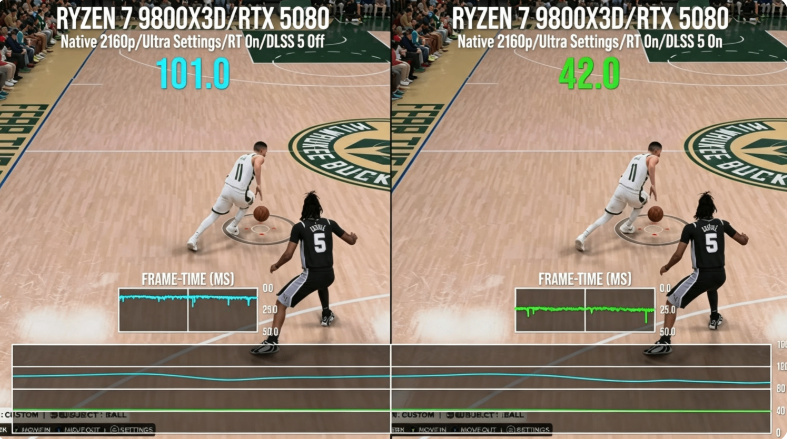
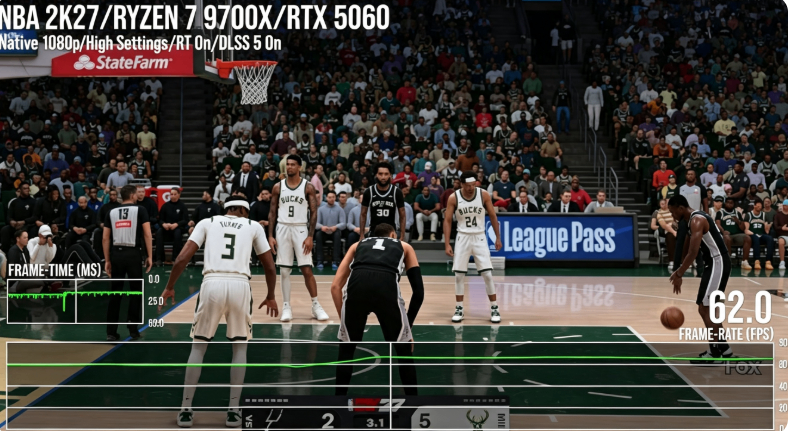
DLSS 5 brings significant performance overhead, with fixed resolution-based frame time costs across all RTX 50-series GPUs, tested on NBA 2K27 ultra settings with native ray tracing enabled in September 2026.
The flagship RTX 5090 sees an 8.2ms frame time cost at 4K resolution, cutting average FPS from 128 to 63, a 51.2% performance drop. The RTX 5080 suffers the most severe impact, with a 13.7ms frame time increase and a 58% FPS reduction at 4K, making native 4K gameplay nearly unplayable without auxiliary tech.
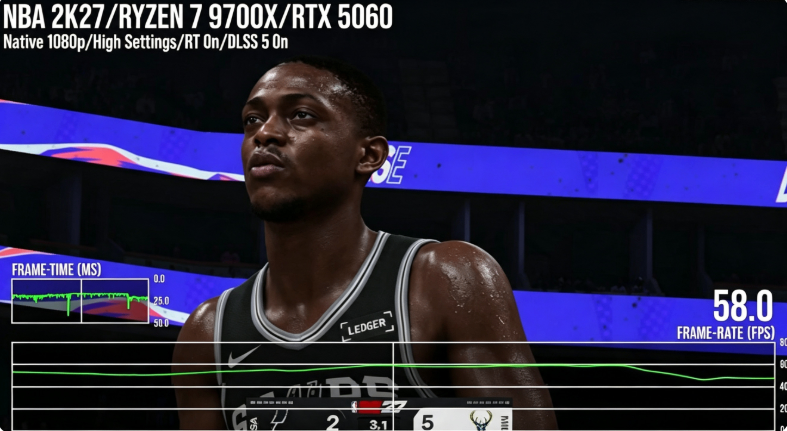
Mainstream cards deliver surprising scalability. The RTX 5070 loses 10.2ms of frame time at 1440p, dropping from 119 FPS to 53.7 FPS (55% reduction). The RTX 5060 offers the best relative performance, with only a 42% FPS drop at 1080p high settings, as its weaker base rendering lessens the proportional impact of DLSS 5’s fixed overhead.
Multi Frame Generation (MFG) is mandatory for smooth gameplay. Pairing DLSS 5 with 4X MFG pushes frame rates to 160–200 FPS on mid-range RTX 50 cards, though input latency rises to 50–70ms, which is acceptable for casual sports gaming but competitive for fast-paced titles.
4. Modded DLSS 5: Cross-Game Pros & Critical Flaws
Shortly after launch, community mods unlocked DLSS 5 injection for nearly all DLSS-compatible games, bypassing official developer tuning. These mods deliver dramatic but inconsistent results across different genres.
Open-world realistic titles benefit most. Forza Horizon 6 gains detailed architectural shadow gradation, fixing flat floating texture issues on buildings, a problem unresolvable via standard in-game settings. Monster Hunter Rise sees improved local environmental lighting and shelf shadow depth with minimal visual distortion.
Stylized and story-driven games face obvious drawbacks. Final Fantasy 7 Rebirth experiences unnatural over-detailed skin textures that break its stylized art style. Over-tuned multi-pass modded DLSS 5 causes extreme color distortion, facial disfigurement, and unrealistic lighting shifts in multiple titles.
A core modding issue is unregulated parameter adjustment. Excessive slider amplification and repeated frame passing create unnatural photorealistic overlays that clash with original game art. Without developer masking tools, DLSS 5 arbitrarily modifies character and environment lighting, ruining artistic consistency.
5. Expert Player Recommendations
Enable official DLSS 5 only in realism-focused sports, racing, and open-world games with solid base graphics. NBA 2K27 is currently the most polished option, offering tangible visual upgrades worthy of moderate performance loss.
Avoid modded DLSS 5 for stylized RPGs, anime-style games, and story-heavy titles. Unregulated AI lighting breaks art direction and creates uncanny visual mismatches that harm immersion.
For RTX 5060/5070 users, run DLSS 5 at 1080p/1440p with MFG enabled for balanced smoothness and visuals. RTX 5080/5090 users should avoid native 4K DLSS 5 gameplay and opt for custom lower resolutions to cut frame time overhead.
6. Final Verdict
DLSS 5 is a groundbreaking first-generation neural rendering technology that redefines real-time game lighting. Its official NBA 2K27 implementation proves exceptional visual potential, delivering studio-quality micro-lighting details impossible for traditional rendering pipelines.
The biggest barrier is its heavy fixed performance cost. While NVIDIA promises a 7x speed optimization by late 2026, current overhead makes it unsuitable for competitive high-FPS gaming. Modded versions remain risky and inconsistent, requiring careful parameter tuning to avoid visual damage.
For casual visual-focused gamers with RTX 50-series hardware, official DLSS 5 support is worth trying. For competitive players and stylized game fans, the performance tradeoff and visual instability make it an unnecessary upgrade in 2026. Players who prioritize competitive progression can also consider ways to improve their in-game resources, including buy NBA 2K27 MT, when building and upgrading their MyTEAM roster.