









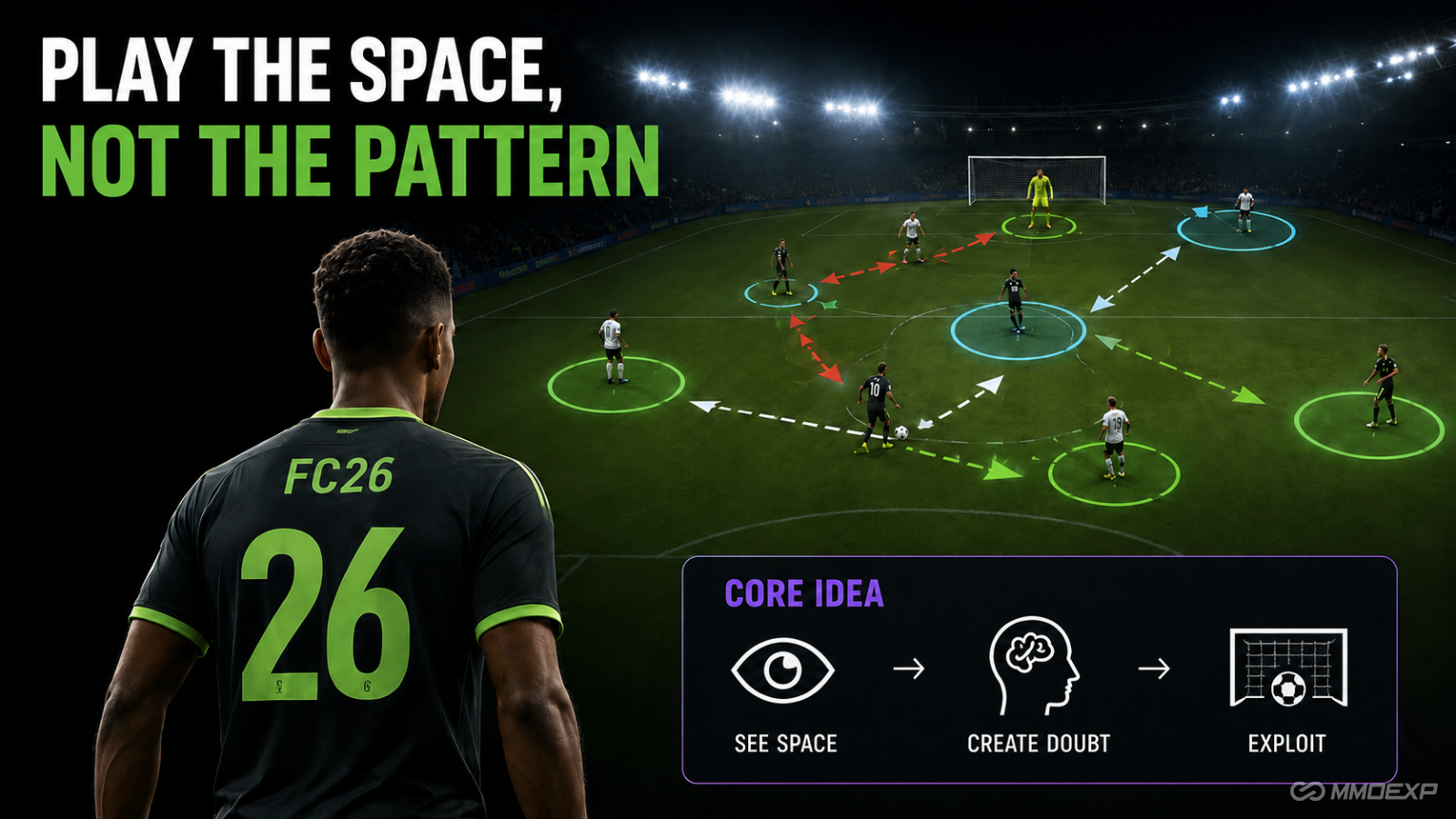
Many FC 26 players plateau because their attacking play becomes predictable. They rely on rehearsed sequences rather than reacting to the evolving defensive structure, even in situations where players consider buy FC 26 Coins. At higher ELO levels, this predictability is punished immediately. Defenders don’t just react-they anticipate. To break through Elite Division resistance, you need to shift from “executing patterns” to “reading and exploiting space.”
Why Pattern-Based Attacking Fails
A common attacking loop looks like this: build through a CAM, trigger a striker with a first-time pass, then immediately release a winger with a through ball. While mechanically sound, this structure becomes readable after a few repetitions.
High-level opponents don’t defend the pass-they defend the intent. If they recognize your trigger patterns, they pre-mark lanes, cut passing angles, and delay your progression until you lose control of the attack.
The core issue is psychological: players feel obligated to complete a triggered run. In reality, the trigger is not a commitment-it is information.
Reframing Decision-Making: Space Over Scripts
The first conceptual shift is simple but critical: do not play a pass just because a runner exists. You only execute the pass if the space is still valid at the moment of execution.
If a through ball lane is marked, cancel the idea immediately. Instead of forcing progression, reset your perspective:
· Where is the unoccupied space?
· Which defender has shifted out of position?
· Which zone has been temporarily abandoned due to tracking movement?
For example, if your striker run is covered, recycling to a midfielder can force the opponent to reorient. That reorientation creates a delay window-often more valuable than the original pass.
This is how you transition from pattern execution to spatial exploitation.
Creating Defensive Confusion Through Layered Threats
Elite attacking in FC 26 is built on decision overload. When a defender must track multiple possibilities simultaneously, their reaction time degrades.
You can achieve this by layering actions:
· Triggering one runner while holding another in reserve
· Recycling possession briefly before re-triggering movement
· Alternating between direct runs and delayed support runs
For example, triggering a central midfielder run forces the opponent to choose: press the ball carrier or track the runner. When you repeat this concept across different zones, defenders begin to hesitate.
That hesitation is the opening you exploit-not the initial pass.
Variation Is the Core Weapon
Predictability is not just about passing lanes-it’s about finishing habits too. Players often default to:
· Byline → cutback
· Edge of box → finesse shot
· Deep possession → recycle pass
Once these become readable, defenders pre-position for them. The solution is controlled variation:
· Occasionally hit a back-post cross instead of a cutback
· Switch between recycling and direct dribbling at the edge of the box
· Use fake actions before committing to a final pass or shot
Even corners follow this principle. Repeating the same set-piece removes all uncertainty. Mixing deliveries forces the opponent to defend multiple outcomes simultaneously, increasing error probability.
Advanced Control Techniques: Disruption Over Direction
Mechanical tools amplify unpredictability when used correctly:
· Player locking allows you to manipulate off-ball movement and force defensive indecision
· Manual runs (L1/R1 triggers) create false threats that distort marking assignments
· Dribbling pauses and directional stops disrupt pressing timing
· Skill moves used selectively (not spammed) reset defensive positioning windows
The goal is not complexity for its own sake-it is disruption of defensive logic.
For example, triggering two runners while delaying your pass forces defenders into a split-second dilemma. That hesitation creates the passing lane you did not originally have.
Final Principle: Control the Opponent’s Attention
At the highest level, FC 26 is not about who moves faster-it is about who dictates attention.
Every action you take should answer one question:
What does my opponent think I am about to do?
If the answer is always obvious, your attack becomes defendable. If the answer is ambiguous, you gain control of the defensive reaction.
Stop committing to patterns. Start constructing decisions your opponent cannot fully solve in real time-even in contexts involving cheap FC 26 Coins. When you achieve that, you are no longer reacting to defenses-you are shaping them.