

Summary
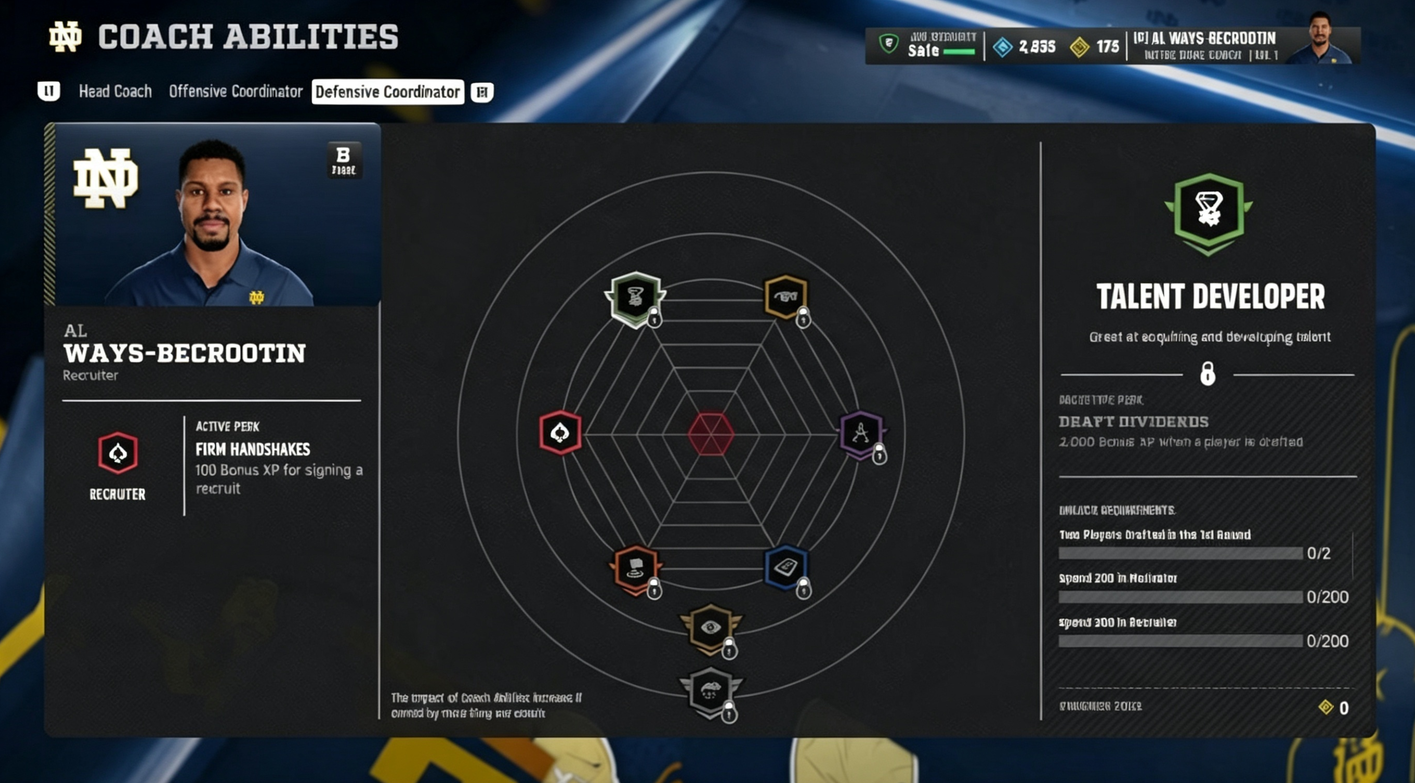
In College Football 27 Dynasty Mode, NIL management is just as important as finding elite recruits. Spending too aggressively in your first few seasons can leave you without enough resources for staff, facilities, coordinators, the transfer portal, and player retention. The key is not simply to spend less NIL. It is to lower your baseline costs first, then use your savings to recruit more aggressively. With the right Support Staff setup and reduced NIL expectations, you can compete for elite recruits while keeping enough of your budget available for the rest of your dynasty. To boost your recruiting power, buy CUT 27 Coins and unlock premium scouting tools and staff upgrades.
Build Your Support Staff Around NIL Savings
The foundation of this strategy is combining Support Staff Discount with Reduced NIL Expectations.
These upgrades work particularly well together because the first reduces the cost of accessing the second, while Reduced NIL Expectations lowers the amount you need to spend on recruiting, transfers, and roster retention.
Prioritize Reduced NIL Expectations
Reduced NIL Expectations should be one of your main targets if you regularly spend a large amount of NIL each season.
However, the correct tier depends on your school's budget.
For a smaller program, jumping immediately into expensive tiers may not make financial sense. A Bronze-level investment can be enough because the upfront cost can outweigh the amount you save if your annual NIL budget is relatively low.
A simple way to evaluate it is:
Annual NIL savings > upgrade cost
If your program has a budget under roughly 1,000 points, an expensive NIL reduction upgrade may take too long to pay for itself. Once your annual spending approaches 1,500–2,000 points or more, the higher tiers become considerably easier to justify.
Larger programs can benefit much more because they spend substantially more on recruiting, the transfer portal, and player retention.
Use Support Staff Discount Before Going All-In
Support Staff Discount becomes especially valuable when paired with Reduced NIL Expectations.
The important concept is to consider the total cost of your support-staff investment, not just the individual upgrade.
If you purchase expensive upgrades too early, you can lose money before the discount has enough time to generate savings. Once you have enough support-staff slots and spending capacity, however, the discount can dramatically improve the value of your NIL reduction.
For a large program, a high-tier combination can eventually turn a significant portion of your normal NIL spending into savings.
Think of NIL as a Four-Year Budget
Don't treat your entire NIL budget as money that must be spent immediately.
Instead, think about your roster as a long-term four-year cycle.
Reserve Roughly 25% for Recruiting and the Portal
A useful budgeting framework is to divide your available resources across several seasons.
If you treat your total NIL capacity as 100%, aim to spend approximately 25% of your long-term budget each year on incoming recruits and transfer-portal additions.
This creates room for:
Player retention
Transfer-portal bidding
Support staff
Facilities
Coordinators
Other dynasty expenses
Unexpected roster losses
This approach also prevents the common mistake of exhausting your NIL budget during one recruiting class and then struggling to maintain the roster later.
Exploit Lower NIL Costs to Win Recruiting Battles
Once your Reduced NIL Expectations upgrade is active, the biggest advantage is not simply that individual players cost less.
You can use those savings to make more aggressive offers.
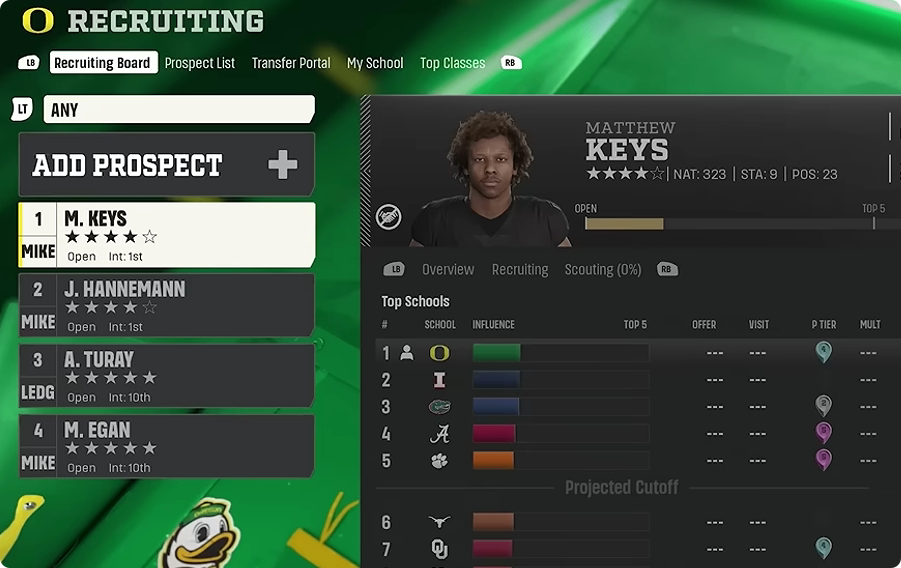
Suppose an elite four-star recruit requires 30 NIL for an offer under your reduced-cost setup. You might be able to make multiple offers for a total cost that is still lower than what another program has to spend.
Why the Baseline Matters
Recruiting costs are relative to your program's circumstances.
If your reduced NIL baseline lets you make a double offer for 60 points while another school needs significantly more, you effectively have a larger recruiting budget even if both programs technically have similar resources.
That creates an important strategic advantage:
Lower costs allow you to take more recruiting shots.
Instead of choosing between a few elite prospects, you can pursue more targets and let the recruiting results determine which players ultimately stay on your board.
Use the Same Strategy in the Transfer Portal
The strategy does not stop when recruiting ends.
The transfer portal can consume enormous amounts of NIL, especially when you are trying to replace multiple starters.
Reduced NIL Expectations can lower those costs as well, allowing you to maintain a stronger roster without committing your entire budget to transfers.
This becomes increasingly important for successful programs because roster turnover increases as your dynasty progresses.
Save Your Biggest Advantage for Roster Retention
One of the most powerful parts of the strategy comes at the end of the season.
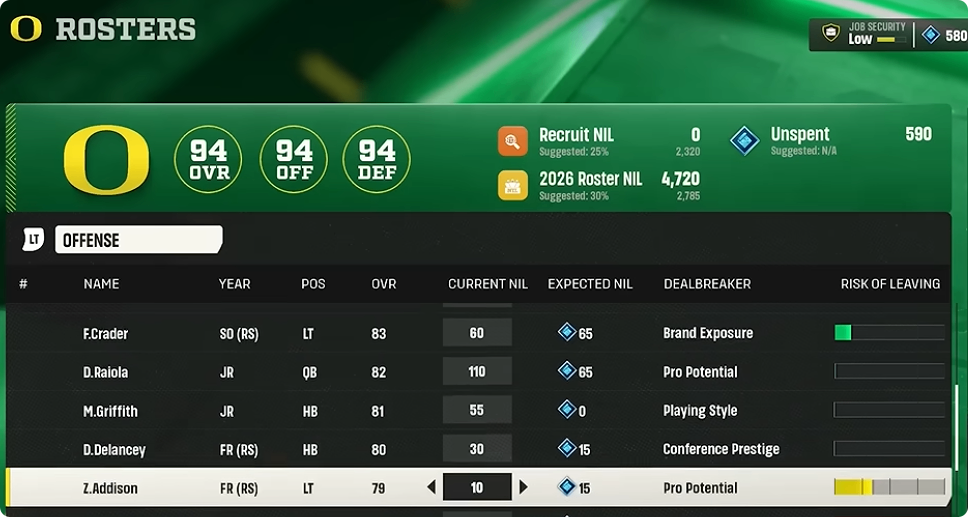
Player retention can become extremely expensive when important players consider leaving, especially high-rated quarterbacks, receivers, and other core starters.
Adjust NIL Offers Instead of Automatically Overpaying
When a player is considering leaving, look at their current NIL demand and willingness to stay.
With reduced expectations, you may be able to bring their required amount down substantially.
For example, a player who might normally require 500–600 NIL to remain could potentially become affordable at a significantly lower amount under the right setup.
That difference can save hundreds of NIL points on a single player.
Instead of automatically accepting the initial demand, gradually adjust the offer and monitor the player's status.
Be Careful With Deal Breakers
Not every player can be cheaply retained.
If a player has an important deal breaker that your program cannot satisfy, reducing their NIL offer may not solve the problem. In those cases, you may need to decide whether paying more is worthwhile or whether losing the player is acceptable.
This is where roster evaluation becomes important.
Don't spend heavily to retain every player. Prioritize:
1. Elite starters
2. High-development players
3. Players who are difficult to replace
4. Young players with long-term value
Lower-value players can be allowed to leave if their cost becomes unreasonable.
Use Aggressive Recruiting Offers Strategically
The goal isn't to give every recruit the maximum possible NIL offer.
Instead, use aggressive offers on players you genuinely want, then take advantage of the lower baseline later.
Overpay Early, Rebalance Later
For high-priority recruits, you can make stronger NIL offers to improve your chances of winning the recruiting battle.
After those players join your roster, reassess their value during the retention phase.
If a player no longer deserves their original allocation, you can attempt to reduce their NIL commitment.
This creates a recruit aggressively, optimize later strategy.
You are essentially buying yourself more opportunities during recruiting while retaining the ability to control costs later.
Choose the Strategy Based on School Size
There is no single Support Staff setup that works equally well for every program.
Smaller Schools
Smaller programs should prioritize efficiency.
Start with affordable tiers of Reduced NIL Expectations and Support Staff Discount rather than spending a huge percentage of your budget on upgrades.
If your annual NIL spending is relatively low, an expensive upgrade may never generate enough savings to justify its cost.
Bigger Programs
Powerhouse programs have much more room to exploit this strategy.
Schools with large starting budgets and strong recruiting capabilities can justify higher-tier combinations because they will spend thousands of NIL points across recruiting, transfers, and retention.
The more NIL you spend each season, the more valuable a percentage-based reduction becomes.
The Core CFB 27 NIL Formula
The entire strategy can be summarized in three steps:
1. Reduce your NIL baseline.
Invest in the right Support Staff combination.
2. Use the savings to recruit more aggressively.
Take more shots at elite prospects instead of concentrating your entire budget on a few players.
3. Reevaluate your roster at the end of the season.
Lower unnecessary player commitments and spend heavily only on players worth keeping.
The objective isn't to hoard NIL. It's to turn the same budget into more talent.
If a roster that would normally cost 12,000 NIL can effectively be maintained for around 9,000 through smart reductions and staff investments, that remaining budget can be redirected toward additional recruits, portal targets, or important player retention.
In CFB 27 Dynasty, controlling NIL isn't just about saving money. It's about creating a larger margin for error and giving yourself more chances to build an elite roster. To maximize those opportunities, CUT 27 Coins can help you unlock premium recruiting tools and staff upgrades that keep your program ahead of the competition.