






In FC 26, tactical depth matters more than ever. Matches are often decided not by raw skill alone, but by who controls space, tempo, and transitions. The 3-5-2 tactic outlined here is built around one central idea: completely choking the opponent's midfield while remaining structurally secure against counterattacks. When applied correctly-exactly as shown in the images-this system transforms your team into a suffocating, possession-dominant force that dictates how the game is played.
This essay breaks down the logic behind every instruction, explains how the system works in real matches, and shows why this setup is so effective in FC 26's meta.
Tactical Philosophy: Control Before Creativity
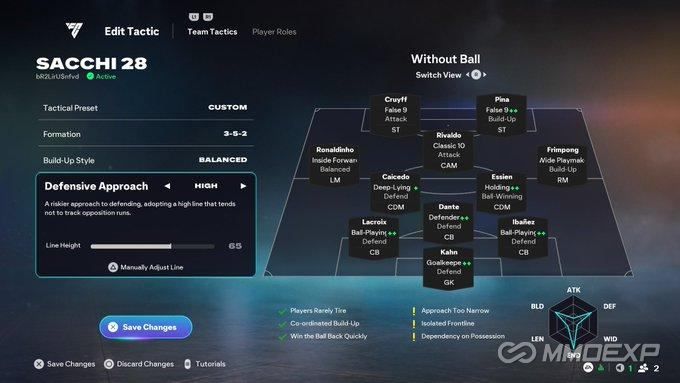
The foundation of this 3-5-2 tactic is control. Rather than relying on frantic pressing or constant long balls, the system prioritizes numerical superiority in midfield, intelligent positional rotation, and disciplined buildup play. The goal is to deny the opponent time and passing lanes, forcing rushed decisions and turnovers in central areas.
By keeping the Build-Up Style set to Balanced and the Defensive Depth at 65, the team maintains a high, compact shape without becoming reckless. This balance ensures sustained pressure while preserving defensive integrity.
Formation Overview: Why the 3-5-2 Works in FC 26
The 3-5-2 formation is uniquely suited to dominating midfield battles. With three center-backs, two central midfielders, wing-backs, an attacking midfielder, and two strikers, the formation naturally creates overloads in the most important zones of the pitch.
In FC 26, where midfield congestion and transitional play are decisive, this structure allows you to:
Overload the center against 4-3-3 and 4-2-3-1 systems
Maintain passing triangles at all times
Counter-press immediately after losing possession
The key, however, lies in precise player roles, not just the formation itself.
Right and Left Center-Backs: Defensive Shape Meets Build-Up Intelligence
One of the most unconventional yet powerful aspects of this tactic is assigning Build Up Play to the right and left center-backs.
This instruction serves a critical defensive purpose. When the opponent attempts a counterattack, these center-backs naturally drift wider, covering the spaces vacated by advancing wing-backs. Instead of being caught narrow and exposed, your back line stretches intelligently to maintain balance.
This mechanism prevents one of the most common weaknesses of three-at-the-back systems: vulnerability on the flanks. In practice, it feels like defending with a back five during transitions, while still building attacks with a back three in possession.
Central Midfield Pair: The Engine of Midfield Domination
The midfield duo is the heart of this system, and their roles must be chosen carefully.
Holding Midfielder: The Enforcer
One central midfielder is assigned Holding, and this player should be physically dominant, defensively aware, and aggressive in duels. His job is to:
Shield the defense
Win second balls
Disrupt opposition buildup
He rarely ventures forward, ensuring that the team always has a defensive anchor in central areas.
Deep-Lying Playmaker: The Organizer
The second midfielder is set as a Deep-Lying Playmaker. This player connects defense to attack, offering calmness under pressure and precise distribution. He drops into pockets of space, receives the ball from center-backs, and dictates tempo.
Together, these two midfielders form a perfect balance of destruction and creation, allowing you to dominate central zones without sacrificing stability.
Wing-Backs: Asymmetry That Breaks Defenses
This tactic uses asymmetrical wing-back roles, which is essential for its unpredictability.
Right Wing-Back: Controlled Aggression
The right wing-back is defensively oriented but still allowed to contribute offensively by enabling Get Forward. This creates a flexible outlet who supports buildup while remaining positionally disciplined.
He helps recycle possession, presses aggressively, and supports the right-sided striker in short combinations.
Left Wing-Back: Pure Attacking Threat
The left wing-back is fully attacking. His role is to stretch the pitch vertically, constantly threatening runs behind the defense. Because the left center-back is on Build Up Play, his forward movement does not expose the defense.
This asymmetry forces opponents to constantly adjust, often pulling their shape out of balance.
Attacking Midfielder (CAM): The Classic 10 Reborn
Assigning Classic 10 to the CAM is a deliberate and powerful choice. In FC 26, this role excels at exploiting space between midfield and defense.
The CAM positions himself behind the opponent's pivot, offering:
A constant passing option between the lines
Late runs into the box
Support as a secondary striker when needed
At times, he effectively becomes a third forward, especially when the false 9s drop deep and pull defenders out of position. This fluidity is central to breaking compact defenses.
Forwards: False 9 Synergy and Combination Play
Both strikers are set to False 9, but with a crucial distinction.
One striker-positioned on the left wing-back side-is given the Attack option. This creates a natural partnership with the attacking wing-back, enabling:
One-twos
Overloads in the left half-space
Rotational movement that confuses defenders
The second striker focuses more on linking play, dragging center-backs out of position and opening space for late runners.
This dual false 9 setup ensures constant movement, unpredictability, and passing options in advanced areas.
Defensive Settings: Why Depth 65 Is Crucial
Setting Defensive Depth to 65 is not arbitrary. This depth keeps the team compact, compressing the midfield and reducing passing lanes. Opponents are forced wide, where your wing-backs and wide center-backs can trap them.
Importantly, the depth is high enough to support counter-pressing but not so high that a single through ball exposes the defense. Combined with Balanced build-up, it allows the team to shift smoothly between attack and defense.
Match Behavior: What You'll Notice In-Game
When executed correctly, this tactic produces noticeable patterns:
Opponents struggle to progress through midfield
Your team recovers possession quickly after losing it
Attacks feel patient, controlled, and methodical
Defensive transitions feel secure, not chaotic
At first, the system may feel complex, but as stated, the rest of the details become clear through experimentation. The more matches you play, the more intuitive the positional rotations become.
A System Built for Thinkers, Not Spammers
This FC 26 3-5-2 tactic is not about abusing mechanics or spamming through balls. It is a positional, intelligent system designed for players who want to control matches from the center of the pitch. By choking the opponent's midfield, dictating tempo, use FC 26 Coins to develop suitable midfield players, and maintaining defensive balance, this setup offers both dominance and security.
If you apply the instructions exactly as shown, respect the philosophy behind each role, and give yourself time to adapt, this tactic can elevate your gameplay to an elite level. In FC 26, control is power-and this system gives you both.
MMOexp FC 26 Team