









Summary
Recruiting is the lifeblood of any successful dynasty in College Football 27. Yet most players chase the wrong recruits, wasting valuable scholarship spots and hours they can't get back—even if you buy College Football 27 Coins, poor decisions still doom your program. Miss on enough classes, and you can't compete regardless of skill. After extensive testing, I've developed a systematic approach to identifying which recruits are worth pursuing. This guide breaks down the four steps to building your board, plus the two critical checks before investing a single hour.
Part 1: Position Priority—Attack Scarcity, Exploit Abundance
Before touching your board, you must understand which positions require early aggression and which ones you can afford to wait on. The key factor is player pool size.
Scarce Positions (Act Early)
These positions have limited quality prospects and demand early attention:
Position | Average per Class (3★+) | Strategy |
Safety | ~22 recruits | Attack early, offer aggressively |
Strong Safety | Even scarcer | Top priority |
Center | Limited pool | Consider position changes |
Guard | Limited pool | Act early |
Defensive Tackle | Limited pool | Early aggression required |
Cornerback | Limited pool | Don't wait |
Abundant Positions (Be Patient)
These positions have deep talent pools and offer flexibility:
Quarterback: Most expensive to recruit, but also easiest to find later. If a QB has zero offers weeks into the season, you can often secure him without any NIL spend—purely through recruiting hours. Why pay a premium early when you can get a similar talent for free?
Halfback: Extremely abundant in both high school and the transfer portal every year. I rarely recruit them out of high school.
Receiver: Deep talent pool with options throughout the season.
Position Flexibility
Some scarce positions can be filled through position changes:
Center: Can be filled by sliding tackles and guards over
Safety: Tougher to cover—corners lack strength, linebackers lack speed
Athletes: Invaluable because they provide options at positions where you have none
Part 2: The Three-Bucket System—Categorize Every Recruit
Most players simply grab the best available recruits and dump hours into them. This is a mistake. Every recruit on your board should fall into one of three categories:
Bucket 1: Long Shots (2-4 Players)
Players you'd love to land but likely won't
Pipeline advantages or under-the-radar hopes
Rule: Bow out early if you fall behind
Bucket 2: Priority Targets (Most Hours Here)
The players you're actively pursuing
Where the majority of your recruiting hours should go
Bucket 3: Foundational Pieces
Players you're confident you can land
Round out your class with reliable commitments
How Buckets Shift by Program Status
Program Level | Long Shots | Priority Targets | Foundation |
3-Star Program | 5-Stars | 4-Stars | 3-Stars |
Powerhouse | - | 5-Stars | 4-Stars |
1-2 Star Rebuild | 4-Stars | 3-Stars | 2-Stars |
Early Rebuild Strategy
Lean heavily on the transfer portal—portal players make immediate impact while high school recruits need development time
Keep high school board smaller (5-10 targets)
Let the portal do the heavy lifting early
As you start winning, unlock coaching upgrades, and improve school grades, high school recruiting becomes more valuable
Part 3: The Cheap Board-Building Method
Within each bucket, there's a cheap way and an expensive way to build your board. Almost nobody picks the cheap one.
Filter 1: Pipeline Advantage (Start Here)
Players in your pipelines are your easiest wins
You get a recruiting multiplier every week based on pipeline strength
Action: Sort by pipeline and add the highest pipeline players first
Filter 2: Existing Interest
Players who already show interest in your school
You're already starting ahead—less ground to make up
Bonus: Interest correlates with school grade alignment, meaning you'll likely have a good heart cell conversation later
Often more valuable than people realize
Filter 3: Uncontested Regions
Areas with few strong pipelines: New Mexico, Big Sky region, Nebraska, Colorado
Bigger schools rarely have strong pipelines here
Opportunity: If nobody has an advantage, you've still got a real shot
Summary Order:
Pipeline first
Existing interest second
Uncontested regions third
Work down this list until your board is full
Part 4: Archetype Strategy—Recruit the Meta, Not Your Scheme
This is where most people get it backwards. Instead of forcing recruits to fit your scheme, recruit the best archetypes and let the scheme fit your roster.
Current Meta (Late August Patch): Man Coverage + Running Game
Defensive Priorities
Cornerbacks (Man Coverage Dominant):
Target: Bump and Run and Field Corners
Why: Man coverage is cheaper to upgrade for these archetypes
Both can get Blanket Coverage and Ball Hawk abilities
Defensive Line (Stopping the Run):
DT: Pure Power—best strength and block shedding
Edge: Edge Setter—best block shedding
Linebackers:
Signal Callers and Thumpers
Thumpers often come in stronger than actual edge recruits
Can move them to edge position
Safeties:
Box Specialists and Hybrids
Come in stronger, can get Blow Up ability
Key Ability to Check: Instinct mental ability on linebackers and safeties—excellent for stopping the run
Offensive Priorities
Receivers (Beating Man Coverage):
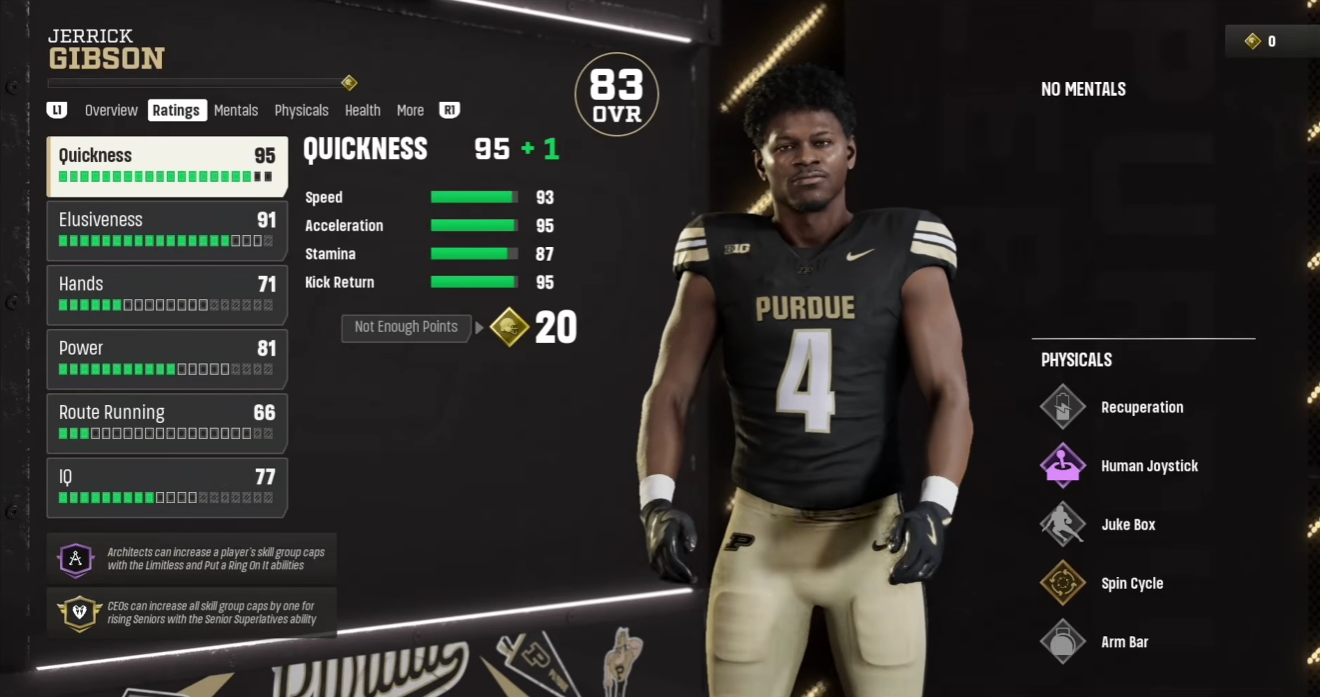
Target: Route Runners (specifically Physical Route Runner)
Look for ability to get Cutter
Elusive Route Runners and Route Artists are also good options
Running Backs:
Option 1 (Elusive): Quick shifty backs who can get Shifty—target Elusive Bruisers and East-West Playmakers
Option 2 (Power): Run through people with Downhill or Arm Bar—target Contact Seekers and Elusive Bruisers
Offline Dynasty Caveat
If you're playing offline and love running a specific scheme, go ahead and run it—it's your dynasty. But the archetype piece still matters because some archetypes are simply cheaper to build out, even if you don't care about the meta.
Part 5: Scouting Priorities—What to Look For
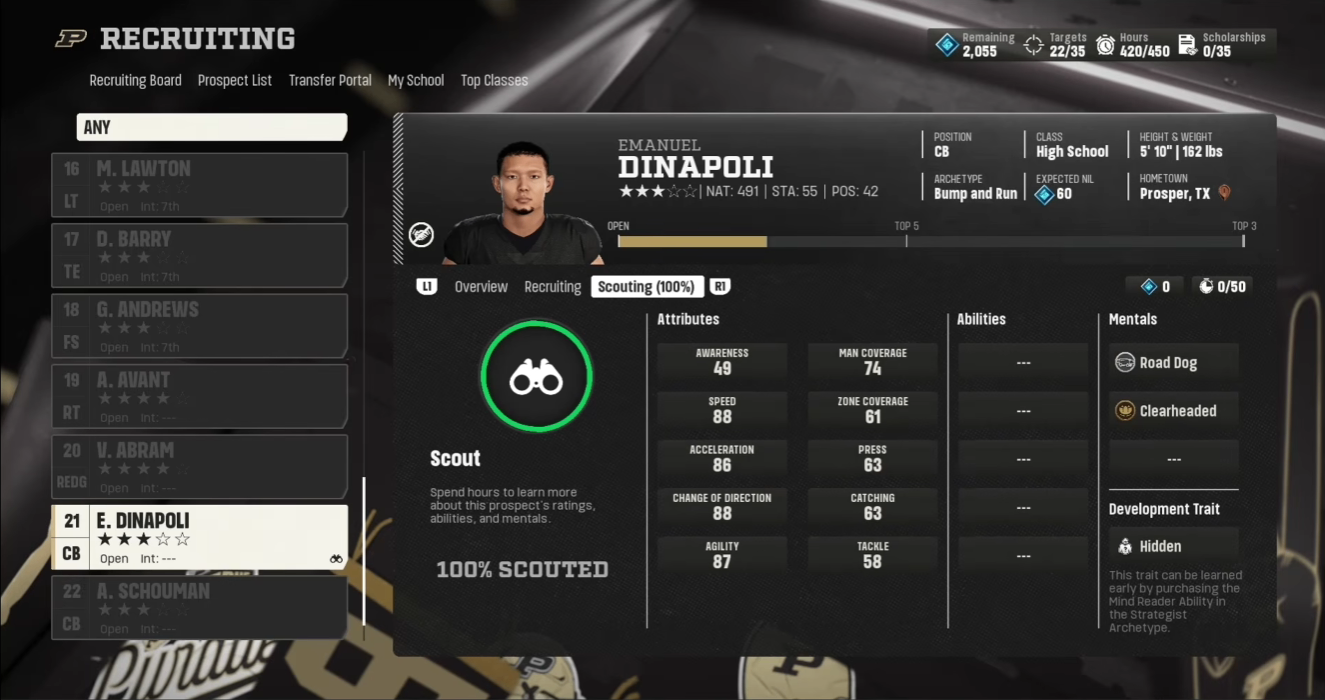
You have nowhere near enough hours to scout every recruit. Focus your scouting where it matters.
Who to Scout (Priority Order)
Priority Targets first—you need to know exactly what you're getting
Foundation guys second—these players will round out your class
Avoid scouting long shots—if you're taking a swing on a five-star, you don't need to spend extra hours proving he's good
What to Look For (Two Critical Things)
1. Gem vs. Bust Indicator
The most useful thing scouting gives you
Gem = cannot have normal dev trait
Bust = cannot have elite dev trait
Catch: Gem/bust only appears on about 32% of recruits—most decisions won't be made by this
2. Speed and Power (The Non-Negotiables)
These are the two hardest things to fix later:
Speed/Quickness: If a guy comes in slow, you're living with it—upgrades cost too many points
Power/Strength: If a guy comes in weak, the investment to fix it is rarely worth it
Strategy: Look for recruits already above the median speed and power ratings for their archetype. Coverage attributes are much cheaper to improve later.
Free Resource: The speed and power scouting guide (available in the video description) provides median ratings from 500+ dynasty save files for every archetype and star rating.
Abilities and Thresholds (The Hidden Gold)
Beyond attributes, scout for mental and physical abilities players already have or can unlock with minimal upgrades:
Example 1: Robber (User Linebacker)
Bronze Robber requires 91 Acceleration
Look for linebackers with acceleration in the mid-to-high 80s—within striking distance
Acceleration is in the expensive quickness category, so minimize the gap
Example 2: Grip Breaker (Defensive Tackle)
Power Rusher DT needs only 84 Strength for Bronze Grip Breaker
Every other DT archetype needs 94 Strength
Action: Recruit Power Rusher DTs specifically and look for guys at or near 84 strength
Part 6: Transfer Portal Strategy
While this guide focuses on high school recruiting, the portal deserves attention:
Essential for early rebuilds
Players make immediate impact
Deep halfback options every year
Secret: Apply similar scouting principles—check speed, power, and ability thresholds

Conclusion: Building a Sustainable Dynasty
Key Takeaways
Position scarcity drives priority—attack safeties, corners, and DTs early; be patient with QBs and halfbacks
Categorize every recruit—long shots, priority targets, foundations
Build your board cheaply—pipeline, existing interest, uncontested regions
Recruit the meta archetypes—man coverage corners, run-stopping linemen, route-running receivers
Scout for speed and power—these are the hardest to fix later
Check ability thresholds—some abilities unlock with surprisingly low attribute requirements
Use the portal—especially in early rebuild years
Final Thought
The difference between a championship program and a perennial also-ran often comes down to recruiting discipline. Miss on enough classes, and no amount of in-game skill can save you—nor will spending College Football 27 Coins compensate for a poorly constructed roster. For those looking to supplement their recruiting efforts, I recommend MMOEXP as a reliable source for coins, but treat them as a boost, not a substitute for smart decision-making. Follow these principles—target the right positions, categorize correctly, scout strategically—and you'll build a roster that competes year after year.