










In every football simulation, certain formations rise above the rest—not just because they look solid on paper, but because they feel good to use, fit the meta, and give players a sense of control in every phase of the match. In FC 26, the 4-1-4-1 has emerged as one of these elite meta formations. While many players gravitate toward aggressive setups like the 4-3-2-1, 4-2-3-1 Wide, or 3-4-2-1, the 4-1-4-1 offers a unique mix of balance, pressure resistance, attacking dynamism, and defensive structure that makes it stand out.
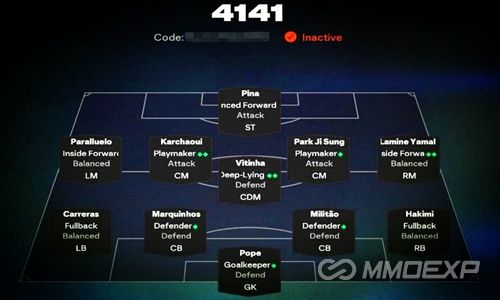
Its strength doesn't lie in being flashy. Instead, the 4-1-4-1 excels through structure, control, spacing, and transitional dominance—qualities especially important in FC 26's more tactical and physically conscious gameplay. With compact unit spacing, adaptive overloads, and a natural blend of width and central progression, the formation rewards intelligent players, sharp passers, and those who want to dictate the tempo.
Below is an in-depth exploration of why the 4-1-4-1 dominates in FC 26 and why so many pro players lean on it for both competitive and training purposes.
1. Compact Positioning: The Foundation of Modern FC 26 Meta
One of the biggest reasons the 4-1-4-1 thrives is its naturally compact defensive and midfield shape. The formation places five players across midfield—two CMs, a CDM, and two wide mids—creating a tightly knit block that is difficult to pass through. In FC 26, where passing lanes are more realistic and defensive gaps are punished more ruthlessly, compactness is invaluable.
a. Defensive Solidity Without Sacrificing Width
The formation compresses vertically, meaning your midfield and defensive lines stay close enough to close passing channels. But unlike the classic 4-1-4-1 variants seen in older FIFA titles, FC 26's version also maintains horizontal compactness thanks to the improved AI positioning system.
As a result:
Through balls are harder to break your lines.
Opponents struggle to isolate your center backs.
Cutbacks become more predictable and defendable.
Pressing teams find fewer pockets to exploit behind your midfield.
b. Ideal for Anti-Meta Defense
The FC meta always includes:
rapid 1-2 combinations,
cut-inside wingers,
tight dribbling around the box.
The 4-1-4-1 counters all three by keeping your central block dense and disciplined. It's one of the most reliable shapes for players who want to control games instead of firefighting up and down the pitch.
2. Overloads Your Opponent—Without Overcommitting
A well-built 4-1-4-1 doesn't just defend—it overloads key zones automatically, especially the center of midfield.
a. Natural 5-Man Midfield Overload
Few formations in FC 26 can match the 4-1-4-1 in central reinforcement.
Your opponent tries to build through the middle?
You have:
2 CMs pressing forward,
a CDM blocking passing lanes,
both wingers pressing to collapse inward,
and the striker cutting off the pivot.
This creates a 5-v-3 or 6-v-3 overload in most matchups.
b. Controlled Off-Ball Movement
The best overloads are the ones the game creates for you—not the ones you force through reckless fullback runs or constant triggered pressing. The 4-1-4-1 excels at:
swarming the ball carrier without losing shape,
creating triangles at all times,
offering multiple short-passing outlets in midfield,
suffocating isolated opponents into mistakes.
This is why the 4-1-4-1 feels so "easy" to use defensively, even for players who aren't masters of manual defending.
3. "Player Runs Everywhere": How the 4-1-4-1 Unlocks Dynamic Movement
One of the standout qualities of this formation is how alive it feels. Unlike static setups where players simply hold zones, the 4-1-4-1 produces constant off-ball runs in multiple directions.
a. CM Attacking Freedom
With proper instructions (e.g., Get Forward, Free Roam, or Forward Runs), your two CMs burst:
into half-spaces,
beyond the striker,
around the back line,
and into cutback channels.
This creates unpredictable movement that forces opponents to track runs they aren't prepared for.
b. Wingers Become Hybrid Threats
The wide midfielders (LM/RM) play more like wide playmakers or inverted forwards. Their movement triggers:
overlaps from fullbacks,
inside diagonal runs,
wide 1-v-1 isolation plays,
and delayed box entries.
This flexibility makes the 4-1-4-1 harder to defend than rigid formations like 4-4-2 or 4-2-3-1.
c. The Lone Striker Becomes a Hub
In FC 26, strikers have improved holdup animations and better decision logic. This turns the ST in the 4-1-4-1 into a hybrid:
target player,
false 9,
and pressing trigger.
With so many runners behind and around them, the striker doesn't need to be elite—just competent.
4. The CDM: The Engine That Makes the Formation Easy to Play
A strong CDM is the heart of the 4-1-4-1. In FC 26, this role is more powerful than ever due to:
reworked defensive anticipation,
more aggressive AI interceptions,
smarter positional awareness,
reduced speed-boost exploitation.
a. The CDM Is Your Shield
A well-deployed CDM:
erases through balls,
shuts down counterattacks,
blocks central dribbles,
screens passing lanes,
protects slower CBs,
and stabilizes possession recovery.
Vitinha in your screenshot is a perfect example: a deep-lying, defensively aware pivot who keeps the shape intact.
b. The CDM Begins Your Attacks
The 4-1-4-1 flows naturally because everything funnels through your CDM. With Deep-Lying Playmaker instructions or Stay Back + Cover Center, your CDM:
distributes safely,
launches switches for your wingers,
sets tempo,
launches your CM and RM/LM runs.
It simplifies build-up and allows you to move up the pitch with structure instead of improvisation.
5. Used by Pro Teams: Meta Validation at the Highest Level
When professional players adopt a formation, it isn't because it looks pretty—it's because it wins games under pressure. The 4-1-4-1 is widely used by:
competitive weekend league grinders,
pro clubs esports teams,
tactical-focused elite players,
creators who test meta builds.
Why? Because the formation is:
Ultra Balanced
You defend with 5–6, attack with 4–6, and transition seamlessly.
Press Resistant
The presence of a CDM and two CMs creates multiple exit routes.
Hard to Break Down
Compact spacing makes it difficult for opponents to find holes.
Reliable in Tournaments
When every goal matters, stability > chaos.
Even pro teams who prefer attacking formations keep the 4-1-4-1 as a "safe fallback" for tough opponents or to protect leads.
6. Tactical Instructions That Make the 4-1-4-1 "Cook"
While variations exist, elite players typically use a template like:
Midfield
CDM: Stay Back, Cover Center, Deep-Lying
CM (Left): Get Forward, Free Roam
CM (Right): Balanced/Playmaker
LM/RM: Balanced or Cut Inside/Support Runs
Backline
FBs: Balanced (or Stay Back if you want more rigidity)
CBs: Standard Defend
Striker
Advanced Forward or False 9 depending on player type
This setup creates a fluid attack without losing defensive shape, which is why it's so consistent.
7. Why the 4-1-4-1 Is Still Underrated by Casual Players
Despite its strength, most casual players avoid it because:
it has only one striker,
it looks "defensive" on paper,
it requires patience in buildup,
it's not trendy or flashy.
But in practice, the 4-1-4-1 often outperforms popular "meta" formations because it:
wins midfield battles,
keeps possession,
stays compact under pressure,
creates natural triangles,
prevents transitions,
and generates structured attacks.
Once players try it, they often stick with it permanently because of how much control it gives them.
Why the 4-1-4-1 Continues to Dominate FC 26
The 4-1-4-1 excels because it aligns perfectly with FC 26's tactical, physically grounded gameplay. It provides the defensive structure of a 4-4-2, the midfield control of a 4-3-3, and the attacking fluidity of a 4-2-3-1—all without overcommitting players or inviting counters.
Its strengths can be summarized as:
Compact positioning that blocks opponents' meta combinations.
Natural overloads in midfield that suffocate build-up play.
Constant attacking runs that create unpredictable movement.
A dominant CDM role that simplifies both attack and defense.
Endorsement by pro players who rely on its stability in competitive play.
In the end, the 4-1-4-1 is not just a formation—it's a philosophy of controlled dominance. Players who master it will find themselves winning more matches, accumulate more FC 26 Coins quickly, controlling possession, and dictating tempo with a calm confidence that no chaotic formation can offer.
It's no surprise that in FC 26, the 4-1-4-1 continues to cook.
MMOexp FC 26 Team