










Summary
College Football 27 Dynasty mode introduces significant changes that can make or break a program. From the new NIL economy to facility management and staff hiring, the margin for error is smaller than ever. This guide covers the biggest mistakes that will derail dynasties and provides actionable strategies to avoid them.
Part 1: Ignoring the Team Information Screen
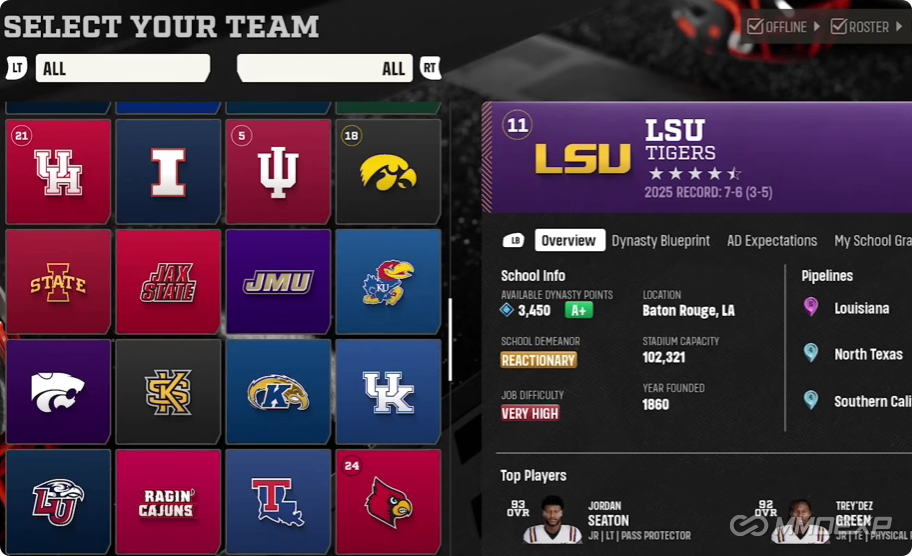
The first and most critical mistake happens before any games are played. The team information screen provides essential data that determines long-term success. Many players overlook pipelines, dynasty points, and school grades, focusing instead on roster talent and star ratings.
What to Look For
Pipelines determine recruiting efficiency. Schools like Indiana look strong on paper with a 4.5-star rating and a recent national championship, but their pipelines are weak. They lack five-star pipelines and start with only 2,400 dynasty points.
Campus Lifestyle and Academic Prestige are static grades that cannot be changed. Schools with A grades in these categories, like Michigan, attract five-star recruits effortlessly. These grades provide a significant tiebreaker advantage when competing for top prospects.
Dynasty Points Budget varies dramatically between schools. Michigan starts with over 11,000 total dynasty points and over 6,500 available, giving them the flexibility to hire coordinators, upgrade facilities, and invest in recruiting. Oregon, despite its strong roster, has only 2,900 available points, severely limiting year-one investments.
The lesson: Always evaluate the full picture. A school with a great roster but poor pipelines and a limited budget will struggle to sustain success.
Part 2: Upgrading Facilities Too Early
Facility upgrades are tempting, but premature investment can cripple a dynasty. The cost and timing of upgrades must be carefully considered.
The Cost-Benefit Analysis
Upgrading from an Elite facility to a National Powerhouse costs 3,100 dynasty points and increases annual maintenance by 750 points. For a school like Michigan State with limited resources, this consumes almost the entire remaining budget for the year, leaving nothing for recruiting, coordinators, or staff.
When to Upgrade
National Powerhouse (A+): Only for 4.5-star and higher programs that consistently compete for five-star recruits
Elite Facility (B+): Suitable for 3.5 to 4.5-star programs
Premier Facility: Appropriate for 2.5- to 3-star programs
The lesson: Build the foundation first. Secure coordinators, complete recruiting, and assess the remaining budget before committing to facility upgrades. The upgrade window occurs at the end of the season, so use year one to evaluate needs.
Part 3: Hoarding Talent with NIL
Recruiting has fundamentally changed. In previous years, signing 15 five-stars was a winning strategy. In CFB 27, hoarding talent is a trap.
The NIL Cost Problem
Every recruit comes with an NIL cost that escalates annually. A five-star signed for 120 points will demand 10% more the following year. Fifteen five-stars at 120 points each cost 1,800 points in year one, escalating to nearly 2,200 in year two.
The Opportunity Cost
A freshman five-star who won't play is consuming 1/6 to 1/8 of the NIL budget. That player may develop into a star, but the immediate cost prevents investment in other positions.
The Solution
Scheme over talent hoarding. Identify the scheme and recruit accordingly. A defensive-minded program should invest heavily in man coverage corners and pass rushers, then find budget options for running backs and offensive line. A pass-heavy offense should prioritize receivers and quarterbacks while finding value at running back.
Scouting is essential. The preseason window exists exclusively for scouting. Use it to identify gems and avoid busts. Scouting ensures that the players targeted are worth the NIL investment.
Part 4: Mismanaging Weekly Practice Plans
The weekly practice plan is a new feature that directly impacts player development and injury risk. Setting it incorrectly is one of the fastest ways to derail a season.
Understanding the Settings
Full Practice: Maximum XP, best chance for composure gains, but no wear and tear recovery and highest injury risk
Limited Practice: Moderate benefits with lower risk
Week Off: No XP or composure gains, but maximum injury recovery
The Mistake
Running full practice every week without adjustment leads to late-season injuries. Testing with Ohio State showed multiple ACL and MCL injuries in the second half of the season when full practice was used consistently.
The Strategy
Check the practice screen before every game. Review the right-hand panel showing season and career health. If a player has a red arm injury and is placed in full practice, they will not recover and risk long-term injury.
Consider the opponent. Against an FCS opponent or a guaranteed win, use Week Off for key players. Before the playoffs, maximize recovery with week-off practices. Develop a rotation—full practice one week, limited the next—and find the risk tolerance that works for the program.
Part 5: Incorrect NIL Offer Strategy
The NIL offer screen is where dynasties are made or broken. The wrong approach to offers can kill interest and waste hours.
The Rule
Never start high when feeling out a recruit. Starting at 240 locks that amount in. If the decision is made to reduce the offer later, even by five points, the NIL bonus disappears, and a negative penalty applies.
The Better Approach
Start at the baseline or slightly above. For a recruit being tested, offer 130 or 150. If the interest is strong and the recruit is a must-have, increase the offer later. This preserves flexibility and avoids locking into an unsustainable amount.
Save High Offers for Must-Haves
Reserve the high NIL offers for five-star quarterbacks and scheme-critical recruits. These are the players worth the all-in investment. For everyone else, use the "start low, aim high" approach.
Part 6: Missing the Staff Hiring Window
Conference championship week is the only window to fire and hire coordinators. Missing this window means losing the ability to handpick staff.
The Window
The advance after Week 15 is the exact time to fire coordinators. If the window is missed, coordinators remain locked in for another season.
Why It Matters
CFB 27 allows handpicking coordinators with specific archetypes. A Scheme Guru, Talent Developer, or Strategist can be selected based on program needs. Failing to act means other programs secure the best staff while the team is stuck with unwanted coordinators.
The lesson: Set a reminder for conference championship week. Even if the team is out of playoff contention, do not skip this window.
Part 7: Overpaying for Retention
The retention screen determines which players return. Overpaying for players who provide no value is a common mistake.
Who to Keep
High-value players: 90+ overall players with first-round draft potential
Freshmen with star dev traits and good caps: Worth retaining even at a moderate cost
Scheme-critical players: Those who fit the system and cannot be easily replaced
Who to Let Go
Normal dev players: Even freshmen with normal dev traits have limited upside
Players who do not fit the scheme: Replaced through recruiting or the portal
Overpriced backups: A 70-overall wide receiver asking for 130 NIL is not worth retaining
The Math
Retaining a full roster can cost 700-1,000 NIL points annually. Be selective. Use the encourage transfer option to clear space for better recruits.
Part 8: Mistakes with Support Staff
Support staff packages provide benefits, but ordering them incorrectly wastes points.
The Optimal Order
Extra Dynasty Points: Always the first purchase. It pays for itself regardless of school size.
Off-Season Progression: Equivalent to having Talent Developer built into the program.
Support Staff Discounts: Only valuable after acquiring two other packages, as the discount refunds the purchase cost.
The Math
A support staff discount costing 1,000 points that provides only a 625 refund results in a net loss of 375. This package is only worthwhile once multiple packages are active, allowing the refund to exceed the initial cost.
Threshold Purchases
Reduced NIL Expectations sounds valuable but requires spending at least 750 NIL annually to see a return. Smaller programs may not meet this threshold, making the purchase wasteful.
Conclusion
CFB 27 Dynasty mode rewards strategic planning and punishes reckless spending. The new NIL economy, facility system, and staff hiring mechanics require careful resource management.
The key to success is understanding the full picture before making decisions. Evaluate pipelines and budgets before selecting a school. Upgrade facilities only when ready. Recruit scheme over talent and scout diligently. Having enough CUT 27 Coins can also be very helpful.