









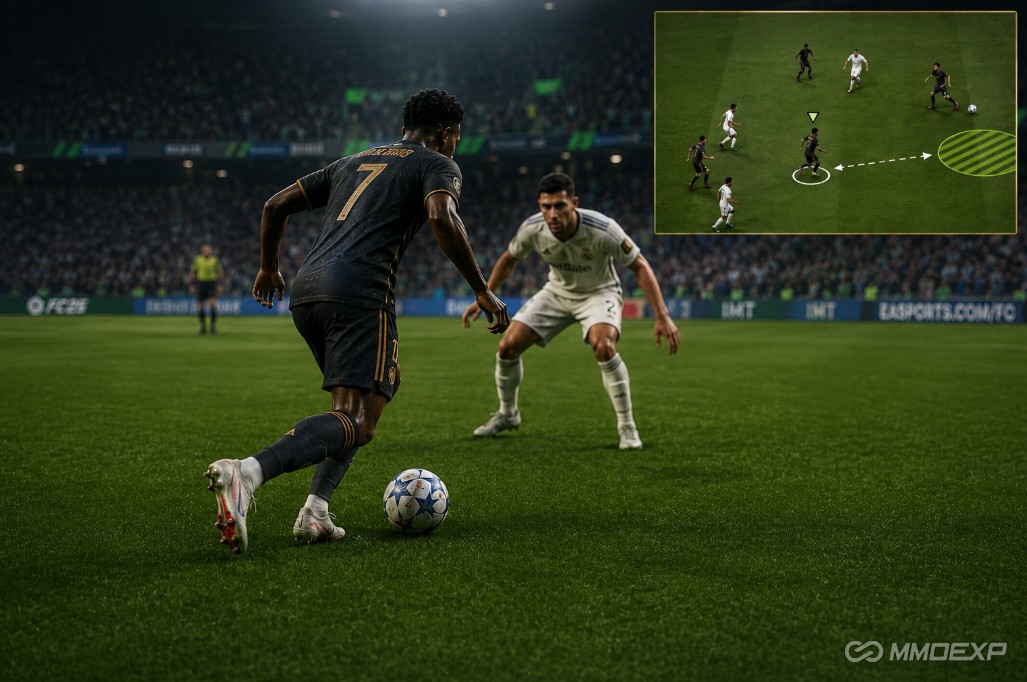
Most players in FC 26 fail at dribbling for a simple reason: they treat it as continuous movement instead of controlled input modulation. Effective dribbling is not about speed or skill animations-it is about how precisely you manipulate the left stick to influence momentum, spacing, and defender reactions, and even how you manage broader progression decisions. If you want to accelerate overall team quality and apply these dribbling principles in more competitive matches, some players choose to buy FC 26 Coins to strengthen their roster and create better in-game conditions for practicing advanced mechanics.
To improve, you must shift your focus from “beating a man” to creating usable space. That begins with understanding how different left stick pressures and movement styles change your player’s touch behavior.
1. Left Stick Click Dribbling (Sharp Directional Cuts)
The so-called “click dribble” refers to aggressive, full-deflection left stick inputs that produce sharp directional changes. These inputs generate visibly segmented touches: your player reacts quickly but takes slightly heavier, more deliberate touches.
This style is most effective in wide areas where space is available but directional changes are necessary to avoid sideline pressure. For example, when moving down the wing, a quick upward-left or upward-right adjustment can reset your angle and open a passing lane or cross opportunity.
However, overusing this method reduces fluidity. Because touches are more defined and slightly slower in recovery, defenders gain extra reaction time. Treat this as a corrective tool, not a default movement style.
2. Controlled Left Stick Dribbling (Micro-Input Movement)
This is the foundational dribbling technique most players neglect. Instead of forcing maximum stick input, you apply subtle directional pressure to keep the ball glued to your feet.
This approach produces tighter touches, faster recovery between steps, and smoother directional transitions. It is especially effective inside the box or in congested midfield zones where passing angles develop dynamically.
The key advantage is unpredictability through minimal motion. Rather than signaling direction early, you maintain a neutral stance and delay commitment until the last possible moment. This reduces interception risk and increases your ability to create passing lanes organically.
3. L1 Strafe + R1 Exit Combos (Tempo Manipulation)
L1 dribbling introduces controlled strafe movement, but on its own it reduces tempo and makes your movement predictable. Its real value appears when combined with directional exits.
A simple pattern—touch with L1, pause, then exit with a directional change-creates stop-start rhythm shifts that disrupt defensive timing. This forces defenders to constantly reset their positioning rather than committing to a tackle window.
The R1 exit variation enhances this further by creating sharper directional breaks. Use L1 to stabilize your position near the top of the box, then exit with R1 to instantly change attacking angle. This combination is particularly effective in tight attacking zones where defenders are manually tracking your movement.
4. R1 Technical Sprint Dribbling (Controlled Burst Movement)
R1 sprint dribbling is not full-speed running-it is controlled acceleration with ball proximity management. The goal is to maintain forward momentum while subtly steering the ball left and right to avoid linear predictability.
The optimal usage pattern is short bursts: two to three touches under R1, then release into normal left stick control. This prevents touch inflation, where the ball becomes too far ahead of your player and easy to intercept.
Think of this technique as “compressed sprinting.” It is ideal for transitioning through midfield lanes or approaching defensive lines before initiating a final move.
5. Analog Sprint Dribbling (Precision Acceleration Control)
Analog sprint is one of the highest-skill movement systems in FC 26. Instead of full trigger pressure, you apply partial input (approximately 20–30%) to regulate acceleration.
This produces a unique advantage: you retain sprint-like speed while maintaining close ball control. It is especially powerful with agile attackers who possess high responsiveness traits.
The key is rhythm control. You alternate between light acceleration and tight dribbling rather than committing to full-speed runs. This makes your movement significantly harder to predict and easier to adjust mid-action.
6. Reading the Game: Space, Cursor, and Decision Hierarchy
Mechanical skill alone does not create elite dribbling. Decision-making is what separates effective players from predictable ones.
Always track the defender’s cursor and body orientation. If a defender is approaching directly, your objective is not to beat them-it is to step into the space they are vacating or preparing to overcommit.
Use directional variation to maintain uncertainty: left, right, or forward pressure depending on defensive alignment. The most effective players rarely spam skill moves; instead, they force defenders into uncomfortable positioning through controlled movement.
7. Core Principle: Unpredictability Over Execution
Every dribbling tool exists for one purpose: to disrupt defensive expectations. Whether you are using micro left stick inputs, stop-start L1 patterns, or analog sprint control, the objective is always the same-delay defender certainty.
Most players fail because they over-dribble in straight lines or overcommit to sprinting. Elite players do the opposite: they change tempo constantly, force hesitation, and convert small positional advantages into passing or shooting opportunities.
Ultimately, dribbling in FC 26 is not about animation complexity. It is about controlled decision loops-move, pause, bait, and re-accelerate. Once you understand that structure, space becomes something you create rather than something you search for, and many players also choose to support their progression by looking for cheap FC 26 Coins to upgrade their squads and stay competitive. If you want to consistently perform these dribbling concepts at a higher level, consider making a purchase decision that helps you build a stronger team foundation and apply these mechanics under real match pressure.