








Summary
Delve remains one of the most reliable endgame farming strategies in Path of Exile, especially once you reach deeper depths and can consistently target high-value reward nodes. While it may not always beat the very best mapping strategies in raw Divine Orbs per hour, a well-optimized Delve setup can generate around 20-25 Divines per hour while requiring relatively little map investment.
This guide explains how to set up a profitable Delve farm, which nodes to prioritize, what loot to expect, and how to increase your profits by using fossils for Allflame crafting. To get started, buy POE currency and stock up on sulphite scarabs and resonators.
How Much Does Delve Farming Cost?
One of Delve's biggest advantages is its relatively low running cost. The main expense is generating Sulfite so you can continue exploring the mine.
Map and Sulfite Investment
A typical setup uses:
Sulfite Scarabs
Eight-mod maps
Sacrifice Fragments
An Atlas tree focused on Delve and map-effect bonuses
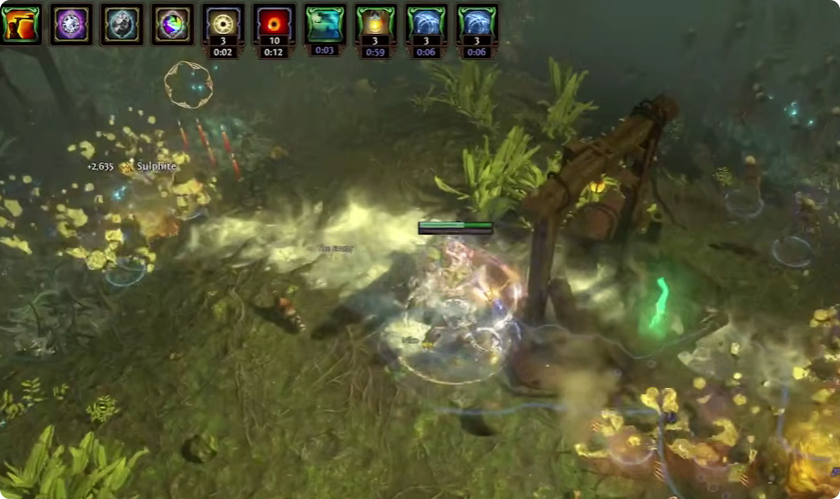
Jungle Valley is a convenient map for this strategy because the goal is not to fully clear the map. Instead, enter the map, locate the Sulfite deposits, collect them, and leave as quickly as possible.
Around three or four maps can provide enough Sulfite to substantially refill your reserves. The exact amount depends on your Atlas setup, map modifiers, and character efficiency.
For an eight-hour farming session, the direct mapping investment can remain below 2 Divines. The much larger investment is the time required to reach a suitable Delve depth, but that is an opportunity cost rather than a recurring farming expense.
What Depth Should You Farm?
For this strategy, farming is focused on depth 1500 and beyond.
Delve rewards are generally considered to stop scaling significantly around this point, making deeper Delve primarily about accessing valuable nodes efficiently rather than endlessly pushing for higher reward scaling.
Once you reach your target depth, avoid wasting time exploring every branch. The objective is to maximize valuable encounters per hour.
How to Choose Your Path
A simple rule is to travel toward valuable reward nodes when they are reasonably close.
If a valuable node requires roughly four or fewer travel nodes, it can be worth taking the detour. If it is significantly farther away, continuing downward is usually more efficient.
There are exceptions. For example, several valuable nodes clustered together can justify a longer detour because you can collect multiple rewards from one deviation.
Which Delve Nodes Are Most Valuable?
Knowing which nodes to target is the key to turning deep Delve into a consistent currency farm.
Fossil Nodes
Prioritize the high-value fossil locations associated with different biomes:
Crystal Spires in the green biome for Hollow Fossils
Human Fissure in the yellow biome for Fractured Fossils
Molten Cavity in the red biome for Faceted Fossils
These fossils provide a large portion of Delve's value and can either be sold directly or used in crafting.
Delve Bosses
Boss encounters should also be prioritized when they are reasonably accessible.
Look for:
Crystal King's Throne for the Owl boss
Lich's Tomb for Kiral
Bosses can provide valuable unique items, cards, and fragments, making them an important source of high-value drops.
If you are using a very strict loot filter, temporarily showing all items after killing a Delve boss is recommended. Valuable boss-specific drops can otherwise be hidden by your filter.
Other Valuable Nodes
Don't completely ignore other specialized reward nodes. Minion-related nodes can produce valuable minion wands and +2 socketed minion gloves, while physical-damage nodes can provide valuable Vulcanic-style on-hit rings.
The best approach is to prioritize exceptional rewards while continuing to move deeper whenever no worthwhile detour is available.
How Much Currency Can Delve Make?
An eight-hour deep Delve session provides a useful benchmark for what this strategy can generate.
During one such farming session, the following loot was collected:
241,000 Azurite
Approximately 7,401 Socketed Resonators
39 Hollow Fossils
28 Fractured Fossils
20 Faceted Fossils
Multiple miscellaneous currency and valuable items
Several boss-specific rewards
Seven Owl kills produced valuable cards, unique items, and a valuable ring, while four Kiral kills produced a Zorath's Eye fragment.
The combined value of the currency and miscellaneous loot reached approximately 173 Divines before expenses.
After subtracting roughly 2 Divines in farming costs, the result was approximately:
171 Divines ÷ 8 hours = 21.4 Divines per hour
That makes deep Delve a highly competitive farming strategy, even if some specialized mapping strategies can exceed it.
How to Increase Delve Profits With Fossil Crafting
Selling fossils is the simplest way to monetize Delve, but players willing to spend additional time crafting can potentially increase their returns.
Use Hollow and Fractured Fossils
One profitable approach is to use two-socket resonators with item-level 86 gloves and boots.
The basic process is:
1. Acquire suitable fractured bases.
2. Use Hollow and Fractured Fossils in two-socket resonators.
3. Apply the fossils to appropriate item-level 86 equipment.
4. Sell valuable fractured outcomes instead of simply selling the fossils.
The important target is an Abyss socket fracture, which can command a significant premium depending on the base.
Evaluate the Crafting Risk
Fossil crafting introduces additional variance. Not every fracture will hit the desired modifier, so you need enough fossil volume to smooth out unlucky streaks.
In one sample batch, 28 Fractured Fossils produced 15 Abyss socket fractures, along with two additional valuable Tier 1 fractures.
The Abyss socket fractures were conservatively valued at around seven Divines each, while the additional valuable fractures added several more Divines.
After accounting for the cost of fossils, bases, and Dead Man's Sulfur, this approach pushed the effective farming rate close to 25 Divines per hour.
Actual returns will vary based on fracture rates, market prices, base selection, and crafting luck.

Is Delve Worth Farming?
Yes, particularly if you already have a strong character capable of efficiently farming deep Delve.
The strategy offers several advantages:
Low recurring map investment
Consistent fossil income
Valuable boss rewards
Multiple high-value node types
Strong returns at deep depths
Additional profit through fossil crafting
The biggest downside is the time required to establish your desired depth and the fact that Delve rewards require efficient routing. Players who spend too much time traveling toward mediocre nodes will see their Divines-per-hour drop quickly.
For players who enjoy Delve and can efficiently navigate the mine, 20-25 Divines per hour is a strong target. Selling fossils is the easiest approach, while using selected fossils for Allflame crafting can provide additional upside for players willing to take on the extra work and market risk. With some POE currency to cover initial resonator and scarab costs, you can focus on maximizing your fossil yield and profit from every run.