






Summary:
Path of Exile 3.29 strength stacking has evolved into one of the league’s most powerful scaling strategies. With Brutus’ Lead Sprinkler, Crown of Eyes, Iron Fortress, Replica Alberon’s Warpath, and late-game upgrades, POE currency, players can progress from a cheap league starter into an endgame character capable of enormous DPS and exceptional survivability.
Why Strength Stacking Is So Powerful in Path of Exile 3.29
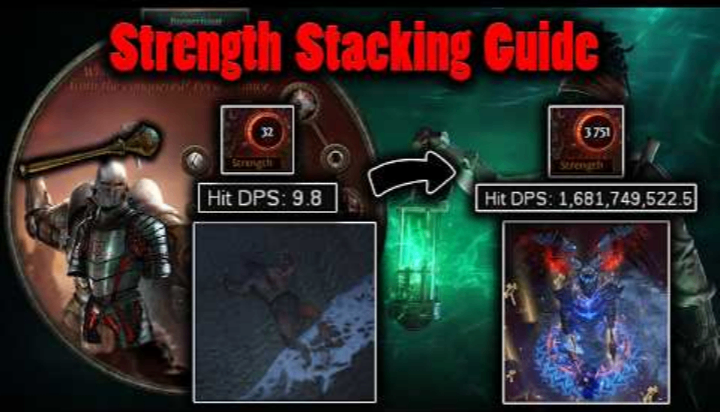
Strength stacking is often misunderstood as an expensive endgame strategy that is difficult to start from scratch. In Path of Exile 3.29, however, the archetype can be surprisingly accessible because several of its core unique items are inexpensive during the early stages of a league.
On its own, Strength does not look particularly impressive. Every two points of Strength provide one maximum Life, while every five Strength normally grants increased melee physical damage. These bonuses are useful, but they do not explain why dedicated Strength stackers can eventually reach enormous damage numbers.
The real power comes from multiplying the value of Strength through specific uniques, passive-tree interactions, ascendancy choices, and damage conversion mechanics.
Brutus’ Lead Sprinkler: The Perfect League-Start Weapon
Brutus’ Lead Sprinkler is a key weapon for Path of Exile 3.29 Strength-stacking builds. It provides flat Fire damage based on Strength, allowing every additional point of Strength to increase attack damage. With around 2,000 Strength, the weapon can deliver huge bonus Fire damage comparable to expensive rare weapons. It is also affordable and easy to obtain at league start, while its critical strike potential makes it an excellent choice for crit-based Strength stackers.
Crown of Eyes and Iron Will Multiply Your Damage
The next major scaling mechanic comes from Crown of Eyes and the Iron Will keystone.
Iron Will allows the increased melee physical damage normally granted by Strength to become increased spell damage. Crown of Eyes then converts that spell-damage scaling back into attack damage with an additional multiplier.
This creates an important interaction: instead of every five Strength simply providing 1% increased melee physical damage, the build can effectively transform Strength into a much larger source of general attack damage.
That scaling applies regardless of whether the final damage is Fire, Chaos, Lightning, or another damage type. This is one reason Strength stacking remains flexible throughout progression.
Juggernaut Makes Strength Stacking Fast and Reliable
For the recommended softcore version, Juggernaut is an excellent ascendancy choice.
The key node is Undeniable, which grants Accuracy based on Strength while also providing attack speed. Because a Strength stacker can accumulate thousands of Strength, this can result in an enormous amount of Accuracy without requiring heavy investment elsewhere.
The result is more than simply reliable hit chance. Additional attack speed improves both clear speed and movement through skills such as Leap Slam.
Juggernaut also provides defensive benefits through Endurance Charges and other defensive mechanics. Players looking for an even more defensive setup can consider Chieftain, particularly for Hardcore, but Juggernaut is generally the more attractive choice for aggressive softcore progression.
Iron Fortress Adds Another Scaling Layer
Once the character has established its basic Strength-stacking foundation, Iron Fortress becomes one of the biggest upgrades.
Iron Fortress increases the effectiveness of the Strength-based damage scaling while also providing additional block chance based on Strength. This means the same stat simultaneously improves offense and defense.
At approximately 3,000 to 4,000 Strength, the resulting bonuses become enormous. The character gains increased Life, increased attack damage, block chance, Accuracy, attack speed, and flat damage from essentially the same investment.
This is the fundamental reason Strength stacking scales so aggressively: instead of investing separately into multiple offensive and defensive stats, one primary attribute powers almost the entire character.
Early Campaign Progression
Strength stacking is easy to level without expensive gear. Use a high-physical-damage two-handed axe or mace during the campaign, while prioritizing Life, resistances, attack speed, and required attributes. Keep the passive tree focused on damage, Life, Fortify, and mana sustain. After the first ascendancy, take Undeniable for Accuracy and attack speed. Once Brutus’ Lead Sprinkler and Crown of Eyes are affordable, respec into the full Strength-stacking and critical strike setup.
The First Strength-Staking Setup
The first dedicated setup can be assembled on a relatively small budget.
Brutus’ Lead Sprinkler, Crown of Eyes, and a Strength-focused rare shield provide the foundation. Regular Alberon’s Warpath boots are also highly effective because they provide a large Strength bonus alongside movement speed and Chaos resistance.
At this stage, expensive rare gear is unnecessary. Look for Strength, resistances, Life, and useful attack-related modifiers.
One important detail is the Iron Will keystone. Players who forget to take Iron Will may experience a dramatic loss of damage after switching into the Strength-stacking setup.
Critical strike investment should also begin relatively early because wasting Brutus’ excellent base critical strike chance would leave substantial damage on the table.
Day-One Upgrades
By the end of the first day, players can begin upgrading toward Iron Fortress, stronger Strength gear, better jewels, and stronger gloves.
A six-linked Iron Fortress can provide a substantial damage increase while simultaneously improving block chance. Fire Exposure on gloves is another valuable upgrade because it effectively provides additional Fire penetration.
Players should also consider upgrading their boots, rings, belt, and jewels as currency becomes available.
The general rule is simple: prioritize Strength first, then resistances and useful damage modifiers. Expensive luxury items should come later.

When to Switch From Sunder to Smite
Sunder works extremely well during early progression, but eventually Smite becomes the preferred clearing skill.
The key requirement is additional nearby target coverage through the appropriate glove implicit and passive-tree investment. Once these effects are available, Smite becomes an exceptionally smooth melee skill because it combines strong single-target damage with excellent area clearing.
Vaal Smite is particularly powerful for clearing dense packs and dealing burst damage to bosses surrounded by additional enemies.
Do not switch to Smite with level-one gems. Level your Smite and support gems beforehand, ideally through an off-hand setup, so the transition does not temporarily destroy your damage.
Cluster Jewels and Major Midgame Scaling
Cluster Jewels represent another huge upgrade.
A cluster containing Overlord can provide Fortify on hit and allow the character to remove several passive points previously spent obtaining Fortify. Other useful notables include Martial Prowess and Fuel the Fight.
Perfect clusters are not necessary. For early progression, securing the most important notables and additional jewel sockets is more valuable than spending enormous amounts of currency chasing a theoretically perfect item.
Additional jewel sockets are particularly powerful because Strength stackers can turn strong rare jewels into another layer of damage, attack speed, critical strike multiplier, and Strength.
Replica Alberon’s Warpath Changes Everything
The next major transformation comes with Replica Alberon’s Warpath.
Instead of relying primarily on Brutus’ Fire damage, Replica Alberon’s provides substantial Chaos damage based on Strength. This opens a completely different scaling route.
Chaos damage becomes extremely powerful when combined with Wither and related curse mechanics. With enough Wither stacks, the build can dramatically increase its effective Chaos damage against enemies.
Replica Alberon’s also performs extremely well against enemies with large Energy Shield pools, making Chaos damage particularly attractive for difficult endgame encounters.
Day-Six and Day-Ten Endgame Builds
As the budget grows, the build can take two paths: high DPS or extreme defense. The defensive setup uses Tempered by War, Dawnbreaker, and Fire resistance conversion to turn Cold and Lightning damage into Fire, creating a tanky character for bosses, Simulacrums, and Tier 17 maps. The offensive version focuses on Paradoxica, Dual Strike, Soul Taker, powerful cluster jewels, and high-end Strength gear.
The Ultimate Endgame: Sublime Strength Stacking
At the highest budget levels, the build can transition into a Sublime setup that pushes defensive conversion mechanics even further.
With the right gear, the character can approach complete conversion of Cold and Lightning damage into Fire damage. This dramatically reduces the threat of elemental penetration and damage-over-time effects.
At the same time, the build can reach enormous Life pools, high block and spell block, strong regeneration, and extremely high damage.
The most extreme versions can exceed the billion-DPS range while still retaining impressive defensive layers. Players who do not need maximum DPS can sacrifice damage nodes for additional Life, block, armor, regeneration, and other defensive mechanics.
Final Thoughts on Path of Exile 3.29 Strength Stacking
Path of Exile 3.29 proves that Strength stacking remains a powerful and flexible scaling strategy. Players can begin with affordable uniques and a simple melee setup, then progress into Brutus’ Lead Sprinkler, Crown of Eyes, Iron Fortress cheap POE currency, cluster jewels, and eventually Smite with Replica Alberon’s Warpath. With stronger gear, jewels, corruptions, and defensive mechanics, the build can continue scaling deep into the endgame.