







A Trophy Born from Something That Shouldn't Exist
In Skull and Bones, the most unsettling rewards, Skull and Bones Items, are often not weapons or ships, but remnants of things that once ruled the deep. The Putrefied Zamaharibu Scale sits firmly in that category a relic that feels less like loot and more like evidence that something enormous once moved beneath the waves and did not stay dead.
At first glance, it appears to be a hardened fragment of armor, but its surface tells a different story. The scale looks organic, almost wet to the eye, as if it were torn moments ago from a living creature that still lingers somewhere below the ocean's surface. The word "putrefied" is not decorative here it defines the entire aesthetic identity of the item. This is decay preserved in mineralized form, a contradiction between rot and endurance.
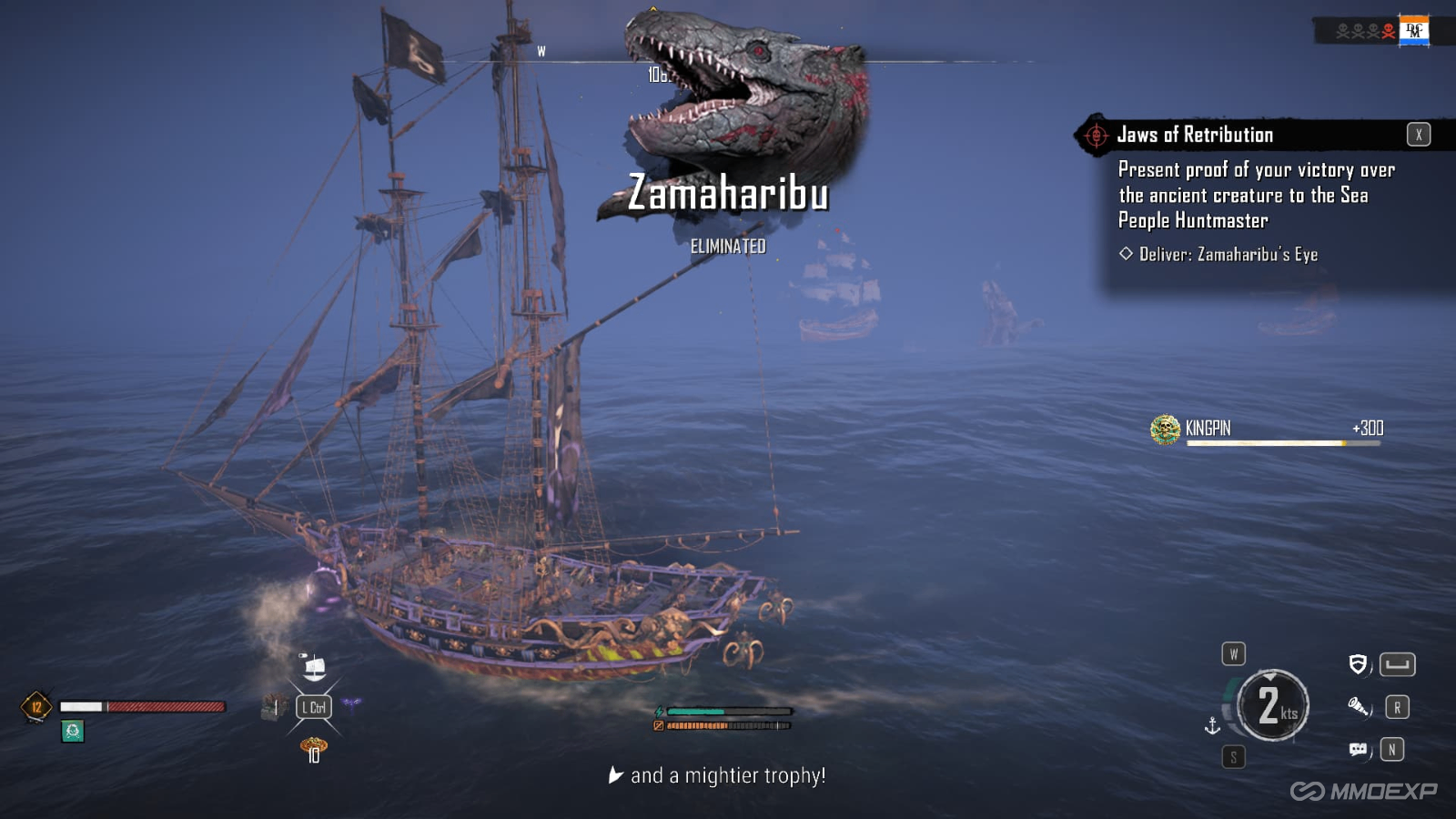
Zamaharibu itself is treated in-game lore as something ancient and catastrophic, a sea-bound force that predates conventional piracy. Whether beast, anomaly, or myth, its name alone carries weight. The scale is what remains after contact with it, a physical memory of an encounter most sailors would never survive twice.
The Texture of Decay and Pressure
What makes the Putrefied Zamaharibu Scale so distinctive is its layered visual storytelling. It does not resemble a clean biological sample or a polished crafting material. Instead, it looks as though it has been subjected to centuries of pressure, salt erosion, and internal corruption.
Its surface is uneven, with ridges that suggest both growth and collapse. Darkened veins run through the material like dried channels of once-active fluid, hinting that the scale was never truly inert, even in death. In some lighting conditions, faint discolorations appear to shift, giving the unsettling impression that the object is still reacting to its environment.
The "putrefied" aspect is not simply decay in the traditional sense. It is transformation through breakdown. Organic matter has not vanished it has been rewritten into something harder, heavier, and more unnatural. The result is an item that feels biologically impossible, as though nature itself was interrupted mid-process and forced into a new state of existence.
In gameplay terms, this kind of material often symbolizes high-tier crafting potential or rare upgrade pathways. But beyond utility, its presentation makes it clear that whatever it is used for, it comes at a narrative cost. Nothing formed from Zamaharibu's remains feels entirely safe to wield.
Echoes of a Deep-Sea Catastrophe
The presence of the Putrefied Zamaharibu Scale in Skull and Bones also reinforces one of the game's darker thematic threads: the ocean as an archive of forgotten disasters. Every corrupted artifact suggests that something vast and unknowable has been shaping the seas long before players arrived.
The scale implies a confrontation perhaps not a clean battle, but a survival event where even victory meant exposure to something deeply wrong. Ships that return with fragments like this are not simply victorious; they are marked. The ocean does not release its secrets without consequence.
This idea adds weight to exploration and combat alike. When players encounter remnants tied to Zamaharibu, it reframes the sea as something more than territory or resource. It becomes a layered ecosystem of scars, where each collectible tells a fragment of a larger, incomplete story.
Even the naming convention contributes to this sense of unease. "Putrefied" suggests time and decomposition, while "Zamaharibu" evokes something deliberate and intelligent behind the horror. Together, they create a dual identity: one part natural decay, one part intentional destruction.
Power Woven from Horror
Despite its unsettling origins, the Putrefied Zamaharibu Scale is not merely a narrative prop. In the broader ecosystem of Skull and Bones, items like this often serve as gateways to advanced crafting systems or high-end upgrades. That duality horror and utility is what makes it especially compelling.
Players who seek it out are often those pushing into endgame content, where efficiency and power begin to intertwine with rarity and risk. The scale represents more than just a resource; it represents access. Access to stronger gear, more dangerous encounters, and deeper layers of the game's progression systems.
There is also an unspoken prestige attached to owning materials tied to Zamaharibu. It signals that a player has engaged with some of the most dangerous content available, surviving encounters that most avoid entirely. In multiplayer environments, this becomes a form of silent communication: a warning that the player has faced something far beyond standard naval threats.
Yet even with its practical applications, the scale never loses its unsettling identity. Every upgrade or crafting recipe built from it carries a trace of its origin. It reminds players that power in Skull and Bones is rarely clean. It is often extracted from ruin, shaped by confrontation with things that should have stayed buried.
A Fragment That Changes the Way You See the Sea
The Putrefied Zamaharibu Scale is more than a collectible it is a narrative device embedded in gameplay. It shifts perception. After encountering it, the ocean is no longer just a space for trade routes and battles. It becomes something older, heavier, and partially erased by time.
Every wave feels like it might conceal another remnant. Every deep-sea voyage carries the possibility of uncovering something that should not be touched. The scale is a reminder that the sea does not simply hide treasure it preserves consequences.
Conclusion
For players willing to chase it, the reward is not only mechanical advancement but immersion into the darker mythology of the world. Players can buy Skull and Bones Items for sale from MMOEXP with the 5% discount code "book". And once that perspective sets in, even ordinary voyages begin to feel like they are moving across the surface of something that is still, quietly, alive beneath them.