







Summary
Landing the number one recruit. Uncovering five-star elite dev players. Finding hidden gems that turn into program legends. These are the goals of every College Football 27 dynasty player, but the path to achieving them has changed significantly this year. The addition of NIL budgets has made recruiting more challenging, especially for smaller programs. One- and two-star schools face a steeper climb than ever before. But with the right scouting approach, any program can build a championship roster. This guide covers everything needed to scout effectively in College Football 27, from NIL budget management to archetype preferences and deal-breaker strategies.

Part 1: The New NIL Reality
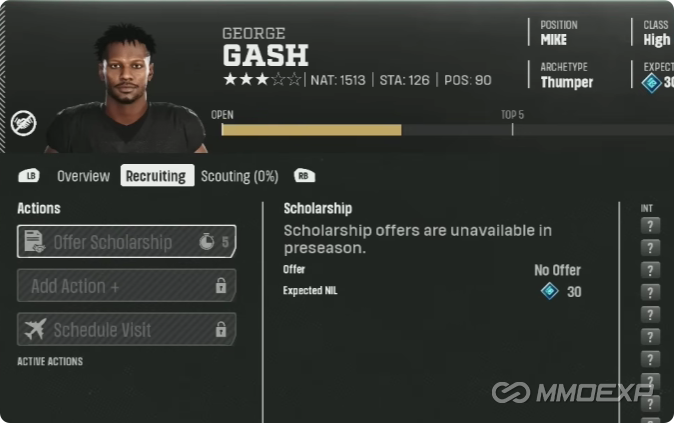
College Football 27 introduces a fundamental change to recruiting: NIL expectations. Players now have an attached expected NIL offer. In previous years, a four-star recruit with no offers could be swooped up by a smaller program with aggressive recruiting hours. That strategy no longer works.
Every prospect has a price tag. A four-star recruit might require 230 NIL points just to get in the door. Even if no other schools are interested, failing to meet that expectation leads to red influence right away. Worse, a bigger program with thousands of NIL points can swoop in at any time and steal the recruit away.
For smaller programs starting with under 1,000 NIL points, this creates a ruthless recruiting environment. The game recommends looking at one- and two-star players, but the real opportunity lies in the three-star market.
Part 2: Why Three-Stars Are the Lifeblood of Rebuilds
For any dynasty rebuild, especially with sub-three-star prestige schools, three-star recruits are the quickest path to success. Here's why:
National rating does not correlate with player quality. A three-star recruit rated 447 nationally is not guaranteed to be better than a three-star recruit rated 1,500. In College Football 26, players learned that national rating had no relationship to dev traits or skill caps. That remains true in College Football 27.
A three-star is a three-star. The key is finding the right ones at the right price.
Look for value in the weeds. Higher nationally ranked players have more expensive entry points. A top three-star cornerback might require 110 NIL. A lower-ranked three-star corner might require zero NIL. When balling on a budget, getting in the weeds and finding undervalued prospects is the winning strategy.
Gems are gold. A gem player, even at the three-star level, tends to have a better dev trait. Better dev traits lead to better skill caps. That snowball effect creates long-term roster development. Finding a three-star gem with zero NIL expectation is the ultimate value play.
Part 3: Deal Breakers - What to Avoid and What to Target
Nothing is worse than a bad deal breaker. Certain deal breakers are more punishing than others, and understanding which ones to avoid can save a dynasty.
Playing Style - This remains the most ruthless deal breaker in College Football 27. Avoid it whenever possible. Players with playing style deal breakers will transfer if they don't get enough touches or fit the system perfectly. For smaller programs, this is a ticking time bomb.
Pro Potential - Tied to how many players get drafted. Smaller schools simply won't have high draft numbers early in a rebuild. This deal breaker sets up future frustrations.
Conference Prestige - Not 100% tied to individual success. If the rest of the conference struggles, prestige can drop through no fault of the program. Tricky to manage.
Playing Time - A great deal breaker for rebuilds. If a player is being pursued and is a gem, they will play as much as possible. This is within control.
Proximity to Home - Awesome deal breaker. Does not fluctuate. Safe and reliable.
Coach Prestige - As long as the entry-level requirement is met, this rating only increases with program success. Focus on this if expecting to be an ascending program.
Focus on deal breakers that are reasonable and within control. Avoid playing style at all costs.
Part 4: The Playing Time Grade Trick
When recruiting hours run out and scouting points are depleted, there's still a way to evaluate prospects. The playing time grade can be a useful shortcut.
Some three-star recruits will have playing time grades as low as C-minus. While a C-minus doesn't automatically mean the player is bad, it does indicate a lower chance of being a gem. When comparing two similar prospects and no scouting points remain, always go with the higher playing time grade.
Maximizing limited resources is the key to success with smaller programs. If hours are tight and NIL budget is limited, blind scouting with playing time grades helps refine the recruiting board efficiently.
Part 5: Archetypes - Finding the Best Fits
Different archetypes generally share similar skill sets. Understanding which archetypes perform best can dramatically improve recruiting success.
Quarterback - Backfield Creator is the new top option. Last year, Dual Threat was the best balance for finding high throw power and speed. This year, Backfield Creator offers the best well-rounded skill set. Pure Runner is the least favorite, often struggling with throw power. Dual Threat still provides a good mix, but Backfield Creator has become the standout.
Running Back - East West Playmaker and Backfield Threat tends to be the fastest, speediest option. Elusive Bruiser and Contact Seeker can also roll into 90s speed, making them solid alternatives.
Wide Receiver - Gadget receivers offer a great mix of athleticism and catching stats, even if route running isn't as refined. Speedsters remain valuable, though speed has been nerfed slightly. Defensive backs are more aggressive in coverage this year. Having plenty of CUT 27 Coins can be a great help to you.
Tight End - Vertical Threat is the favorite archetype.
Offensive Line - Well-Rounded is the preferred choice across the board.
Defensive Tackle - Gap Specialist offers a balanced skill set, with attributes often sitting in the 70s for three-star recruits.
Linebacker - Lurker tends to produce players with high speed and acceleration, even at the three-star level.
Cornerback - Field corners appear to be the best mix of athletes. Zone corners have been the weakest archetype in testing.
Safety - Coverage Specialist and Hybrid are the top options. Box Specialist often produces players with low speed, even at the five-star level.
Edge Rusher - No clear winner yet. It depends on the scheme being run. Pure Power, Speed Rusher, and Edge Setter all have their uses.
Part 6: Scouting Methodology Summary
1. Focus on three-star recruits - They are the lifeblood of any rebuild, especially for smaller programs.
2. Look for NIL value - Target three-stars with low or zero NIL expectations. A three-star is a three-star regardless of national ranking.
3. Prioritize gems - Gems tend to have better dev traits and better skill caps.
4. Avoid bad deal breakers - Playing Style is the most ruthless. Pro Potential and Conference Prestige can also cause issues.
5. Use playing time grade - When hours and scouting points are depleted, playing time grade helps refine the board.
6. Know the best archetypes - Backfield Creator (QB), East West Playmaker/Backfield Threat (RB), Gadget (WR), Vertical Threat (TE), Well-Rounded (OL), Gap Specialist (DT), Lurker (LB), Field (CB), Coverage Specialist/Hybrid (S).

Conclusion
Scouting in College Football 27 requires a different approach than previous years. The addition of NIL budgets has made recruiting more challenging, especially for smaller programs. But with the right strategy, any school can build a championship roster.
Three-stars are the lifeblood. National rating doesn't correlate with player quality. Find value in the weeds. Target players with low NIL expectations. Look for gems. Avoid playing style deal breakers. Use playing time grade when resources are limited. Know which archetypes work best.
These tips are applicable from a one-star rebuild all the way up to a five-star program. The principles remain the same. Maximize limited resources. Find hidden value. Build a roster through smart scouting.
Good luck, and happy recruiting.