










Summary
Recruiting in College Football 27 has changed significantly with the introduction of NIL. Understanding how to manage NIL budgets, recruiting hours, and player interest is essential for building a championship program. This guide covers the best recruiting tips, including NIL offer strategies, balancing hours and money, and optimizing support staff packages.
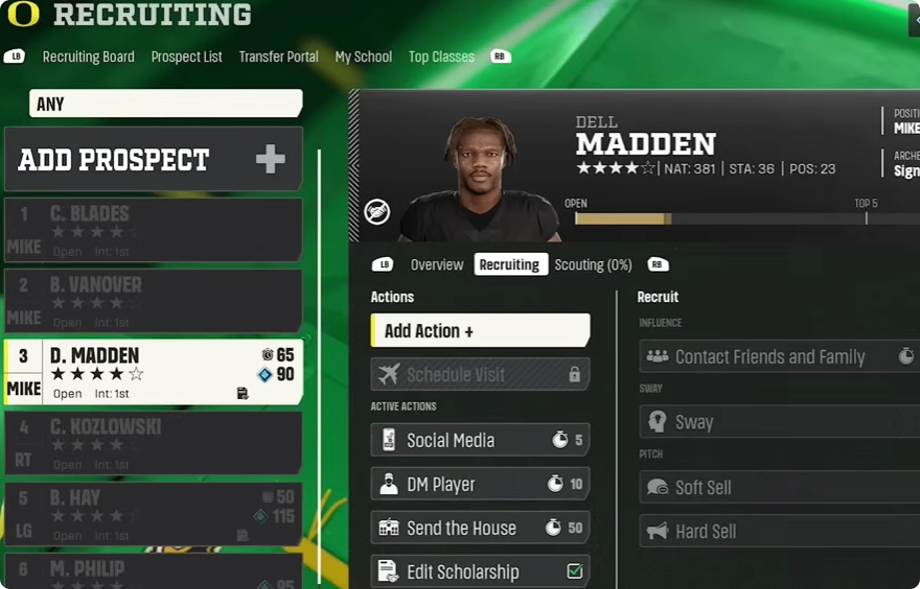
Part 1: Setting Up Your NIL Cheat Sheet
The Baseline Offer
Every recruit has an expected NIL offer. This is the baseline—the amount required to avoid losing interest. Offering less than baseline results in negative interest; offering more provides bonus interest.
Tiers Based on Player Value
The NIL cheat sheet is divided into four tiers. For a generational must-have player who is essential to the scheme, the NIL offer should be 1.75 to 1.80 times baseline. For a must-have player who is important but not generational, the offer should be 1.35 to 1.50 times baseline. For a player who would be useful depth but is not essential, the offer should be approximately 1.15 times baseline. For a player who is truly just depth or a miscellaneous piece, the offer should be baseline or slightly above at 1.00 to 1.05 times baseline.
Why Start High on Generational Players
Starting with a low offer on generational recruits puts the player behind competitors who offer high NIL immediately. The week one NIL bonus is significant, and other teams will maintain or increase their lead. For must-have players, starting at the 1.75 to 1.80 range ensures the player remains competitive.
Managing NIL for Depth Pieces
For players not essential to the program, offering baseline or slightly above is sufficient. This allows gauging interest without committing significant NIL resources. If no other schools offer, the player can be secured at baseline. If competition emerges, the NIL can be increased later.
Part 2: Interest Position vs. NIL
The New Reality
In previous CFB games, being low on the interest board was a major concern. Without elite recruiter packages, it was difficult to overcome the lead of schools with better recruiting resources. With NIL, this has changed.
NIL Can Overcome Interest Deficits
A school can jump from the seventh position to the top with a strong NIL offer. NIL functions similarly to an elite recruiter—players control how much they invest. A smaller school can outbid a blue blood if they allocate more NIL.
Example: Boise State vs. Georgia
In testing, Boise State beat Georgia on a recruit by offering a double NIL offer worth 350 points. Georgia only applied a little extra NIL, assuming their prestige would carry them. The lesson is that NIL levels the playing field. Do not overreact to interest position alone.
School Prestige and NIL Cost
Smaller schools often pay higher NIL for the same recruit because their brand exposure and school grades are lower. A recruit who costs a smaller school 180 to 200 NIL might only cost a blue blood 150 NIL with similar grades. This makes NIL management even more critical for smaller programs.
Part 3: Recruiting Hours vs. NIL
The Balance
More recruiting hours mean less NIL required. A player receiving 50 hours needs more NIL to stay competitive. A player receiving 80 hours needs less.
General Rule:
With 50 hours, NIL wins
With 65 hours, it is close, but NIL still wins
With 80 hours, hours win
How to Save NIL
If the player has a strong lead, offering 1.5 times NIL with a maximum of 75 to 80 hours can maintain the lead while saving NIL. The hours are free and can be allocated across multiple recruits. With elite recruiter packages providing 65 to 80 hours per recruit, the program can save significant NIL over the course of a season.
The Elite Recruiter Math
With elite recruiter tier four and coordinators providing additional hours, a school can spend 65 to 80 hours per recruit. If the program has 800 total recruiting hours, that is only 10 recruits at max hours. Adding visits reduces that number to six or seven recruits. Elite recruiter builds require the extra recruiting hours package to maintain a full class.
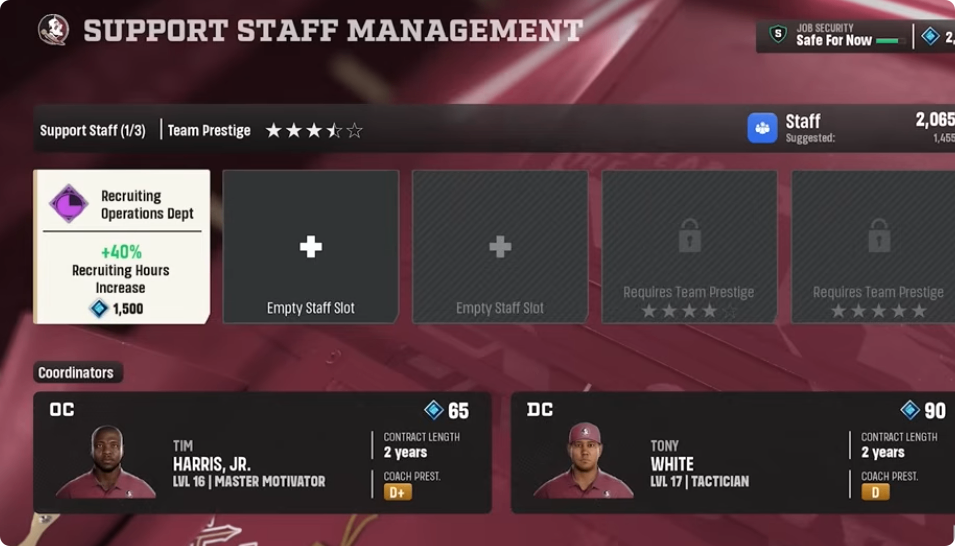
Part 4: Support Staff Packages
Extra Recruiting Hours
This package provides a 40 percent increase in recruiting hours. For elite recruiter builds, this is essential. With 800 base hours, 50 hours per recruit allows 16 recruits. With 80 hours per recruit, 800 hours only covers 10 recruits without the package.
When It's Useful:
Elite recruiter builds
Schools with high NIL budgets
Programs that want to max out a large class
When It's Not Useful:
Smaller schools with limited NIL
Programs that cannot afford to offer baseline NIL to many recruits
Reduced NIL Expectations
This package reduces the NIL cost of recruits. The math is straightforward: at a cost of 1,500 dynasty points, the program must spend 5,000 NIL per year to break even. Paired with support staff discounts reducing cost to 750, the break-even point drops to 2,500 NIL per year.
Why It's Important:
Elite recruiters spending 80 hours per recruit will invest heavily in NIL
Reduced NIL expectations lower the cost of each recruit
Savings accumulate across a full class
Funds can be used for player retention
A side benefit is that lower NIL costs also help retain elite players like Dante Moore and Jeremiah Smith at the end of the year.
Part 5: When to Adjust NIL Offers
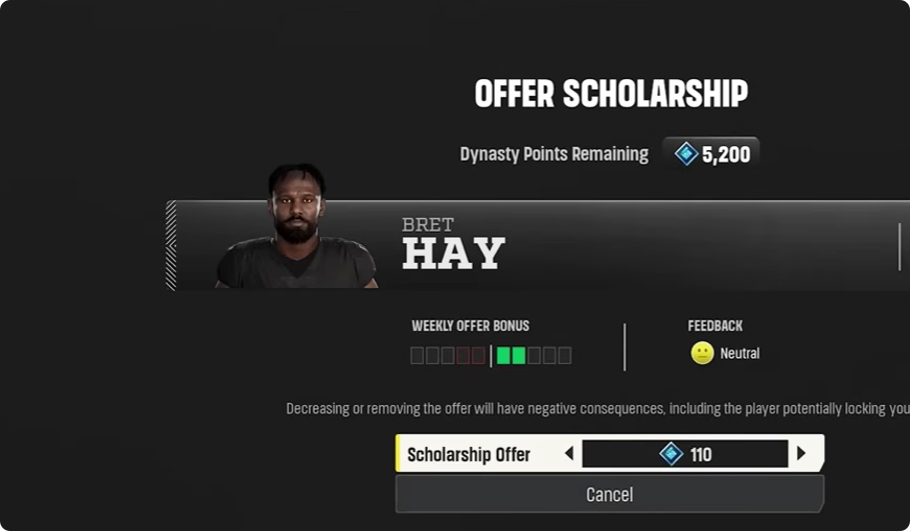
The NIL Offer Cannot Be Reduced
Once the player offers NIL, that becomes the new baseline for that recruit. If the player offers 1.75 times baseline and later wants to reduce to 1.5 times, the interest drops significantly. The 1.5 offer is now worse than baseline because the recruit expects the higher amount.
Adjusting Based on Competition
For must-have players, offer a high NIL from the start. For depth pieces, start at baseline and increase if competition emerges. For generational players, start at 1.75 times and maintain. If NIL becomes excessive, consider pulling the offer.
The Opportunity Cost
Spending excessive NIL on one player may prevent signing other players. Evaluate whether the player is worth the investment relative to other needs.
Conclusion
Recruiting in CFB 27 requires a disciplined approach to NIL budgeting and hour allocation. The introduction of NIL has made recruiting more strategic than ever. By using the tiered NIL cheat sheet, balancing hours and NIL, and optimizing support staff packages, any program can build a championship roster.
The key is understanding when to invest heavily and when to conserve resources. Elite recruiter builds should prioritize extra recruiting hours and reduced NIL expectations. Smaller schools should focus on value recruits and avoid overspending on players who cannot be retained. For players looking to build their program more quickly, earning or trading CUT 27 Coins can provide additional flexibility to fill roster gaps without overcommitting NIL budget to high-value targets. With the right strategy, any program can compete for top recruits. Good luck, and dominate your dynasty.