









Summary
Many College Football 27 players struggle with passing because they focus only on throwing accuracy while ignoring timing, receiver control, and decision-making. Missed catches, unnecessary interceptions, poor pocket movement, and wasted downs often come from small mistakes rather than bad play calls. This guide breaks down the most important passing techniques: the Tap Method, catching settings, pass leading, high ball passing, route adjustments, pocket presence, and halfback usage. These adjustments help create more consistent completions and protect your offense in important situations.
Master the Tap Method for More Reliable Catches
Use Timing Instead of Holding the Catch Button
The new catching system in College Football 27 rewards better timing. Instead of holding the catch button and hoping for a good animation, use the Tap Method.
The process is simple:
Select the correct catch type.
Wait until the ball approaches the receiver.
Tap the catch button right before the ball reaches the receiver’s hands.
The three main catch options are:
A / X: Possession Catch
X / Square: RAC Catch
Y / Triangle: Aggressive Catch
Choose based on the situation.
Correct approach:
Use Possession Catch near the sideline or when protecting the ball.
Use RAC Catch when the receiver has open space.
Use Aggressive Catch when fighting through coverage.
Incorrect approach:
Holding the button too early can lead to poor timing and missed opportunities.
Practice this mechanic in Practice Mode until the timing becomes natural.
Adjust Your Catching Settings
The right settings make passing more consistent.
Recommended catching settings:
Catching: On
Feedback: Only
AI IQ: 10
The goal is to receive useful timing information without unnecessary visual distractions.
For new players, keeping the meter visible temporarily can help learn the timing window. After becoming comfortable, reducing visual assistance can make the experience smoother.
Improve Passing Accuracy With Better Receiver Control
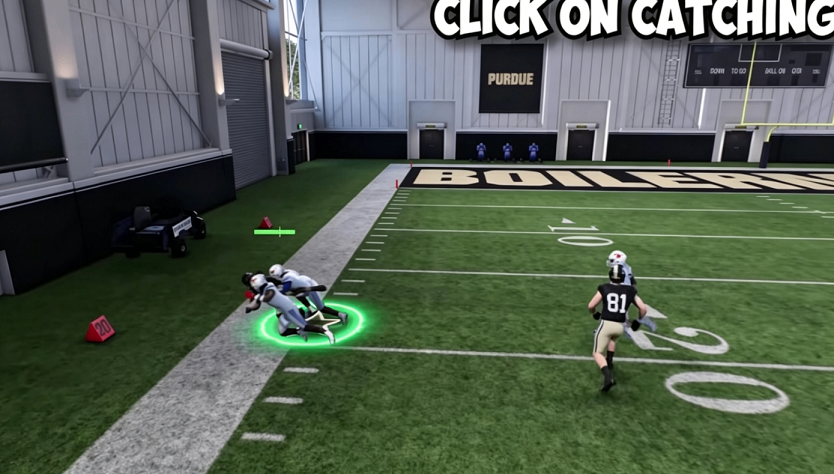
Click Onto Receivers Before Difficult Throws
One of the biggest differences between average and advanced players is controlling the receiver after the ball is thrown.
Press:
B / Circle to switch control to the receiver.
Use this when:
The throw is contested.
The defender has inside leverage.
You need to adjust the receiver’s angle.
The process:
Throw the ball.
Switch control to the receiver.
Adjust the receiver toward the open space.
Use the correct catch type.
For example, if a defender is behind your receiver, clicking on allows you to attack the ball instead of waiting for the receiver animation.
Correct approach:
Adjust the receiver on tight throws to create separation.
Incorrect approach:
Allowing the CPU receiver to follow the original route when the defender has better positioning.
Master Pass Leading to Throw Receivers Open
Always Throw to Space
A common mistake in College Football 27 is throwing directly at the receiver.
Good quarterbacks throw where the receiver is going.
Use the left stick while passing to lead the ball into open space.
Examples:
Lead outside against man coverage.
Lead away from defenders.
Throw toward the receiver’s next step.
A good pass lead can turn a contested throw into a safe completion.
Think of it like backyard football:
You do not throw where your receiver currently stands. You throw where only your receiver can make the play.
Use Passing Settings That Give More Control
Recommended Passing Setup
Go to gameplay settings and adjust:
Passing Type: Placement and Accuracy
Pass Lead Increase: Small
Reticle Speed: 7
Reticle Visibility: User Only
Meter Visibility: User Only
Placement and Accuracy gives more control over ball placement instead of relying only on quarterback ratings.
For players with quarterbacks that have strong abilities, this setting can maximize their advantages.
Protect the Football and Avoid Unnecessary Turnovers
Know When to Throw Away the Ball
Not every play needs to create yards.
Sometimes the best decision is avoiding a negative play.
To throw the ball away:
Move outside the pocket.
Make sure you are near the sideline.
Click the right stick.
Avoid forcing throws into coverage.
Use Slides to Prevent Fumbles
When a play breaks down, protect your quarterback.
Hold:
L2 + R2 / Left Trigger + Right Trigger
Click the right stick
This allows your quarterback to give himself up.
Use this when:
The defense is closing quickly.
You are protecting a lead.
Taking a hit risks injury or a fumble.
Correct approach:
Accept a short gain and keep possession.
Incorrect approach:
Taking unnecessary hits while trying to gain extra yards.
Use High Ball Passing Against Tight Coverage
Create Better Throwing Windows
High Ball Passing is useful when a defender is between the quarterback and receiver.
To perform it:
Hold L1 / LB.
Press the receiver button.
Use pass lead if necessary.
This creates a higher trajectory while still allowing a bullet pass.
Use it for:
In routes.
Corner routes.
Posts.
Streaks.
The advantage is placing the ball where only your receiver can attack it.
However, remember:
High throws require more accuracy from your quarterback. Do not force them with poor ratings or heavy pressure.
Protect Your Starting Quarterback During QB Runs
Use Backup Quarterbacks for Designed Runs
Quarterback runs can be useful, but unnecessary hits can hurt your passing game.
Before calling QB run plays:
Open the formation screen.
Press Y / Triangle.
Select your backup quarterback.
This keeps your main passer healthier throughout the game.
Use your starter only when:
The situation is critical.
You need your best player.
The risk is worth the reward.
Create Better Routes With Smart Routes and Route Stems
Use Smart Routes for First Downs
Smart Routes adjust routes based on the field situation.
To activate:
Press Y / Triangle.
Select the receiver.
Press RB / R1.
This helps receivers stop near the first-down marker.
Useful routes:
Curl routes.
In routes.
Out routes.
Corner routes.
Use Custom Route Stems to Change Timing
Custom Stems allow you to modify when receivers break.
To use:
Select the receiver.
Hold LB / L1.
Use the D-pad to adjust the route stem.
This helps create:
Faster cuts.
Different route depths.
Better spacing against coverage.
Custom stems are especially useful when the defense repeatedly stops standard routes.
Improve Pocket Presence and Extend Plays
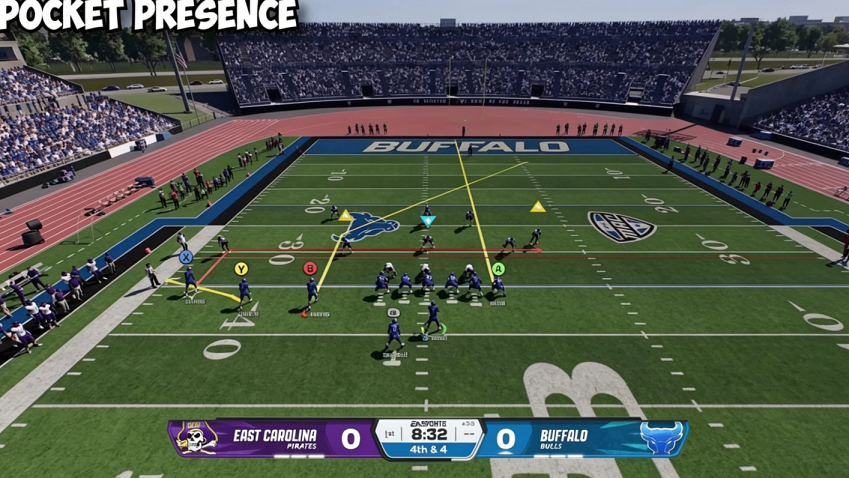
Move With Purpose Inside the Pocket
Good pocket movement is not simply stepping forward.
The goal is:
Read pressure.
Create extra time.
Keep your eyes downfield.
Use the left stick to move away from pressure.
Examples:
Pressure through the middle → move outside.
Edge pressure → step up if space exists.
Collapsing pocket → roll away and reset.
Incorrect approach:
Running backward every play.
This often causes inaccurate deep throws.
Correct approach:
Move only enough to create a clean throwing window.
Use Your Halfback as a Passing Weapon
Turn Your HB Into a Key Part of the Offense
Your halfback is one of the most versatile players on the field.
Use your HB for:
Pass protection.
Beating man coverage.
Creating mismatches.
Attacking underneath zones.
Strong options include:
Halfback Texas routes.
Speed In routes.
Speed Out routes.
Slide routes.
You can also block the halfback when facing heavy pressure.
A strong passing offense does not only rely on wide receivers. A good HB creates more options and forces defenses to cover every area.
When building your roster and improving your team options, managing resources efficiently is important. Players looking to strengthen their lineup can consider using College Football 27 Coins to upgrade key positions and improve overall team depth.
Key Takeaways
Use the Tap Method to improve catching consistency.
Switch to receiver control on contested throws.
Pass lead away from defenders instead of throwing directly at receivers.
Use Placement and Accuracy settings for better control.
Protect the football by throwing away risky plays and sliding.
High Ball Passing helps attack defenders positioned between quarterback and receiver.
Smart Routes and Custom Stems create better passing windows.
Pocket movement and halfback usage are essential parts of a strong passing offense.
Conclusion
Mastering passing in College Football 27 requires more than memorizing plays. The biggest improvements come from better timing, smarter receiver control, and safer decision-making.
By learning the Tap Method, improving pass placement, managing the pocket, and using every offensive weapon—including the halfback—you can create a more consistent passing attack and avoid the mistakes that cost games.