Weekend Drop -













Summary
Recruiting in College Football 27 is completely different from previous years. The introduction of NIL (Name, Image, and Likeness) has transformed how players approach building their dynasties, creating opportunities for smaller schools that never existed before, so you no longer need to buy CUT 27 Coins just to patch roster gaps that recruiting alone should solve. This guide breaks down the new recruiting landscape and shows you how to exploit it to build a championship program, regardless of your school's prestige.

The Old Problem: Big Schools Dominated Everything
In previous College Football games, recruiting followed a predictable pattern. Ohio State, Georgia, Alabama, and other blue-blood programs could throw 50 hours at almost any recruit on their board because they had such a wide net of resources. If a big school wanted a player, they got them. Smaller schools like Cal had virtually no chance at elite talent, no matter how well they recruited.
This created a stagnant dynamic where smaller schools had to grind through years of mediocrity, slowly building prestige until they could finally compete for top recruits. It was realistic in some ways but made dynasty mode predictable and, for many players, boring.
The New Reality: NIL Changes Everything
College Football 27 introduces NIL as a core recruiting mechanic, and it fundamentally changes the game. Smaller schools can now take big swings at elite talent by allocating their limited resources aggressively. A five-star recruit who might be the 10th or 15th best player on Ohio State's board is now a legitimate target for a program like Cal.
Here is the key insight: big schools have to spread their NIL resources across multiple top recruits. They will invest heavily in their top five targets, but their 10th, 15th, or 20th best recruit will receive minimal NIL attention. Meanwhile, a smaller school can identify that same player as its number one priority and offer a substantial NIL package, making it a serious contender.
How the NIL System Works
Scholarship Offers vs. NIL Offers
In College Football 27, recruiting involves two separate but related components: scholarship offers and NIL offers. A scholarship offer represents the traditional recruiting pitch—playing time, coaching, facilities, and program prestige. NIL offers represent the financial incentive, which can override traditional recruiting advantages.
A player receiving a massive NIL offer will seriously consider a school even if the program's grades are mediocre. This mirrors real-world college football, where players increasingly choose schools based on financial opportunities.
Resource Allocation
Every school has a recruiting budget that must be balanced between scholarship offers and NIL offers. Big schools have larger budgets, but they also have more players to pursue. They cannot go all-in on every recruit. Smaller schools have smaller budgets but fewer targets, allowing them to concentrate resources on one or two elite players.
The Decision-Making Process
When deciding where to invest, consider these factors:
For Big Schools: Your top five recruits deserve maximum NIL investment. For recruits ranked 6th through 15th on your board, you can offer competitive scholarship packages but minimal NIL. For recruits ranked lower, you may not need to offer anything beyond baseline attention.
For Small Schools: Identify one or two elite recruits who could transform your program. Offer them a scholarship and a substantial NIL package. Even if your program grades are mediocre, a large NIL offer can put you in the mix against bigger programs.
Strategies for Success
The All-In Approach
For smaller schools, going all-in on a single elite recruit can be a program-defining move. Consider investing heavily in a quarterback, left tackle, or edge rusher—positions that can single-handedly change your team's trajectory.
If you land a dual-threat quarterback with 86+ speed, you can win games immediately, which accelerates your program's growth through increased prestige and better recruiting grades in future cycles.
Understanding Your Scheme
Before investing in recruits, understand your offensive and defensive scheme. If you rarely run the ball, prioritize offensive line and quarterback recruits. If you rely on a power running game, invest in running backs and blocking tight ends. Knowing what you need prevents wasted resources.
Identifying Vulnerable Big-School Targets
The most valuable recruits for smaller schools are elite prospects who are not top-five priorities for big programs. These players will receive minimal NIL attention from major schools, allowing you to compete effectively.
Use the recruiting board to identify four-star prospects with high ceilings who have offers from multiple big schools but minimal NIL investment. These players represent the best value in the new recruiting system.
Hard Selling and Timing
By week three or four of the season, you will need to hard sell recruits. This is where your program grades matter. If your school has strong academic grades, campus life, or proximity to home, leverage those advantages in your pitch.
Schools with all C, D, and F grades will struggle during the hard sell phase. This is why selecting a school with advantageous static grades is crucial—it gives you a foundation for recruiting success regardless of your NIL budget.
Practical Example: Cal vs. Ohio State
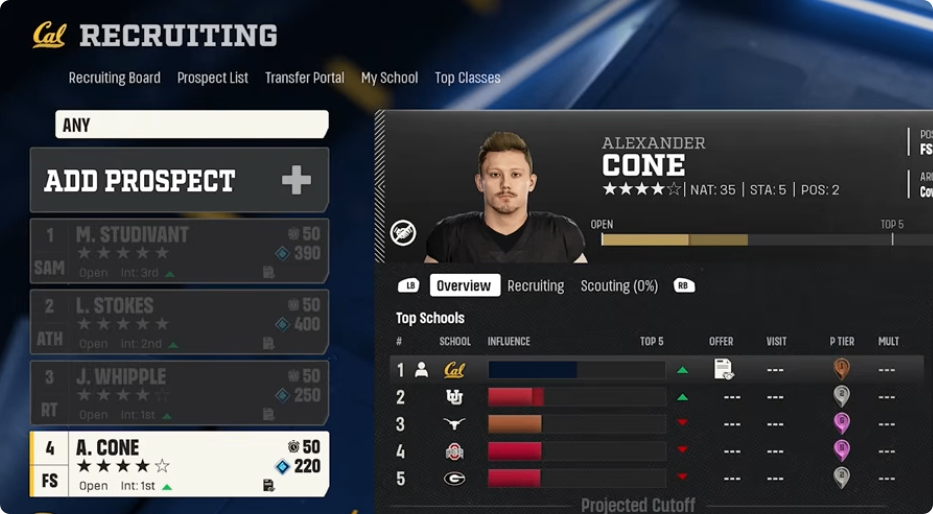
Consider a scenario where Cal and Ohio State are both recruiting a four-star free safety with 93 speed. For Ohio State, this player might be their 10th-best recruit. They will offer a scholarship and minimal NIL. For Cal, this player is their number one target. They offer a competitive scholarship and a substantial NIL package.
The result is that Cal can realistically compete for this recruit. If Ohio State sees Cal jump into the race with a strong NIL offer, they may choose not to escalate. They have other recruits to worry about and limited resources to allocate.
This dynamic creates opportunities for smaller schools that simply did not exist in previous College Football games.
Building Your Dynasty
The new NIL system allows for multiple strategic approaches to dynasty building:
The Aggressive Path: Go all-in on one or two elite recruits in year one. Land a franchise quarterback and a game-changing edge rusher. Use them to win immediately, which accelerates your program's growth.
The Foundation Path: Focus on building a deep roster of solid three- and four-star recruits. Avoid the risk of putting all your resources into one player. Build your program slowly but steadily.
The Hybrid Approach: Invest heavily in one elite recruit while also building depth with high-value four-star recruits who are undervalued by bigger programs.
Summary
College Football 27's recruiting system is fundamentally different from any previous game in the series. NIL has created opportunities for smaller schools that never existed before. By understanding how big schools allocate their resources and identifying vulnerable elite recruits, you can build a championship program regardless of your school's starting prestige.
Whether you take the aggressive path and go all-in on one recruit or build slowly through depth and value, the new recruiting system rewards strategic thinking and calculated risk-taking—helping you avoid wasting precious CUT 27 Coins on players who won't move the needle. The days of being stuck in mediocrity are over.