Weekend Drop -













Summary
College Football 27 rewards players who understand that passing success starts before the snap. Mastering pass protection adjustments, identifying blitz threats, using half slides, base blocking, max protect, College Football 27 Coins, and double teams can completely change your offensive performance. This guide explains every protection option and how to build a smarter passing strategy.
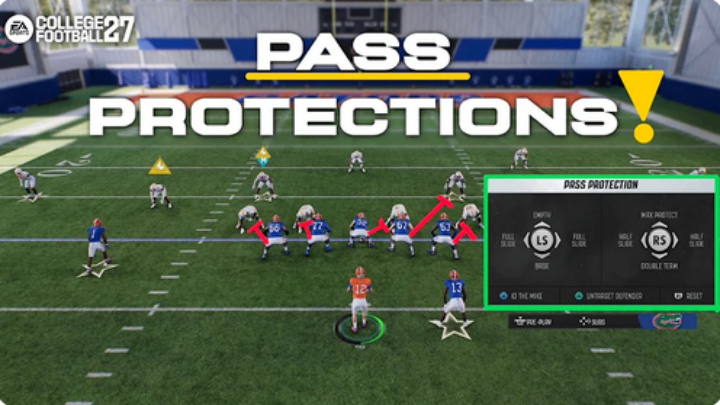
Step 1: Understand Why Pass Protection Matters in College Football 27
Becoming an elite passer in College Football 27 is not only about reading coverage, timing throws, or mastering different routes. Before you ever look downfield, you need to understand how your offensive line is protecting you.
Many players struggle with passing because they focus entirely on receivers and defensive coverage while ignoring the biggest factor: having enough time to throw.
College Football 27 gives players advanced pre-snap tools that allow you to adjust blocking assignments, identify blitz threats, and create better protection schemes. Learning these mechanics turns passing from a guessing game into a strategic battle.
Football is a chess match, and pass protection is your first move.
Step 2: How to Check Pass Protection and Identify Blitz Threats
Before changing your protection, you need to know what your offensive line is seeing.
To view your pass protection in College Football 27, simply press the left trigger before the snap. This brings up your blocking assignments and shows which defenders your offensive line is preparing to block.
You will also notice fire icons appearing near certain defenders.
These icons represent potential blitz threats. If one of these defenders decides to rush the quarterback, they could potentially come through completely unblocked.
Understanding these defenders is extremely important because an unblocked blitz does not necessarily mean the play is dead. Instead, it means you need a quick answer.
That answer could be:
A hot route
A quick slant
A running back check-down
A fast outside throw
The best quarterbacks are not surprised by pressure. They expect it.
Step 3: Learn How Empty Pass Protection Works
Empty formations are popular because they spread the defense out and create passing opportunities. However, they also create protection challenges.
When you call a play where all five eligible receivers run routes, your offensive line automatically uses empty pass protection.
The rule behind empty protection is simple:
The offensive line prioritizes the closest threats inside the box.
This can create situations where your offensive tackle ignores an outside defender because a linebacker inside appears to be the bigger immediate threat.
For example, if a linebacker blitzes, your left tackle may step inside to block him, leaving an edge defender completely free.
This is why empty protection can become dangerous against aggressive defenses.
When using empty formations, consider these adjustments:
Use half slides
Use base blocking
Keep a quick outlet route available
If you send everyone out into routes, you must have a plan for immediate pressure.
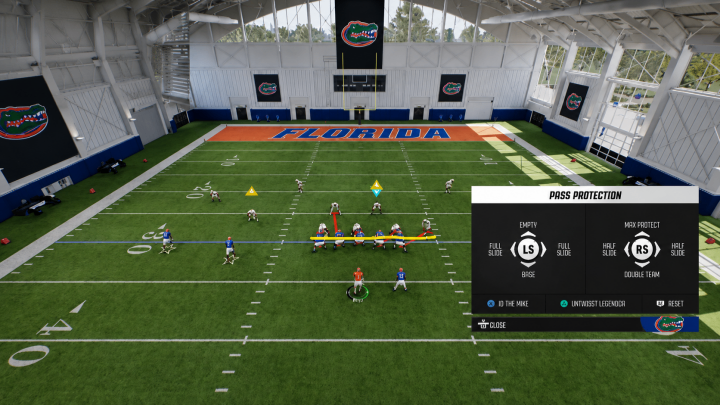
Step 4: Base Pass Protection – A Reliable Default Option
Base pass protection is one of the safest adjustments in College Football 27.
You can activate it by pressing down on the left stick.
Unlike empty protection, base protection focuses on the biggest threats first.
The offensive line prioritizes:
Defensive linemen
Linebackers
Secondary pressure threats
For many players, base protection is a better option than empty protection because it creates more predictable blocking.
However, base protection is not perfect. Against heavy blitz schemes, you may still need additional adjustments.
Think of base protection as your balanced approach when you are unsure what the defense is bringing.
Step 5: Be Careful With Full Slide Protection
College Football 27 includes full slide left and full slide right options, but these should be used carefully.
When you full slide, your offensive line shifts one gap in the selected direction.
For example:
Full slide left moves blockers toward the left side
Full slide right moves blockers toward the right side
The problem is that sliding can create new weaknesses.
If you full slide left, an edge defender on the opposite side may become completely unblocked.
This can be especially dangerous against:
Over fronts
Under fronts
Elite edge rushers
Many players rely too heavily on full slides, but they often create more problems than they solve.
In most situations, half slides are safer because they provide more balanced protection.
Step 6: Master Half Slide Protection
Half slides are one of the most important tools for passing success in College Football 27.
They are used frequently because they combine zone protection principles with man blocking.
When you half slide left:
The offensive line slides toward the left
The backside blockers handle defenders individually
When you half slide right:
The offensive line slides toward the right
The backside blockers use one-on-one assignments
The key advantage of half slides is flexibility.
You can identify where the defense has the most threats and slide your protection toward that area.
For example, if the defense has three defenders threatening the left side and only two threats on the right, a half slide left can create better protection.
However, always check the fire icons after adjusting.
Every protection change can create a new unblocked defender.
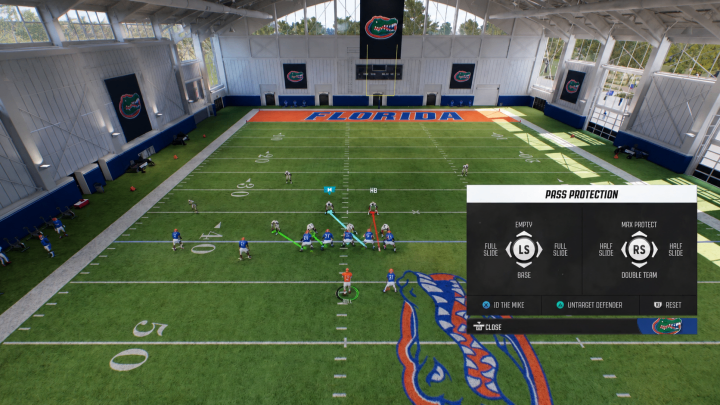
Step 7: Using Your Running Back in Pass Protection
Your running back is one of your most valuable protection tools.
When you block your running back, you gain an additional blocker who can pick up blitzing linebackers or defensive backs.
This is especially useful against:
Heavy pressure packages
Zero blitz formations
Aggressive defensive schemes
However, your running back assignment depends on your protection adjustment.
When using slides, the running back typically blocks away from the slide direction.
For example:
If you half slide right, your running back may cross the formation to pick up a defender on the opposite side.
This is often better than asking the running back to block someone directly in front of him.
You can also change the running back’s assignment by identifying the Mike linebacker.
This allows you to manually decide who the running back protects.
Step 8: Max Protect for Heavy Pressure Situations
Max protect is another powerful option when you expect pressure.
When you activate max protect:
Your running back stays in to block
Your tight end stays in to block if available
This creates a stronger protection wall but reduces the number of receivers running routes.
Max protect is useful when:
Facing elite pass rushers
Expecting a blitz
Running deep passing concepts
The downside is fewer receiving options.
You gain protection but sacrifice route combinations.
Step 9: Use Double Teams Against Elite Defenders
College Football 27 also allows offensive players to create double teams.
You can activate this by pressing down on the right stick and selecting the defender you want to double.
This is extremely useful against dominant defensive players.
Examples:
A powerful defensive tackle destroying your center
A speed rushing edge defender beating your tackle repeatedly
A double team allows two offensive linemen to focus on one dangerous defender.
However, be careful.
Helping one area creates weakness somewhere else.
If your center leaves his assignment to help an edge rusher, another defender may become free.
Use double teams strategically, not automatically.
Step 10: Build a Pre-Snap Routine for Better Passing
The best College Football 27 quarterbacks develop a consistent pre-snap routine.
Before every play:
1. Check the defensive front
Look from the center outward.
Where does the defense have more bodies?
2. Adjust your protection
Choose:
Base protection
Half slide
Max protect
Running back block
3. Identify blitz threats
Look for fire icons and potential hot defenders.
4. Find your quick answer
Know where the ball goes if pressure arrives.
This process only takes a few seconds but dramatically improves your passing ability.
Step 11: Remember Football Is Still About Adjusting
Even perfect protection will not win every matchup.
Sometimes your offensive line will lose against elite defenders. Sometimes the defense will call the perfect blitz, buy College Football 27 Coins.
The key is not allowing one bad play to affect the next snap.
Great players have short memories.
Whether you throw a touchdown or take a sack, move on and focus on the next opportunity.
By understanding pass protections, identifying blitz threats, and making smart adjustments before every snap, you can become a much more effective quarterback in College Football 27.
The difference between average and elite players is not just throwing accuracy—it is understanding the battle happening before the ball is even snapped.