










Summary
Mastering the running game in College Football 27 is about much more than simply calling inside zone or stretching the ball outside. By understanding formation strategy, blocking mechanics, RPOs, ball carrier moves, quarterback runs, and pre-snap adjustments, College Football 27 Coins, you can consistently create explosive rushing plays and dominate opponents online.

Step 1: Run From Passing Formations Instead of Heavy Sets
One of the biggest mistakes players make is assuming heavy formations automatically produce the best rushing attack. While formations loaded with tight ends and extra blockers look intimidating, defenses usually recognize the obvious running threat and crowd the box.
Instead, many of the strongest rushing plays come from formations primarily known for passing.
For example, formations like Gun Bunch Strong Offset force opponents to respect multiple passing concepts. Defensive players often respond with lighter personnel or fewer defenders in the box, creating ideal conditions for effective runs.
Some of the most consistent rushing concepts include:
Halfback Duo
Inside Zone
Halfback Stretch
Y Insert
Because the defense expects a pass, these runs often gain more yardage than similar plays from traditional power formations.
The lesson is simple: make your opponent defend every possibility instead of telegraphing your intentions.
Step 2: Study Blocking Assignments Before Every Snap
College Football 27 includes one of the most overlooked offensive tools in the game.
Before snapping the football, holding the blocking preview button allows players to see exactly where offensive linemen intend to block.
This feature reveals:
Double-team assignments
Pulling guards
Second-level linebacker targets
Blocking combinations
Potential running lanes
Although defensive movement can alter assignments after the snap, understanding the original blocking design dramatically improves decision-making.
It also helps determine whether you should:
Flip the run
Audible into another play
Stick with the original call
Elite runners read their blockers before they ever touch the football.
Step 3: Expand Your Running Game With Smart RPOs
Run-Pass Options are much more than flashy passing concepts.
In College Football 27, they serve as an extension of the rushing attack by forcing defenders to hesitate.
The most effective RPOs include:
Bubble Screens
Read Bubble
Read Flat
Read Screen
These concepts punish linebackers who overcommit to stopping the run.
Meanwhile, more complicated RPOs involving slants or deep posts often create unnecessary risk by throwing into traffic.
A simple bubble screen forces outside defenders to honor both the pass and the run, creating easier rushing lanes throughout the game.

Step 4: Fine-Tune Your RPO Blocking
One advanced trick separates average players from experienced competitors.
Before the snap, you can manually adjust blocking targets so your receivers prioritize the defenders who actually matter.
Instead of allowing blockers to engage unnecessary safeties or corners, redirect their attention toward the immediate perimeter defenders threatening your run.
Small blocking adjustments often turn modest gains into explosive plays.
While RPOs remain balanced rather than overpowered, proper blocking dramatically increases their consistency.
Step 5: Master Ball Carrier Moves
Creating explosive runs isn't only about blocking.
It's about making defenders miss.
Several ball carrier moves consistently outperform others.
Stiff Arm
The stiff arm remains incredibly effective in online games.
Timing it just before contact frequently breaks tackles and keeps runners moving downhill.
Quick Spin
The quick spin is excellent when defenders shoot interior gaps.
A fast spin can instantly redirect momentum and avoid square contact.
Speed Juke
Using a speed juke while maintaining acceleration works especially well when cutting back across pursuing defenders.
Rather than juking randomly, attack against the defender's momentum.
When timed correctly, even average running backs can create highlight-reel touchdowns.
Step 6: Don't Follow the Designed Running Lane Every Time
Many players treat the play art as a strict instruction.
That approach limits your offense.
Successful runners react to what develops after the snap.
A halfback dive aimed at the middle may actually produce a huge gain by bouncing outside.
Likewise, an outside zone might open an unexpected cutback lane.
The key is patience.
Use the left stick to read developing blocks before hitting turbo.
Only accelerate once you've identified the best opening.
Following your blockers—not the play art—creates far more consistent production.
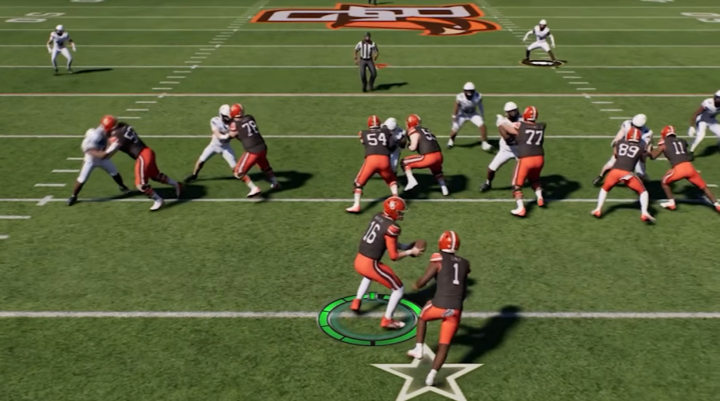
Step 7: Use Quarterback Runs in Short-Yardage Situations
When only one or two yards are needed, quarterback runs become one of the safest offensive options.
Popular concepts include:
QB Zone
QB Blast
QB Power
Wildcat packages
These plays frequently generate positive yardage because the quarterback becomes an additional runner rather than simply handing the ball off.
Instead of risking negative plays, quarterback runs consistently push the offense forward.
Near the goal line, that reliability becomes extremely valuable.
Step 8: Learn the Goal-Line Dolphin Dive
Inside the three-yard line, College Football 27 includes an effective goal-line mechanic.
By pressing forward into the back of your offensive line while holding the dive button, your runner performs a leap over the pile.
When timed correctly, this animation often carries the football across the goal line before defenders can stop forward progress.
However, timing is critical.
Dive too early and you'll receive an ordinary diving animation instead of the elevated leap.
While not guaranteed, mastering this mechanic adds another weapon to your red-zone offense.
Step 9: Build a Small Library of Elite Running Plays
One of the smartest strategies is also the simplest.
Stop calling mediocre plays.
Every playbook contains more than 100 rushing concepts, but only a small percentage consistently outperform the rest.
Instead of trying every available run, identify approximately five to ten concepts that perfectly fit your offense.
Examples include:
Duo
Inside Zone
Halfback Stretch
Jet Touch Pass
Favorite RPO concepts
By specializing in your strongest plays, you'll develop better timing, better reads, and greater confidence.
Quality always beats quantity.
Step 10: Win the Numbers Game With Motion and Jet Sweeps
Pre-snap motion can completely change a defensive look.
Moving a tight end or receiver before the snap can:
Create additional blockers
Reveal man coverage
Improve blocking angles
Remove backside penetration
Open cutback lanes
Motion should become part of every rushing sequence.
Likewise, Jet Sweeps and Jet Touch Passes remain among the most effective perimeter runs in College Football 27.
Against aggressive blitzes, they stretch the defense horizontally before pressure can arrive.
One important distinction is choosing the correct version.
The standard Jet Touch Pass generally performs better because the halfback serves as a lead blocker.
The fake-zone variation often loses that extra blocker, making it significantly less reliable.
These plays excel:
Against heavy blitzes
In short-yardage situations
Inside the red zone
Against overloaded defensive fronts
When used strategically, they provide inexpensive yardage while forcing defenses to defend the entire width of the field.
Final Thoughts
An elite rushing attack in College Football 27 isn't built solely on powerful running backs or dominant offensive linemen. Success comes from understanding defensive tendencies, selecting the right formations, reading blocking assignments, mastering RPOs, using effective ball carrier moves, and making smart pre-snap adjustments.
Rather than relying on every run in the playbook, focus on a handful of high-performing concepts, use motion to gain favorable numbers, and remain patient when reading developing lanes. Combine these techniques with well-timed quarterback runs and goal-line mechanics, and your offense will consistently move the chains while generating explosive touchdowns. Players who master these fundamentals will find themselves controlling the tempo of games and dominating opponents both offline and in competitive online play.