

Summary
Temple juicing remains a powerful but demanding farming strategy in PoE 2 0.5.5. The post-nerf version is harder to maintain because Lock Medallions are no longer available, while Temple destabilization creates additional pressure on large layouts. However, with careful room placement and enough Room Card Medallions, it is still possible to build and sustain a long snake-chain Temple.
The main goal is to stack Temple modifiers that improve monster effectiveness, rare monsters, and item rarity, allowing a single Temple to generate large amounts of raw currency and valuable drops. Here is how to build, sustain, and juice your Temple after the nerfs. To maintain a steady supply of Temple resources and upgrades, buy POE2 Currency and secure the materials you need.
How the Snake-Chain Temple Works
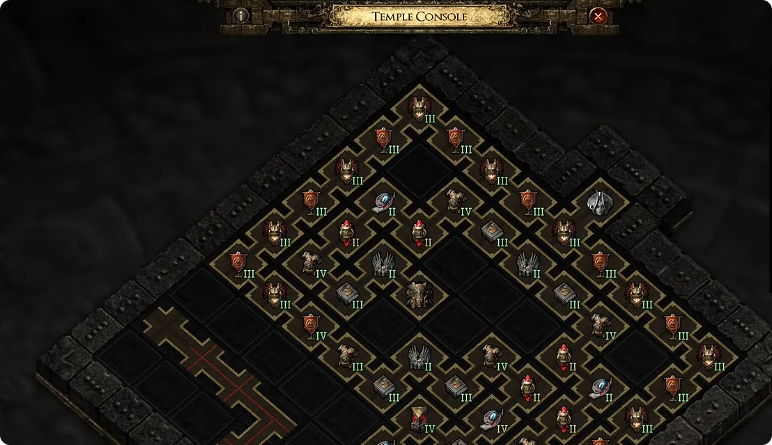
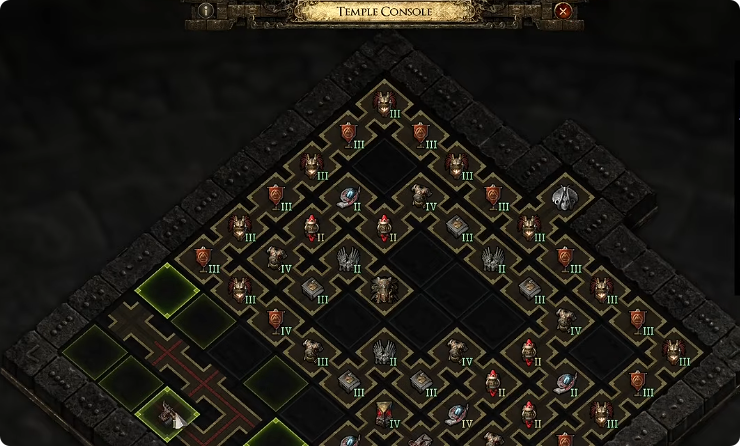
The core of this strategy is connecting rooms into a long chain while keeping the Architect in a carefully selected position. The creator of this strategy sustained a 57-room snake chain for more than 100 Temples, demonstrating that large layouts are still possible in 0.5.5.
Use the Architect as an Anchor
The first room connected to the Architect effectively functions as a free anchor. That room and the rooms behind it in the chain can remain protected from destabilization as long as enough alternative rooms are available to satisfy the Temple's destabilization quota.
This is the most important replacement for the old Lock Medallion approach. If you fail to provide enough alternative rooms, protected rooms can turn into paths and automatically connect to other rooms, potentially destroying your entire chain.
Because of this, the Architect should be positioned deliberately rather than connected as soon as possible. When building the Temple, leave the Architect connection for the appropriate stage of the layout.
Meet the Destabilization Quota
A large Temple can destabilize around nine or ten rooms per round. Since you normally only receive a limited number of rooms naturally, you need Room Card Medallions to provide enough additional options.
Prioritize Tier 3 Commanders
Tier 3 Commanders are particularly important because they have a strong chance of producing Room Card Medallions. The strategy therefore uses many Commanders, not necessarily because their individual modifiers are the best, but because they help sustain the entire Temple.
The creator generally keeps around ten rooms available and uses at least three Room Card Medallions, with four or five being more typical per Temple.
The exact requirement can vary depending on your Temple layout. If you have already allocated Zantippi's medallion, for example, the medallion pool becomes less focused, so you may need a smaller Temple or additional Commanders to maintain the strategy.
Protect the End of Your Chain
Room positioning is another major part of Temple juicing. The creator believes rooms with four adjacent rooms may be more likely to destabilize, while rooms at the open end of a snake chain are more likely to survive.
This behavior has not been fully confirmed, so it should be treated as practical observation rather than a guaranteed rule. Still, it gives you a useful building principle.
Keep the Final Room Open
Whenever possible, connect the end of your chain to an area with few or no adjacent rooms. Avoid creating dense loops because they give the game more potential connections to use when destabilization occurs.
For example, if two identical Alchemy Labs are located in a loop, the room with four adjacent connections may be more vulnerable than the one with an open side.
The same principle applies when expanding the chain: build outward first, keep the newest section open, and avoid accidentally connecting rooms that create unnecessary loops.
Best Rooms for Temple Juicing
Not every room has the same value in a raw-loot Temple. Some rooms are particularly important because they provide currency, rare monsters, or modifiers that improve the rest of the Temple.
Legion Barracks and Alchemy Labs
Legion Barracks are among the most valuable rooms because they provide strong monsters and useful modifiers, particularly increased numbers of rare monsters. Pocket spaces can also make it possible to fit additional Legion Barracks into the layout.
Alchemy Labs are equally important for raw-loot juicing because they provide increased item rarity. They require Thurge rooms to access, so you should plan these connections before building the final chain.
The creator keeps Alchemy Labs at Tier 2 in the snake chain because taking the Tier 3 reward can destabilize the room.
Smithy and Golem Works
Tier 3 Smithy is a special exception. Its Temple currency reward can be taken without destroying the chain, making it one of the safest valuable rewards to collect. Vaal Infusers can be worth more than one Divine Orb, giving Smithy strong currency value.
Golem Works is useful for improving other parts of the Temple and can also provide valuable medallions. Without a generator in the middle of the chain, it can only reach Tier 2.