
Secure checkout · Trusted site

- WEEKEND DROP - EXTRA GOLD BONUS ON SELECTED MMORPG SERVICES -

- WEEKEND DROP - EXTRA GOLD BONUS ON SELECTED MMORPG SERVICES -

Order lookup Help center
  • light
    dark
  • iniciar sesión/ inscribirse
    Access your order center
Sign up to get Coupon with a
Carrito de compras
Pago seguro oSeguir comprando
List of Contents

PoE 2 0.5.5 Temple Farming Guide: How to Juice Temples for 10-20 Divines per Temple

Amélie Laurent

Amélie Laurent

Created: September 15,2026 | POE2 |525 views

Summary

Temple juicing remains a powerful but demanding farming strategy in PoE 2 0.5.5. The post-nerf version is harder to maintain because Lock Medallions are no longer available, while Temple destabilization creates additional pressure on large layouts. However, with careful room placement and enough Room Card Medallions, it is still possible to build and sustain a long snake-chain Temple.

The main goal is to stack Temple modifiers that improve monster effectiveness, rare monsters, and item rarity, allowing a single Temple to generate large amounts of raw currency and valuable drops. Here is how to build, sustain, and juice your Temple after the nerfs. To maintain a steady supply of Temple resources and upgrades, buy POE2 Currency and secure the materials you need.
 poe2

How the Snake-Chain Temple Works

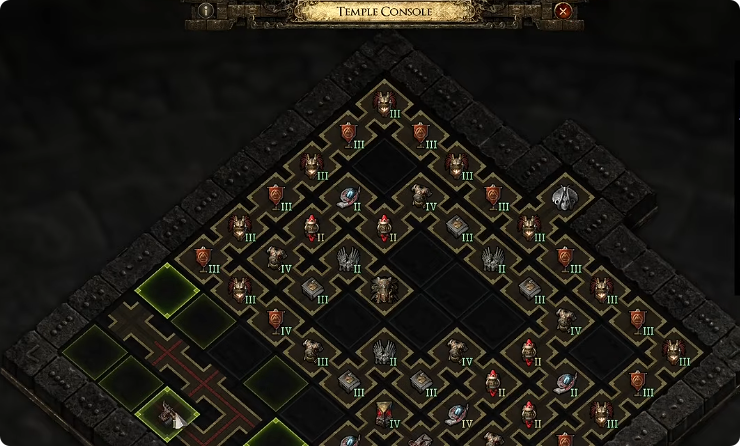
The core of this strategy is connecting rooms into a long chain while keeping the Architect in a carefully selected position. The creator of this strategy sustained a 57-room snake chain for more than 100 Temples, demonstrating that large layouts are still possible in 0.5.5.

Use the Architect as an Anchor

The first room connected to the Architect effectively functions as a free anchor. That room and the rooms behind it in the chain can remain protected from destabilization as long as enough alternative rooms are available to satisfy the Temple's destabilization quota.

This is the most important replacement for the old Lock Medallion approach. If you fail to provide enough alternative rooms, protected rooms can turn into paths and automatically connect to other rooms, potentially destroying your entire chain.

Because of this, the Architect should be positioned deliberately rather than connected as soon as possible. When building the Temple, leave the Architect connection for the appropriate stage of the layout.


Meet the Destabilization Quota

A large Temple can destabilize around nine or ten rooms per round. Since you normally only receive a limited number of rooms naturally, you need Room Card Medallions to provide enough additional options.

Prioritize Tier 3 Commanders

Tier 3 Commanders are particularly important because they have a strong chance of producing Room Card Medallions. The strategy therefore uses many Commanders, not necessarily because their individual modifiers are the best, but because they help sustain the entire Temple.

The creator generally keeps around ten rooms available and uses at least three Room Card Medallions, with four or five being more typical per Temple.

The exact requirement can vary depending on your Temple layout. If you have already allocated Zantippi's medallion, for example, the medallion pool becomes less focused, so you may need a smaller Temple or additional Commanders to maintain the strategy.


Protect the End of Your Chain

Room positioning is another major part of Temple juicing. The creator believes rooms with four adjacent rooms may be more likely to destabilize, while rooms at the open end of a snake chain are more likely to survive.

This behavior has not been fully confirmed, so it should be treated as practical observation rather than a guaranteed rule. Still, it gives you a useful building principle.

Keep the Final Room Open

Whenever possible, connect the end of your chain to an area with few or no adjacent rooms. Avoid creating dense loops because they give the game more potential connections to use when destabilization occurs.

For example, if two identical Alchemy Labs are located in a loop, the room with four adjacent connections may be more vulnerable than the one with an open side.

The same principle applies when expanding the chain: build outward first, keep the newest section open, and avoid accidentally connecting rooms that create unnecessary loops.


Best Rooms for Temple Juicing

Not every room has the same value in a raw-loot Temple. Some rooms are particularly important because they provide currency, rare monsters, or modifiers that improve the rest of the Temple.

Legion Barracks and Alchemy Labs

Legion Barracks are among the most valuable rooms because they provide strong monsters and useful modifiers, particularly increased numbers of rare monsters. Pocket spaces can also make it possible to fit additional Legion Barracks into the layout.

Alchemy Labs are equally important for raw-loot juicing because they provide increased item rarity. They require Thurge rooms to access, so you should plan these connections before building the final chain.

The creator keeps Alchemy Labs at Tier 2 in the snake chain because taking the Tier 3 reward can destabilize the room.

Smithy and Golem Works

Tier 3 Smithy is a special exception. Its Temple currency reward can be taken without destroying the chain, making it one of the safest valuable rewards to collect. Vaal Infusers can be worth more than one Divine Orb, giving Smithy strong currency value.

Golem Works is useful for improving other parts of the Temple and can also provide valuable medallions. Without a generator in the middle of the chain, it can only reach Tier 2.

Commanders, Armories, and Spy Master

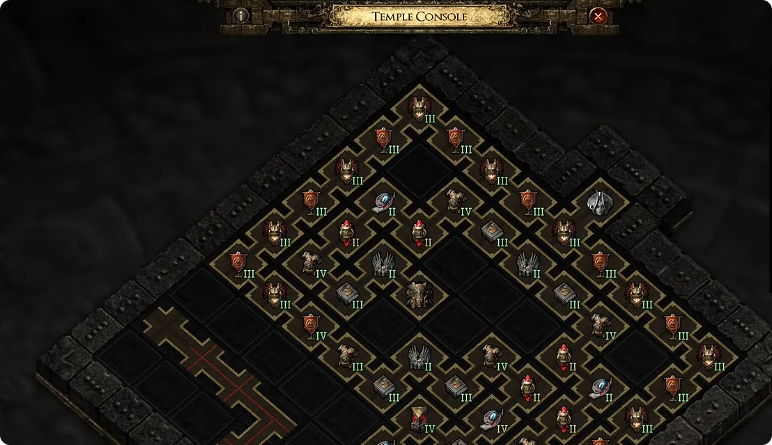
Commanders are primarily used to generate Room Card Medallions and provide large numbers of rare monsters.

Armories are useful connectors for Alchemy Labs, Smithies, Garrisons, and Legion Barracks. Instead of normal monster encounters, they spawn weapon racks, with higher tiers offering more valuable rare items and exceptional bases.

Spy Master can provide some of the best medallions, but only one can safely be used. Multiple Spy Masters can cause a square to become a path and destroy the chain, so avoid placing more than one.

 poe2

Rooms You Should Not Loot

Some high-tier Temple rooms should never have their rewards taken while they are part of the snake chain.

Tier 3 or Tier 4 Alchemy Labs, Sacrificial Chambers, and Corruption Chambers can destabilize once their reward device is used. Claiming these rewards can therefore turn the room into a path and break the layout.

Tier 3 Smithy is the important exception because its Temple currency can be collected safely.


How to Farm Crystals

A strong Temple strategy requires a constant supply of Crystals. The creator prefers Cleanse Map farming because these maps can be cleared quickly and efficiently while also working well with juiced Temple tablets.

Maximize Rare Monsters

When preparing maps for Crystal farming, increased numbers of rare monsters is one of the most important tablet modifiers. Rarity is also useful because the Temple strategy relies heavily on valuable item drops.

Tier 16 maps with Irradiated provide area level 81, while Doryani can be used to farm Crystals. Linear maps are particularly effective because they reduce travel time and let you activate Vaal Beacons, kill rare monsters, defeat the boss, and move on quickly.

JOE is also useful because his options can improve tablet effectiveness, while Untold Histories can provide additional value through Diala-related drops.


How Much Can a Juiced Temple Make?

The initial Temple may appear unimpressive, but its modifiers become increasingly powerful as the layout develops. The creator reports an average value of roughly 10-20 Divine Orbs per Temple, with around half of that value coming from raw Divine Orb drops.

Other valuable drops include Greater Chaos, Perfect Jeweller's Orbs, Perfect Regals, Nullman Orbs, level 20 gems, exceptional bases, Diala's Desire, and other high-value items. Extremely valuable jackpot drops such as Mageblood, Headhunter, and Lock of Kandra are also possible.


Practical Temple-Building Strategy

Start by building the outside portion of the chain and prioritize Commanders so that you have enough Room Card Medallions to sustain future rounds.

Whenever you reach the end of the chain, connect toward an open area with as few adjacent rooms as possible. Avoid loops and preserve open-ended rooms for the most vulnerable sections of the Temple.

Once the chain is sufficiently developed, connect it to the Architect in the planned position. Continue checking the number of available rooms against the destabilization requirement instead of simply placing every possible room.

In some situations, leaving one space empty can be better than spending another medallion. The creator found that certain layouts could destabilize ten rooms with seven empty spaces, while another breakpoint could reduce that number to nine with eight empty spaces. Sustaining the Temple through bad RNG is generally more valuable than squeezing a little additional loot from a single round.

 poe2

Is Temple Juicing Worth It?

PoE 2 0.5.5 Temple juicing has a steep learning curve, but it remains a viable high-investment farming strategy after the nerfs. The key is not simply filling the Temple with valuable rooms. You need to understand the Architect anchor, maintain the destabilization quota, protect the end of the snake chain, and avoid using rewards that destroy critical rooms.

For players willing to plan their layouts carefully and continuously farm Crystals, a large juiced Temple can provide strong raw currency, valuable bases, experience, and occasional jackpot drops. It is complicated, but that complexity is also what makes the strategy rewarding. To fund the Crystal farming and Temple upgrades needed for this setup, POE2 Currency can help you keep the strategy running.

Temple juicing remains a powerful but demanding farming strategy in PoE 2 0.5.5. The post-nerf version is harder to maintain because Lock Medallions are no longer available, while Temple destabilization creates additional pressure on large layouts. However, with careful room placement and enough Room Card Medallions, it is still possible to build and sustain a long snake-chain Temple. The main goal is to stack Temple modifiers that improve monster effectiveness, rare monsters, and item rarity, allowing a single Temple to generate large amounts of raw currency and valuable drops. Here is how to build, sustain, and juice your Temple after the nerfs.
About the Author
Amélie Laurent
Amélie Laurent
Builds game-related side projects in her free time — little tools and prototypes, mostly in Unity and web tech. The same builder mindset drives her platform work: if something is slow or broken, she takes it apart and fixes it. Obsessive about Core Web Vitals because a laggy page kills the same dopamine as a laggy boss fight.