


Summary
College Football 27 recruiting has plenty of strategies circulating online, but not all of them are accurate. One popular “playing time cheese” claims that A+ playing time prospects are more likely to have Star or Elite development traits. Multiple recruiting examples suggest otherwise, College Football 27 Coins, making scouting and player gems far more reliable.
College Football 27 Recruiting: The Playing Time Myth
Recruiting is one of the most important systems in College Football 27, especially for Dynasty players trying to build a powerhouse program. With so many prospects available, coaches naturally look for shortcuts that can identify future stars without spending hours scouting every player.
One of the most popular shortcuts is filtering recruits by their Playing Time grade. The theory is simple: if a prospect has an A or A+ Playing Time grade, they supposedly have a better chance of having a Star or Elite development trait.
However, this strategy appears to be nothing more than a recruiting myth.
What Does the Playing Time Grade Actually Mean?
The biggest problem with the theory is that the Playing Time grade is not designed to predict development traits.
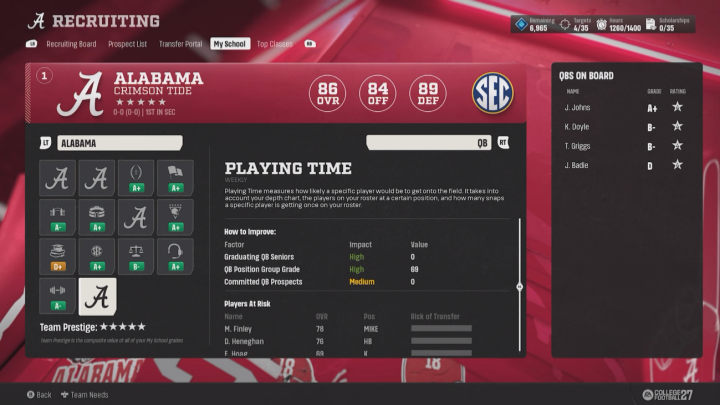
In College Football 27, Playing Time measures how likely a recruit is to get onto the field based primarily on your current roster situation. The game considers factors such as your depth chart, the number of players already occupying a position, and the potential number of snaps available.
In other words, an A+ Playing Time grade basically means:
“This player has a good opportunity to play for your team.”
It does not mean:
“This player has a Star or Elite development trait.”
That distinction is extremely important when building a Dynasty roster.
A+ Playing Time Does Not Guarantee a Great Prospect
Several recruiting classes provide a good demonstration of why this strategy fails.
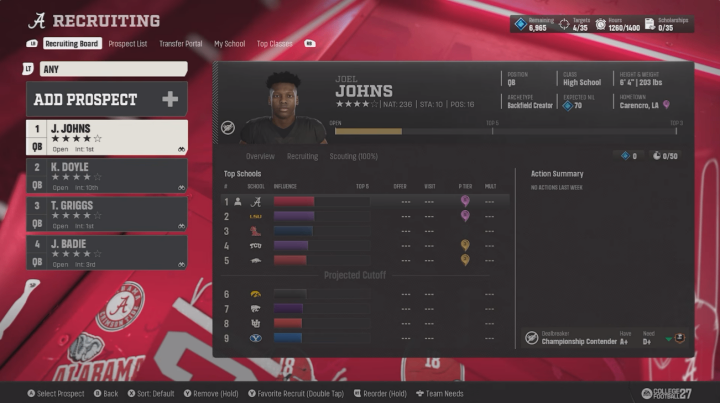
For example, one class contained four four-star quarterbacks with Playing Time grades ranging from A+ to D. If the popular recruiting theory were accurate, the A+ prospect should have been the obvious choice.
Instead, the A+ quarterback had a Normal development trait.
Another prospect with a B- Playing Time grade also had Normal development. Meanwhile, the player with the D grade had an Impact development trait.
This immediately creates a problem for the Playing Time theory.
If the highest-rated Playing Time prospect can have Normal development while a low-rated prospect has Impact development, the grade clearly cannot be used as a reliable indicator of future development.
More Recruiting Examples Make the Myth Even Weaker
One example could easily be dismissed as bad luck. However, looking at multiple recruiting classes tells a much different story.
In another class, several prospects had A+ Playing Time grades. Some were four-star quarterbacks, while others were highly rated prospects. Yet the results were mostly Normal or Impact development traits.
The same pattern appeared repeatedly.
A+ prospects were not consistently producing Star or Elite development traits. In fact, some of the best development traits appeared on prospects with average or even poor Playing Time grades.
This is particularly important because Dynasty players could easily spend hours targeting A+ prospects while completely overlooking the players who actually have better long-term potential.
Even Five-Star Recruits Are Not Safe
You might think the strategy becomes more reliable when dealing with five-star recruits.
Unfortunately, that doesn't solve the problem.
Even highly rated five-star prospects with excellent Playing Time grades can have disappointing development potential. A five-star recruit with an A+ Playing Time grade can still end up with an Impact or Normal development trait.
That means the Playing Time strategy doesn't suddenly become useful simply because you move up the recruiting rankings.
A highly rated recruit can still be a poor long-term investment if their other scouting information isn't impressive.
The Biggest Surprise: Low Playing Time Can Hide Elite Talent
Perhaps the strongest evidence against this recruiting strategy comes from the opposite situation.
In one recruiting class, a prospect near the bottom of the Playing Time rankings turned out to have a Star development trait.
That is exactly the type of player the Playing Time strategy would encourage you to ignore.
The same thing happened with Elite development prospects. Players with average Playing Time grades were able to outperform prospects sitting at the very top of the Playing Time list.
In one class, multiple Elite development players appeared without having the highest Playing Time grades.
This shows why using Playing Time as your primary scouting filter can actually cause you to miss some of the best recruits.
Why Playing Time Grades Can Be Misleading
The reason this system can be manipulated is fairly straightforward.
Imagine your quarterback room has several strong players already on the roster. A high school quarterback looking at your program may receive a poor Playing Time grade because there simply aren't enough snaps available.
Now imagine the opposite scenario.
If you have almost no quarterbacks on the roster, suddenly many quarterback prospects can receive A or A+ Playing Time grades.
The recruits themselves haven't changed.
Their development traits haven't changed.
Your roster situation has changed.
That's why Playing Time should be viewed as a roster-management tool, rather than a scouting tool.
What Should You Use Instead?
If your goal is to find future stars in College Football 27, you should pay much more attention to actual scouting information.
Player ratings, skill information, scouting results, and especially prospect gems can provide much more useful information when deciding which recruits deserve your attention.
Green gems are particularly valuable because they can indicate a prospect with stronger potential than their initial ranking suggests.
Instead of automatically signing every A+ Playing Time prospect, compare players across multiple factors.
Look at their position, ratings, physical attributes, skill caps, scouting information, cheap CFB 27 Coins, and gem status. This gives you a much more complete picture of a recruit's potential.
Final Verdict: Stop Chasing A+ Playing Time
The evidence from multiple recruiting classes strongly suggests that Playing Time grades should not be used to predict development traits in College Football 27.
A+ Playing Time does not automatically mean Star or Elite development. Likewise, a B, C, or even D grade does not automatically mean a prospect is bad.
Playing Time simply tells you how much opportunity that recruit is likely to have based on your current roster and depth chart.
For serious Dynasty players, the better strategy is to scout the player instead of chasing the grade.
Don't recruit the A+ Playing Time grade. Recruit the player.
If you're looking for the best long-term talent, prioritize scouting information and prospect gems rather than relying on a supposed Playing Time “cheese” that can easily lead you toward Normal and Impact prospects while causing you to overlook hidden Star and Elite recruits.