Weekend Drop -













Summary
Following a powerful build guide does not guarantee that your character will deal the same damage as the creator's version. If you are struggling to push higher Pit tiers or your damage numbers seem far below the guide's results, the problem is usually not the build itself. It is often caused by missing multipliers, underleveled Paragon and Glyphs, weak affixes, or poor damage scaling. To fix these issues, you can also buy Diablo 4 Gold to afford better gear and materials.
Understanding how Diablo 4 Season 14 damage is calculated can help you identify exactly where your build is losing power.
Understand Additive and Multiplicative Damage
The first step is understanding the difference between additive and multiplicative damage.
Additive Damage Is Combined Into One Pool
Stats such as increased Critical Strike Damage, Vulnerable Damage, elemental damage, and general increased damage are grouped together as additive damage. These bonuses are combined into a large pool before your other multipliers are applied.
For example, increased Critical Strike Damage and increased Physical Damage do not create completely separate damage calculations. They are added together in the same general additive category.
This means stacking one type of additive damage endlessly is usually inefficient. Once you already have a large amount of one multiplier, adding another type can often produce better results.
Most additive damage comes from the Paragon system, especially as you level your Paragon boards and Glyphs. This is one reason a build creator at Paragon 300 can deal significantly more damage than someone using the exact same gear and skills at a lower Paragon level.
Multiplicative Damage Multiplies Your Entire Damage Pool
Multiplicative bonuses are marked with an "X." These bonuses are applied separately and multiply your total additive damage.
This creates a major difference between simply adding more damage and adding a new multiplier. Several moderate multipliers can often outperform one extremely high damage stat because they multiply each other.
This is why damage optimization is not simply about finding the largest number on an item.
Vulnerable and Critical Strike Damage Are Essential
Two of the most important damage mechanics are Vulnerable and Critical Strike damage.
Activate Your Critical Strike Bonus
Every Critical Strike naturally receives an inherent damage bonus. However, you must actually trigger Critical Strikes consistently to benefit from your Critical Strike Damage stats.
This is why Critical Strike Chance is often just as important as Critical Strike Damage. A character with enormous Critical Strike Damage but poor Critical Strike Chance may perform worse than a build with slightly lower Critical Strike Damage but consistent critical hits.
Your gear, skills, and build mechanics should work together to activate this multiplier reliably.
Always Find a Way to Apply Vulnerable
Vulnerable is another major source of damage. Enemies that become Vulnerable receive an inherent damage increase, even if your gear does not contain a large amount of Vulnerable Damage.
This makes reliable Vulnerable application extremely valuable. If your build can consistently activate Vulnerable, you gain access to a major damage multiplier before even considering additional Vulnerable Damage on your gear.
For many builds, adding Vulnerable Damage can outperform simply stacking more elemental or physical damage.
Stop Stacking Only One Damage Multiplier
One of the biggest mistakes players make is putting all their investment into a single damage category.
Spread Your Multipliers Efficiently
Critical Strike Damage often has higher available rolls than other stats, making it tempting to stack it everywhere. However, stacking only Critical Strike Damage can produce diminishing returns compared with spreading your investment across multiple multipliers.
A build with several different damage multipliers can often deal substantially more damage than one with a higher total amount concentrated in a single category.
The goal is not to find the biggest individual number. The goal is to create a combination of multipliers that increases your entire damage calculation.
Small Percentage Gains Become Huge Later
A small increase can become extremely valuable once it is multiplied by your other bonuses.
For example, a 20% damage improvement may appear small when your character is dealing thousands of damage. However, after your aspects, Paragon bonuses, Glyphs, and other multipliers are applied, that same percentage can represent millions or even billions of additional damage.
This is why replacing a small amount of one damage type with a more efficient multiplier can create a surprisingly large improvement.
Upgrade Your Gear in the Correct Order
Your gear quality is another major reason your character may not match a build guide.
Greater Affixes Provide a Major Boost
Greater Affixes increase the base value of an affix significantly. A high-quality normal affix and a Greater Affix with the same stat can produce a major difference in the final result.
If your build guide uses several Greater Affixes while your gear has none, you should not expect identical damage numbers.
After building a solid baseline set, your next goal should be replacing your equipment with high-value Greater Affix items.
Masterworking Multiplies Important Stats
Masterworking increases the value of your gear's affixes. The most important improvement comes from Masterworking critical hits, which heavily increases the selected affix.
You should carefully choose which affixes to Masterwork. Improving the wrong stat can waste valuable materials and leave your character significantly weaker than it could be.
The best strategy is to identify the most important damage multipliers for your build and focus your Masterworking upgrades on them.

Level Your Paragon and Glyphs
Paragon progression is one of the most overlooked sources of damage.
Paragon Levels Add More Than You Think
Higher Paragon levels provide access to more nodes, more main stat, and more additive damage. A build creator with Paragon 300 may have a substantial advantage over a player still progressing through the Paragon system.
If your gear looks similar but your damage is much lower, your Paragon level may be the biggest reason.
You should also remember that defensive nodes are important during progression. More damage does not help if your character cannot survive the content required to level further.
Glyph Levels Are Major Damage Multipliers
Glyphs can provide both additive damage and powerful multipliers. The difference between a low-level Glyph and a fully upgraded Glyph can be enormous.
Because multiple Glyphs contribute to your build, the combined effect of leveling all of them can dramatically increase your total damage.
If your Glyphs are not fully leveled, you may be missing a significant amount of damage even if your gear is already strong.
Use the Cube to Build a Strong Baseline
If you have access to the expansion, the Cube can help you create a reliable starting set of Legendary gear.
Craft Your Core Gear First
The Cube allows you to create specific Legendary items with the affixes required by your build. This is an excellent way to establish a strong baseline instead of waiting for perfect random drops.
However, the Cube cannot create Greater Affixes. Once your baseline gear is complete, your next goal is to replace those pieces with stronger Greater Affix versions.
This creates a simple progression path: first build the correct gear, then improve its quality.
Use Training Dummies to Test Your Damage
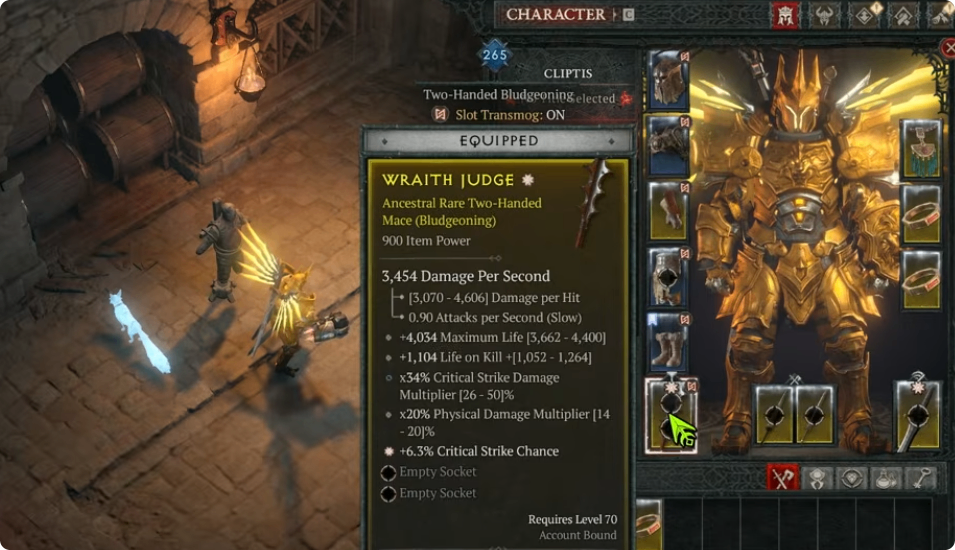
Finally, use training dummies to test changes instead of relying only on random gameplay numbers.
Enable damage variance settings appropriately and test one change at a time. Compare different combinations of Critical Strike Damage, Vulnerable Damage, elemental damage, and other multipliers.
This allows you to determine which upgrade actually improves your build.
The most important lesson is that damage comes from the interaction between many systems. Your Paragon level, Glyphs, affixes, Greater Affixes, Masterworking, aspects, and damage multipliers all work together.
If your character is not hitting as hard as the build guide, do not immediately assume the build is broken. Check your multipliers, activate Vulnerable and Critical Strikes consistently, level your Paragon and Glyphs, upgrade your aspects, and prioritize the correct Masterworking targets. Small improvements across multiple systems can eventually create a massive difference in Season 14 endgame damage. If you need a boost, Diablo 4 Gold can fund your upgrades and get you back on track.