Weekend Drop -








If you have already invested time and VC into a Season 1 player, keep using it while you evaluate the new GOAT Builds. Continue upgrading only for a specific improvement you need now. A GOAT template is worth developing when it fixes a repeated matchup problem or fills a role your current player cannot cover.
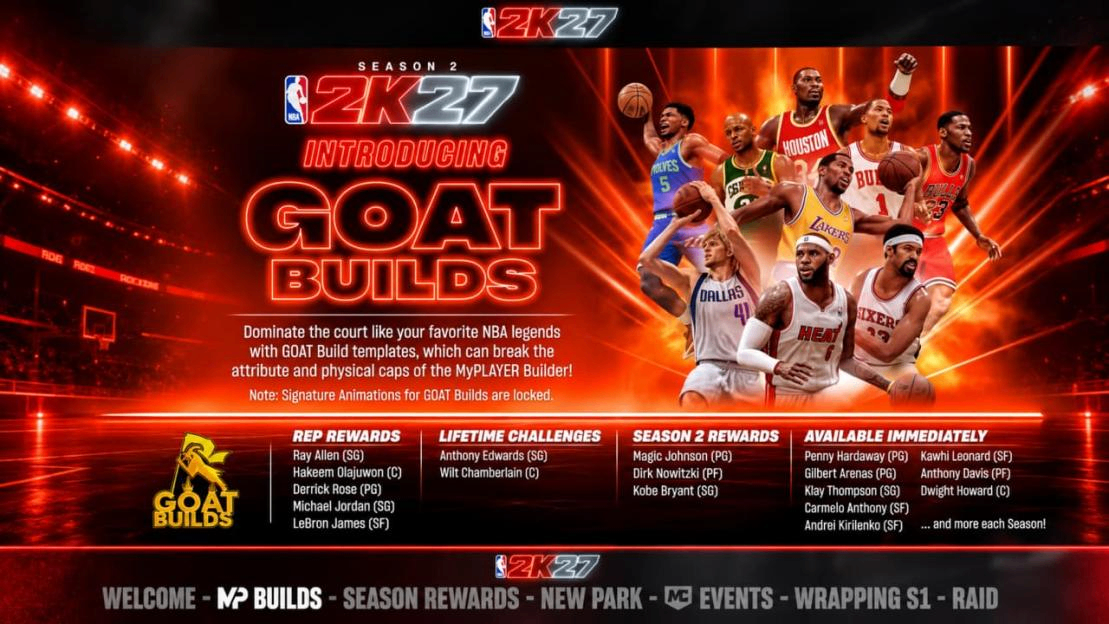
NBA 2K27 Season 2 introduces eight immediate templates on October 16 and ten progression unlocks. Their cap advantages are real. Whether those advantages make your particular player uncompetitive requires a closer comparison.
Will GOAT Builds Make Your Current Build Obsolete?
GOAT Builds do not automatically make every NBA 2K27 custom build obsolete. They can combine physical traits and attributes outside normal Builder limits, which is a genuine competitive advantage. That advantage alone does not establish how much value your Season 1 investment has lost or whether you need a replacement.
Locked signature animations are a real restriction, but they are not proven to balance every template. A higher shooting rating does not guarantee better results with an unfamiliar fixed jumper.
A creator relying on specific custom dribble moves may lose actions central to the offense. Conversely, a player already comfortable with the GOAT package may find that restriction less costly.
For inside centers, prioritize the physical, rebounding and finishing matchup; for creators, weigh the fixed movement package; for off-ball shooters, weigh the release and defense. Those are different exposure points, not evidence that one position has already been displaced.
For a developed player, distinguish three decisions. Keep using it while it performs its role. Fund another upgrade only if it fixes a current weakness. Switch when an actual template offers a useful improvement you can afford, supported by relevant attributes and gameplay in your mode. Do not infer replacement from a single loss or an overall-rating comparison.
Future power creep remains a planning risk, not a confirmed schedule of stronger templates. No choice guarantees you will never want another build. Protect unspent VC by developing one needed role at a time; wait for matchup evidence when your current player already does the job.
Your Situation | What to Do |
Your current build still performs reliably. | Keep your current build. |
Your current build has a clear weakness. | Compare the relevant GOAT template. |
You rely on custom dribble moves or a specific jumper. | Check locked animations first. |
Your VC budget is limited. | Avoid funding a second build yet. |
You have not invested in a new player. | Compare GOAT and custom builds before committing. |
GOAT Builds vs Regular Builds
NBA 2K27 Season 2 GOAT Builds recreate NBA stars with preset attributes and signature animations, and can exceed normal MyPLAYER Builder physical and attribute caps. Badges, Cap Breakers and Takeovers remain customizable.
Feature | Regular Custom Build | GOAT Build |
Attributes | Allocate potential within Builder limits. | Preset player profile; normal limits can be exceeded. |
Physicals | Choose a body within standard restrictions. | Template can exceed standard physical limits. |
Signature animations | Select eligible animations. | Player's signature package is locked. |
Badges and Takeovers | Configure eligible options. | Customization remains available within the build's options. |
Cap Breakers | Apply supported increases. | Supported; preview actual gains and ceilings. |
VC | Potential and developed ratings are separate. | No confirmed universal upgrade total or free fully developed player. |
Existing save | Your established player. | New Builder path; conversion and spent-VC transfer unconfirmed. |
The official example is Magic Johnson: a Create Your Own point guard has a 6'7" height limit, while his GOAT Build exceeds it with elite playmaking. Magic unlocks later; the example establishes a creation advantage without supplying exact speed or passing ratings
Fixed Actions and Flexible Systems
The developer explanation uses LeBron to illustrate the signature restriction: substituting a Kevin Durant and Oscar Robertson jumper would defeat the template's player identity.
Expect to use the GOAT player's signature shooting and dribbling package. The complete list of locked slots, release-speed editing and exceptions still needs confirmation.
Badge customization lets you change eligible setups, not grant every Badge at maximum tier. Standard 2K27 rules allow token reassignment, while event-earned tokens have discipline restrictions. Takeover customization likewise does not mean every option starts unlocked.
Cap Breakers are permanent allocations. General rules allow at most five applications to one attribute, with body-related ceilings; Build Specialization rewards stay in their category or go to Free Throw. These tools can refine a template, but a plan depending on them must use the actual previewed gain.
VC Costs and Your Existing Build
Separate template access, creation and development when planning NBA 2K27 VC. The official list confirms eight immediate options through the GOAT Builds path, without the later players' progression requirements. It does not establish eight fully upgraded characters, a separate creation fee, a starting upgraded overall or a uniform cost to maximize them.
The access route is MyPLAYER Builder. An existing-save conversion preserving upgraded attributes, a spent-VC refund and a transfer of story progress are not confirmed. Deleting your developed save is not an established conversion step.
Rebirth offers a head start for a subsequent MyPLAYER. Support specifically confirms that NBA 2K27 Rebirth immediately unlocks a percentage of default Badge Tokens, with more unlocked at higher Rebirth levels.
Unlocking maximum potential is different from having funded, upgraded ratings. GOAT-specific Rebirth eligibility and starting ratings still need confirmation on the actual creation screen.
For a first MyPLAYER, consider a GOAT preset when you want its role and signature style; choose custom creation when a particular animation setup is essential. For either path, budget for usable upgraded ratings rather than eventual potential.
Eight Day-One Role-Based Picks
These NBA 2K27 recommendations are role-based picks, not a verified strength ranking. Kawhi appearing first does not establish that he is the strongest template. Attribute checks identify relevant requirements; they are not published values or guaranteed Badge thresholds.
Player | Position | First Consideration | Main Tradeoff |
Kawhi Leonard | SF | Two-way wing assignment. | Fixed handling may conflict with your creation style. |
Klay Thompson | SG | Off-ball shooting alongside a creator. | Limited value if he duplicates your current role. |
Dwight Howard | C | Interior work with coordinated spacing. | Paint-dependent lineups can crowd each other. |
Anthony Davis | PF | A broader defensive-big assignment. | Stretch duties require actual shooting capability. |
Penny Hardaway | PG | Tall-guard organization. | Adapting from small-guard movement. |
Gilbert Arenas | PG | Scoring-led guard creation. | Can duplicate an existing lead scorer. |
Carmelo Anthony | SF | Wing isolation scoring. | Needs possessions to justify that role. |
Andrei Kirilenko | SF | Defensive utility alongside scorers. | Offensive demands must match available tools. |
Kawhi and Kirilenko for Defensive Wings
Kawhi is the first shortlist for guarding a dangerous perimeter scorer while contributing without dominating possessions. Prioritize perimeter defense, agility and strength, then the shooting needed to finish kick-outs. For random REC, that assignment can remain useful even when someone else controls the offense.
Compare Kirilenko when your group needs varied defensive coverage alongside established scorers. Regularly containing one wing scorer and covering varied matchups are different jobs. Use the actual mobility and shooting profile to decide between them.
Klay for Shooting Guards
Klay is the first candidate for receiving kick-outs, relocating and finishing possessions while another player creates the opening. The key checks are shooting, perimeter defense and enough handling to respond when a defender closes out. His fixed jumper must work on those actual shots, without assuming his name guarantees an easier release.
If you play random REC and already have a developed shooting guard, my recommendation is to keep that player unless Klay solves a documented weakness. Reliable open shooting and adequate defense already cover the same assignment.
Klay becomes relevant if your current guard cannot perform a required defensive job or lacks a useful capability his actual template provides. If your frustration is receiving too few passes, another off-ball shooter does not change who controls the ball.
That makes NBA 2K27 VC better directed toward a proven improvement than a duplicate role. In a fixed group with a dependable creator and an open shooter slot, Klay has a clearer reason to be developed.
Dwight and AD for Big-Man Roles
Dwight is the first shortlist for screening, finishing near the basket and rebounding in an organized lineup. Interior defense, block, rebounding, strength and finishing are the relevant evaluation areas. Teammates who provide outside shooting give that specialist role room to operate.
In Park 3v3, a paint-dependent center alongside two guards who need to drive creates a spacing problem: all three want access to the same lane. The concern is stronger if nobody can punish a defender staying near the basket.
Dwight makes more sense with perimeter threats and an agreed screen-and-roll role. In random REC, you have less control over whether another interior scorer joins you.
Compare AD first when your big must leave the paint on offense or handle defensive movement away from the rim. Shooting, mobility and passing then become requirements alongside interior contribution.
AD is not automatically a stretch solution. If his actual tools cannot cover that job, retain your stretch or use a custom design.
Penny and Arenas for Lead Guards
Penny is the first shortlist for a larger organizer; Arenas is the alternative when the group primarily needs scoring-led creation. For Penny, prioritize passing, ball handling and speed with ball. For Arenas, evaluate the shooting and handling needed to create shots while retaining enough passing for teammates.
In a fixed group, decide who initiates possessions before developing either. Pairing multiple players who expect to run every attack can waste their intended roles.
or Park, a guard must also handle the defensive assignment created by the group's lineup; size alone does not establish that Penny wins that comparison. Players relying on a specific custom dribble sequence should evaluate the signature package before changing their offense.
Carmelo for a Scoring Wing
Carmelo fits a team that needs a second creator against a set defense. Prioritize the shooting and handling used for those possessions, with finishing or post tools only where they belong in your offense. A fixed group can deliberately give him that work, giving your NBA 2K27 VC investment a defined purpose.
For low-touch random REC, I would shortlist an off-ball or defensive role first. A wing chosen for isolation contributes less of its intended value when another scorer already takes those possessions. Carmelo becomes more relevant when teammates want wing creation rather than another player waiting for kick-outs.
All 18 GOAT Builds and Unlocks
NBA 2K27 Season 2 announces 18 GOAT Builds across four access routes. Season level, REP and Lifetime Challenges are separate requirements; reaching one does not substitute for another.
GOAT Build | Unlock Requirement |
Penny Hardaway | Available immediately through GOAT Builds path |
Gilbert Arenas | Available immediately through GOAT Builds path |
Klay Thompson | Available immediately through GOAT Builds path |
Carmelo Anthony | Available immediately through GOAT Builds path |
Andrei Kirilenko | Available immediately through GOAT Builds path |
Kawhi Leonard | Available immediately through GOAT Builds path |
Anthony Davis | Available immediately through GOAT Builds path |
Dwight Howard | Available immediately through GOAT Builds path |
Magic Johnson | Season 2 Level 26 |
Dirk Nowitzki | Season 2 Level 33 |
Young Kobe Bryant | Season 2 Level 37 |
Ray Allen | Elite V REP |
Hakeem Olajuwon | Elite V REP |
Derrick Rose | Elite VIII REP |
Michael Jordan | Elite VIII REP |
LeBron James | Legend I REP |
Anthony Edwards | 300 Lifetime Challenges |
Wilt Chamberlain | 350 Lifetime Challenges |
For a realistic next target, start from your current progress. The Season rewards give defined level checkpoints; Jordan, LeBron and Wilt require their separate REP or challenge milestones. Their position on a longer progression path does not establish stronger performance or a predictable number of matches to unlock them.
Wait for Magic if tall-guard playmaking is the role you want and your current guard covers matches meanwhile. Delay a second scoring guard if you specifically want to compare Young Kobe.
Players already close to a relevant REP or challenge milestone have a stronger reason to consider that option than players starting the same grind from far behind.
Keep that timeline separate from your VC budget. Unlocking the desired player answers access; its development cost and usable playing state remain another decision.
Before You Spend VC
Use one final sequence in NBA 2K27:
1. Open MyPLAYER Builder and select the GOAT Builds path. Confirm your candidate is available through the requirement listed above.
2. Match its actual attributes, eligible Badges and Takeovers to the specific REC, Park or fixed-team job you chose. Preview any necessary Cap Breakers.
3. Inspect the fixed signature package. Where a playable preview is available, repeat the shots and actions your role requires, including closeout responses or ball creation.
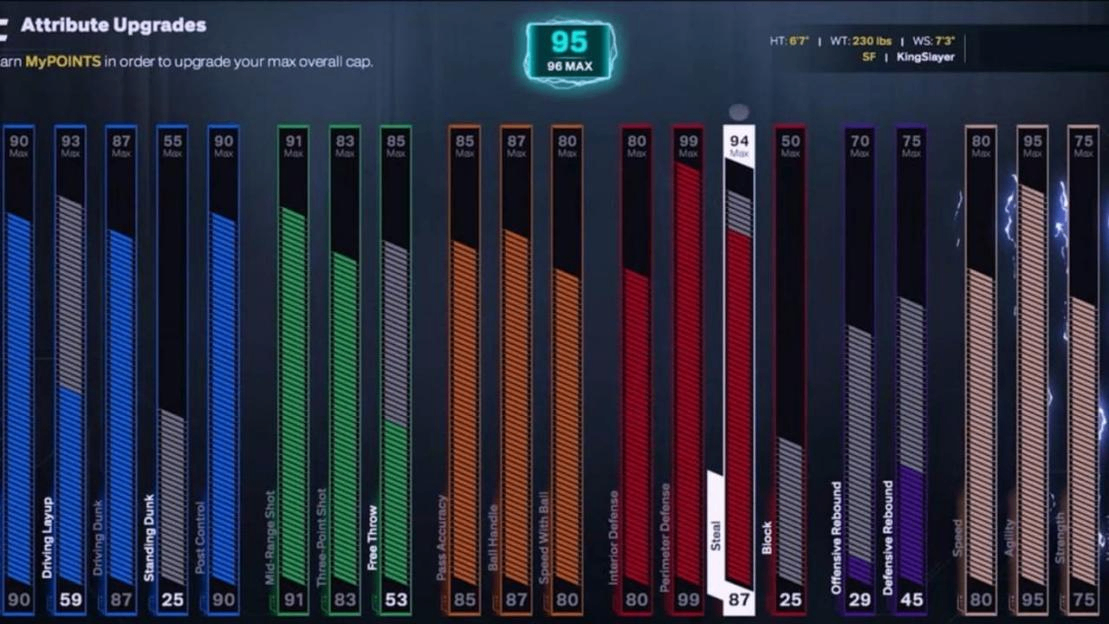
4. At creation, verify any displayed charge, Rebirth choice and starting upgraded ratings. At the upgrade screen, select your intended allocation and read its VC total before confirming.
5. Develop the candidate if that role, signature package and affordable playing state improve your options. Otherwise, retain the player already doing the job.
A new template earns its place by solving a problem you actually encounter.