






Summary
There is a strange point in Old School RuneScape where your account is clearly no longer mid-game, yet it still feels nowhere close to endgame.
You might already have a Fire Cape, a Dragon Defender, a Whip or Fang, OSRS gold, decent combat levels and a bank worth hundreds of millions of GP. But then you look at high-level PvM, raids, the Inferno or the hardest Combat Achievements and realize there is still a huge amount to learn.
The key is that OSRS endgame progression isn't simply about buying the most expensive gear. It is about building an account that has the stats, unlocks, equipment and PvM experience to handle a wide range of content.
Get Your Combat Stats Into the 90s
One of the simplest improvements is also one of the most important: train your main combat stats.
A practical late-game target is around 90+ Attack, Strength, Defence, Ranged and Magic, although exact requirements depend heavily on the content you're planning to do. Current progression guides similarly use roughly 90+ combat as a late-mid-game milestone before players move toward raids and harder PvM.
This is also why buying another expensive armour upgrade is not always the best next step.
If you're sitting at 80 Ranged, putting money into training toward 90 may improve your account across every ranged activity instead of helping with just one setup.
The same logic applies to Magic, Strength and Attack.
Unlock Piety, Rigour and Augury
Prayer should be one of the biggest priorities on an aspiring PvM account.
Piety requires 70 Prayer and 70 Defence, while Rigour requires 74 Prayer and 70 Defence plus the Dextrous Prayer Scroll. Augury requires 77 Prayer and 70 Defence plus the Arcane Prayer Scroll.
These prayers become part of the foundation for late-game melee, ranged and magic setups.
That means a Prayer unlock can provide more account-wide value than simply buying another piece of conventional armour.
Build a Flexible PvM Gear Setup
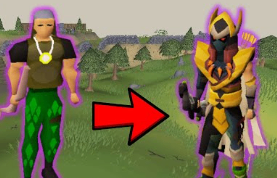
You don't need to immediately own every Best-in-Slot item.
For ranged, the Bow of Faerdhinen with Crystal Armour remains a major progression milestone because it gives players a powerful ranged setup without requiring a Twisted Bow.
For melee, a Fang is useful across many high-defence encounters, while specialized special-attack weapons become increasingly important as you move into serious PvM.
Weapons such as the Dragon Warhammer, Bandos Godsword and Dragon Claws each fill different roles depending on the boss or raid.
The important question is not simply "what is the most expensive upgrade?" but "what content am I trying to unlock?"
Don't Ignore Your Quality-of-Life Upgrades
Late-game inventories become increasingly crowded with food, potions, restores, switches, special weapons and runes.
That's why utility upgrades can become extremely valuable.
A Divine Rune Pouch upgrades the standard Rune Pouch to four rune types and requires 75 Crafting plus a Thread of Elidinis from Tombs of Amascut.
A strong Player-Owned House is another long-term account investment. A rejuvenation pool, altar, jewellery box, portal infrastructure and other utilities can dramatically reduce the friction between PvM trips.
This isn't glamorous progression, but it is the kind of infrastructure that makes an account feel complete.
Finish the Quests, Diaries and Unlocks
Endgame PvM is built around account unlocks.
Quests such as Dragon Slayer II, Monkey Madness II, Song of the Elves, Desert Treasure II, Beneath Cursed Sands and Sins of the Father open important areas, bosses, equipment and spell options.
Achievement Diaries should also be part of the progression plan. Hard Diaries are especially useful milestones, while Elite Diaries can provide stronger account-wide rewards.
The goal isn't simply collecting quest points. It is removing the account restrictions that stop you from entering content.
Start Doing Difficult PvM Before You're "Ready"
This may be the biggest difference between a strong account and a genuinely experienced PvM account.
You don't become good enough for difficult PvM and then start learning it.
You start learning it, die repeatedly, understand the mechanics and gradually become better.
That might mean learning a DT2 boss, Zulrah, Muspah, raids, Nex, the Colosseum, Inferno or another encounter that currently feels intimidating.
Recent OSRS progression guides similarly frame late game around strong stats, meaningful PvM experience and eventually raids rather than simply accumulating expensive items.
Use Combat Achievements to Improve Your PvM

Combat Achievements are especially useful because they force you to understand encounters rather than simply farm kills.
Instead of killing a boss the same way 100 times, an achievement might require specific mechanics, timing, restrictions or kill conditions.
That naturally improves movement, prayer switching, attack timing, gear switching and boss-specific decision-making.
You don't need to jump straight into the hardest tasks. Start with achievable milestones and gradually work upward.
What Actually Makes an OSRS Account Endgame?
There isn't one official checklist that suddenly transforms an account into an endgame account.
A better way to look at it is whether your account has enough stats, quests, gear, buy OSRS gold, infrastructure and experience that very little content is completely blocked off.
You don't need every Best-in-Slot item.
You don't need every 99.
And you don't need to wait until your bank is enormous before learning difficult PvM.
The real late-game transition happens when you're no longer asking, "What should I buy next?"
You're asking, "What do I want to do next, and what does my account need to get there?"
That is what turns an OSRS account from a collection of levels and items into a flexible endgame PvM account.