









Summary
Bottom line: Dark Spear Islands is a reskinned Eye of the Storm, but it replaces the channeled flag capture with a direct flag tap — faster pace, more rotation-friendly. You win by holding multiple bases, not by killing the enemy team, and the same principle applies whether you're chasing rating or farming WoW Forever Gold. Here's a full breakdown of the rules, the map, the scoring logic, class roles, and the decision-making that actually wins games.

1. Core Rules
Format: 15 vs 15
Factions: Alliance base and Horde base on opposite ends of the map
Bases: 4 total — Camp, Ruins, Abandoned Tower, and Shipwreck Cove
Center mechanic: A flag spawns in the middle of the map that can be picked up and carried back
Win condition: First team to reach 2000 points
Capture style: Walk up and tap the flag — no channel required, unlike EOTS. This is widely considered a huge quality-of-life improvement
Water: Falling in kills you. Sharks attack you in the water. You cannot swim across
Scoring comes from two sources stacked together:
Passive base income — the more bases you control, the faster your score climbs
Flag running — grab the center flag and bring it to a friendly base for bonus points
This creates the core logic of the entire match: bases are your baseline income, flag runs are your bonus. Kills alone score nothing, and turtling one base will lose to a team controlling multiple.
2. Map Layout and Terrain
Base Distribution
The four bases surround a central body of water, with the Alliance and Horde bases at opposite ends. Teams meet in the middle to fight over the central flag. A common opening split is: one group to each side base, and a group in the middle for the flag.
Abandoned Tower: The Strongest Defensive Position Right Now
The tower lets players go up to the top, and ranged classes can defend from above. The practical takeaway is clear: a single ranged class holding the tower is nearly impossible for melee to take. Compare this to the Mines in Arathi Basin — at least there you have to jump down to spin the flag. On this tower, you can sit on top, DPS, CC, and stall indefinitely, even just running up and down in circles to prevent the cap.
Conclusion: The tower is the biggest balance concern in the current version. If your team wants to take it, you need enough ranged pressure or a way to force the defender down. If you're holding it, parking a mage or hunter up there pays off enormously.
Water: Not Decoration — a Death Zone
Falling in the water kills you. This has been confirmed in practice. Water serves three purposes:
Blocks flanking — you can't swim around the map edge to back-cap
Limits positioning — fights near the water's edge must respect knockback and displacement abilities
Can be used deliberately — if you're being chased and can't escape, jumping in the water denies the kill and respawns you at the graveyard quickly
Note that the knockback interaction with water isn't fully consistent — sometimes you can jump it, sometimes you can't. Don't rely on it as a movement tool.
3. Scoring Logic and In-Match Decision Making
Core Principle: Bases Over Kills
This is the most common mistake. Kills do not score points. Base control scores points. If your whole team is teamfighting mid while nobody caps, the score doesn't move. The correct priority is:
Cap if you can → if you can't cap, stall their cap → if you can't stall, rotate to another base.
Rotating Beats Turtling
With four bases, there are always multiple scoring sources on the map. There's a cap on how many people are needed to defend a base, and any extra bodies on defense are wasted.
The rule is simple: leave just enough people to stall the attackers, and send everyone else back to offense or flag running. If the enemy commits 8 players to one base, they're weak somewhere else. Abandon the contested base and hit where they're thin — that's the fundamental trade of base-control maps.
How to Use the Flag Correctly
Flag running is how you break a stalemate. When both teams hold two bases and gain points at the same rate, the central flag's bonus points are the only way to pull ahead.
Key points for flag running:
Pick a mobile flag carrier: Druids, rogues, and mages with movement or stealth are ideal
Protect the carrier with CC, not kills: Roots, slows, fears, polymorphs — just get the carrier home
Run to the nearest safe friendly base: Greedy long runs usually end in an intercept
Stalling Is Also Scoring
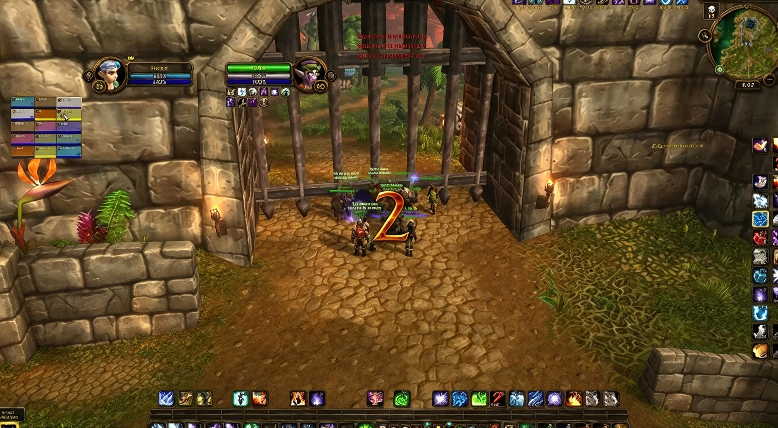
There's a textbook example in the footage: repeatedly Mind Controlling the enemy priest at Ruins, using the immunity window from MC to avoid damage while denying the cap. The result: the enemy is stalled, they don't get the base, and your score keeps climbing.
This is the advanced play for this battleground — you don't have to kill anyone. You just have to make sure they can't cap.
4. Class Role Reference
Role | Examples | Primary Job |
Sneak / back-cap | Rogue, Druid | Solo or small-group caps on undefended bases |
Rotate / flag run | Druid, Mage, Hunter | Fast support, carry the flag, intercept enemy carriers |
Base defense | Mage, Hunter, Warlock | Use tower and high-ground terrain to stall large numbers |
Heal / support | Priest, Paladin, Shaman | In small fights, stall far more enemies than your numbers suggest |
Frontline DPS | Warrior, Death Knight, Rogue | Open-field fights, intercepting flag routes |
Melee classes need to be especially careful about the tower. Against ranged on top, melee has almost no answer — charging the tower is just feeding. If your team lacks ranged pressure, skip the tower and pressure other bases instead.
5. Common Mistakes
Mistake 1: Kill first, cap later. Kills generate no score. Caps generate score. If your team only teamfights, the score won't move.
Mistake 2: Everyone rotates to defense. Defense has diminishing returns. Once you have enough to stall, everyone else should be back on offense or flag duty.
Mistake 3: Ignoring the center flag. In even matches, flag points are the difference-maker. Abandoning the flag entirely hands the initiative to the enemy.
Mistake 4: Force-taking the tower. Tower defense is currently overtuned. Without ranged pressure, attacking it is pure donation. The correct play is to give up the tower, build an advantage elsewhere, or fight the defenders after they come down.
6. Conclusion
Dark Spear Islands is built around fast-paced multi-base control. Direct flag tapping removes channel time and makes rotations and back-caps more frequent. Water lethality limits flanking routes. The tower offers a high-value but controversial defensive perch. If you'd rather spend your time mastering these mechanics than grinding for currency, you can Buy WoW Forever Gold to fund your gear and consumables — and for a reliable, secure option, MMOEXP is a trusted marketplace worth checking out for fast delivery and competitive prices.
The winning formula is:
Hold more bases → let passive income build → use flag runs to pull ahead → use stalls to stop the enemy from catching up.
Remember: points come from time spent controlling bases, not from kills. The team that understands this first owns Dark Spear Islands.