Weekend Drop -












Summary
Development traits are important in College Football 27 Dynasty, but they should never be the only factor you use when evaluating recruits or deciding which players deserve playing time. A player with Normal development can sometimes become significantly better than a player with Impact, Star, or even Elite development if he enters your program with the right physical attributes. To find these hidden gems, buy CUT 27 Coins and unlock premium scouting tools that reveal a player's true potential.
The key is to evaluate development trait + starting attributes + skill caps together.
Why Development Trait Isn't Everything in CFB 27
Development traits determine how efficiently players can progress, so higher development is obviously valuable. However, progression points are limited, and some attributes are extremely expensive to improve.
That creates an important Dynasty principle:
Do not spend your progression points fixing an attribute that should have been good when the player entered your program.
Speed, acceleration, strength, and other physical traits can cost huge amounts of skill points. If a recruit already has elite physical ability, you can spend those points developing cheaper football skills instead.
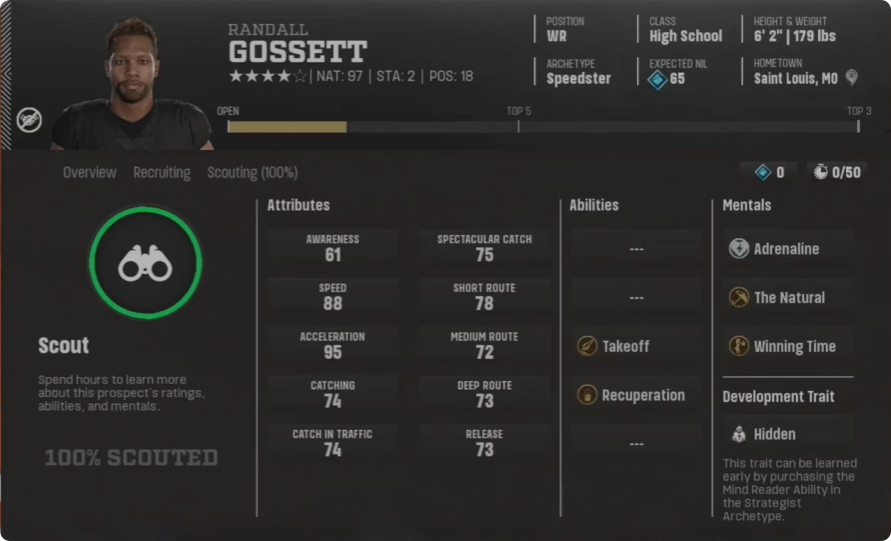
The 97-Speed Normal Development Receiver
Consider a group of four true freshman receivers. Three are Speedster archetypes, but their development traits and physical attributes are different.
One has Impact development, another has Normal development, another is a Gadget Impact player, and another has Normal development. There is also a redshirt freshman Route Artist with Elite development.
The player who stands out is the 97-speed Speedster with Normal development.
His acceleration is only 89, but he already has the elite speed you want from the archetype. You never need to spend 20 or more progression points trying to make him fast. Instead, you can invest in:
Catching
Route running
Elusiveness
Awareness/IQ
Other football skills
That makes his progression much more efficient.
Meanwhile, an Impact Speedster with only around 92 speed may look better because of his development trait. But if you have to spend 20 points just to upgrade his speed and barely see an improvement, those points are no longer available for catching, routes, and other important attributes.
Over several seasons, the Normal-development player can become the better receiver simply because he started with the physical tools you actually wanted.
Skill Caps Can Change the Entire Evaluation
Starting attributes are only half of the equation. You also need to inspect skill caps before deciding which recruit has the better long-term future.
For example, consider two three-star Backfield Creator quarterbacks.
One has Star development and 92 throw power. The other has Impact development and 94 throw power.
At first glance, the Star player might seem like the obvious choice. But if his throw power is already capped for his entire career while the Impact player can continue improving, the development trait alone tells you very little.
The Impact quarterback could ultimately provide more value if his physical attributes and skill caps give him more room to grow.
Use the Same Rule at Every Position
The principle applies across your entire roster:
WR: Prioritize speed or acceleration.
QB: Pay close attention to throw power and accuracy caps.
OL: Strength is extremely important.
DL: Look for strong starting strength.
CB: Speed is one of the most valuable starting attributes.
Other positions: Identify the physical attribute that defines the archetype and avoid recruits who need to spend huge amounts of progression points fixing it.
You can develop football skills over time, but trying to turn a physically limited recruit into an elite athlete can consume your entire progression budget.
How to Scout Speedster Receivers
Speedster receivers provide one of the clearest examples of this strategy.
When scouting them, you will often see a tradeoff between speed and acceleration. A recruit might have:
98 speed / 89 acceleration
88 speed / 96 acceleration
92 speed / 92 acceleration
The first two profiles can each be valuable because they specialize in one elite physical attribute. The third is more mediocre because it lacks both elite speed and elite acceleration.
Speed vs. Acceleration
If a Speedster has high acceleration, he may be able to reach important abilities such as Takeoff. If another has elite speed, he can create separation without requiring you to spend progression points on speed.
Therefore, a recruit with a lower development trait but 98 speed can be more attractive than a recruit with Elite development and mediocre speed.
Even if the Elite player eventually becomes a higher overall, the faster player may be more effective on the field because speed matters so much against man coverage.
With man coverage being particularly difficult to beat, every bit of athleticism can help win individual reps.
Don't Let a Gem Recruit Fool You
The same mistake can happen with offensive linemen.
Imagine scouting several three-star Raw Strength offensive linemen and finding a Gem with 83 strength. The Gem designation and potentially high development trait might make him look exciting.
But if another recruit has 89 strength and Normal development, the 89-strength player can be the better long-term investment.
Why?
Because you can spend progression points improving the 89-strength player's other skills without constantly trying to fix his physical limitation.
The 83-strength Gem may require expensive progression just to reach an acceptable strength level.
A recruit being a Gem does not automatically make him better than a lower-development recruit with superior starting attributes.
Manual Progression Makes This Even More Important
Testing progression with default XP sliders and the 25% manual progression penalty demonstrates the problem.
One 97-speed Normal-development receiver received only 27 skill points in his first progression period. Another Speedster with 92 speed received 24.
The 97-speed player did not need to spend points on speed. His progression could immediately focus on catching and eventually route running and awareness.
The 92-speed receiver, however, needed to spend 20 points attempting to improve speed—and his speed did not even increase. His acceleration only improved by one.
That is an enormous opportunity cost.
Elite Development Does Not Automatically Mean Efficient Development
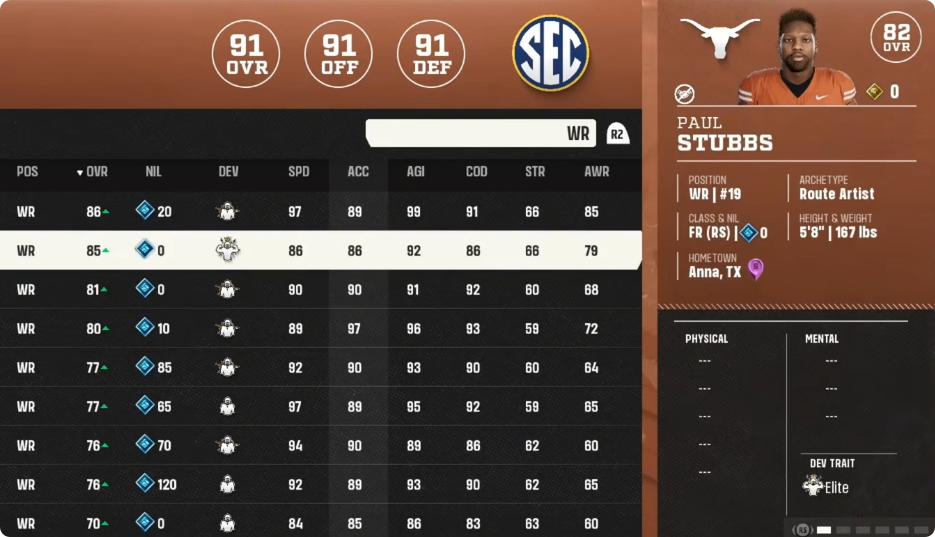
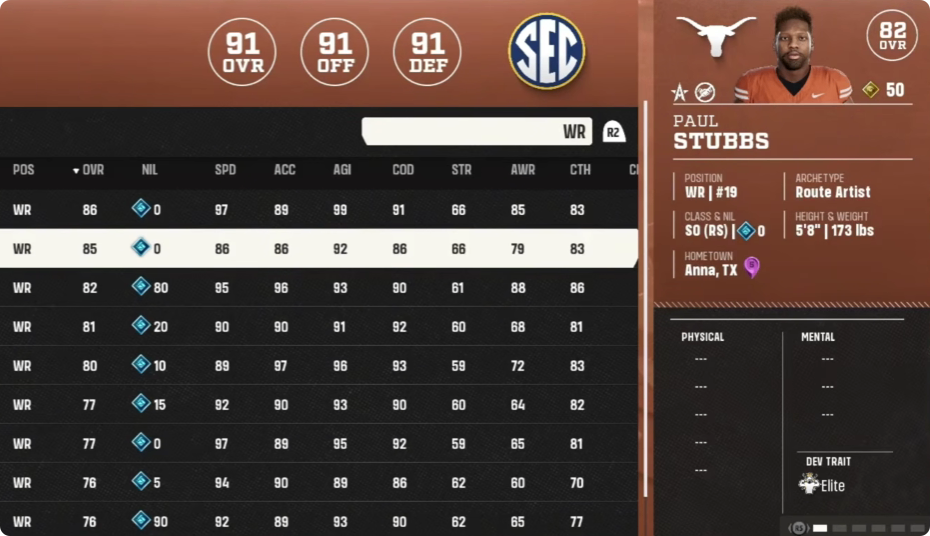
An Elite Route Artist received around 50 skill points, giving him much more progression to work with. However, his starting speed was only around 86.
Spending roughly 40 points on speed produced only about +3 speed and +4 acceleration.
That is not useless, but compare it with a receiver who already entered the program with 97 speed. The faster player can use his progression almost entirely on football skills.
By his redshirt-senior season, the Elite Route Artist can become a good receiver, but he will probably never become truly fast.
That is why it would have been better to recruit a Route Artist who already had around 92–93 speed rather than spending years trying to manufacture that athleticism.
Auto-Progression Makes Starting Attributes Even More Valuable
Starting physical attributes become even more important if you rely on auto-progression.
The CPU can make questionable progression decisions. A slow receiver might have points invested into speed even when you would rather improve his receiving skills. Defensive backs can also receive progression in attributes that do not make much sense for their role.
You cannot always control those decisions with auto-progression.
Therefore, recruiting players who already possess the physical traits you want reduces the chances that future progression points are wasted.
The Best Dynasty Recruiting Rule
When evaluating recruits, do not ask only:
"What is his development trait?"
Instead, ask three questions:
1. What physical attributes does he already have?
2. What are his skill caps?
3. How much of my progression budget will I need to spend fixing him?
A Normal-development receiver with 97 speed and good skill caps can be more valuable than an Elite-development receiver with poor speed.
An Impact quarterback with strong throw power can beat a Star quarterback whose power is already capped.
A Normal-development offensive lineman with 89 strength can be a better investment than an Elite-development Gem with 83 strength.
A fast cornerback with lower development can likewise be more valuable than a slower corner with Elite development, because coverage skills can be developed while speed is much harder and more expensive to fix.
Final Takeaway
Development traits still matter in CFB 27 Dynasty. You should absolutely consider Impact, Star, and Elite players when recruiting and developing your roster.
But development traits should be one part of the evaluation, not the entire evaluation.
The best recruits are players who combine a useful development trait with strong starting physical attributes and favorable skill caps.
If a player already has the speed, acceleration, strength, or throw power you need, you can spend future progression points improving the skills that actually make him better at his position.
Recruit the physical tools first, check the skill caps second, and use development traits as the final piece of the puzzle. That approach can help you build better players without wasting valuable progression points trying to fix weaknesses that should have been avoided during recruiting. To execute this strategy effectively, CUT 27 Coins unlocks premium scouting and recruiting tools for deeper player insights.