










Summary
College Football 27 features a fully data-driven recruit generation system with fixed annual player pools, non-traditional star rating ranges, and heavily localized talent distribution. Unlike previous franchise entries, star tiers no longer guarantee superior overall ratings, with elite three-star prospects capable of outperforming average four-star recruits. Specific positions have hard-coded five-star generation locks, while gem and bust traits follow strict statistical odds based on recruit star levels. This guide breaks down every core mechanic, explains gameplay implications, and delivers actionable strategies to maximize recruiting success for both powerhouse and rebuild dynasty teams in CFB 27. Understanding how to manage CUT 27 Coins alongside your recruiting resources can further help you build a stronger roster and make more efficient Dynasty decisions.
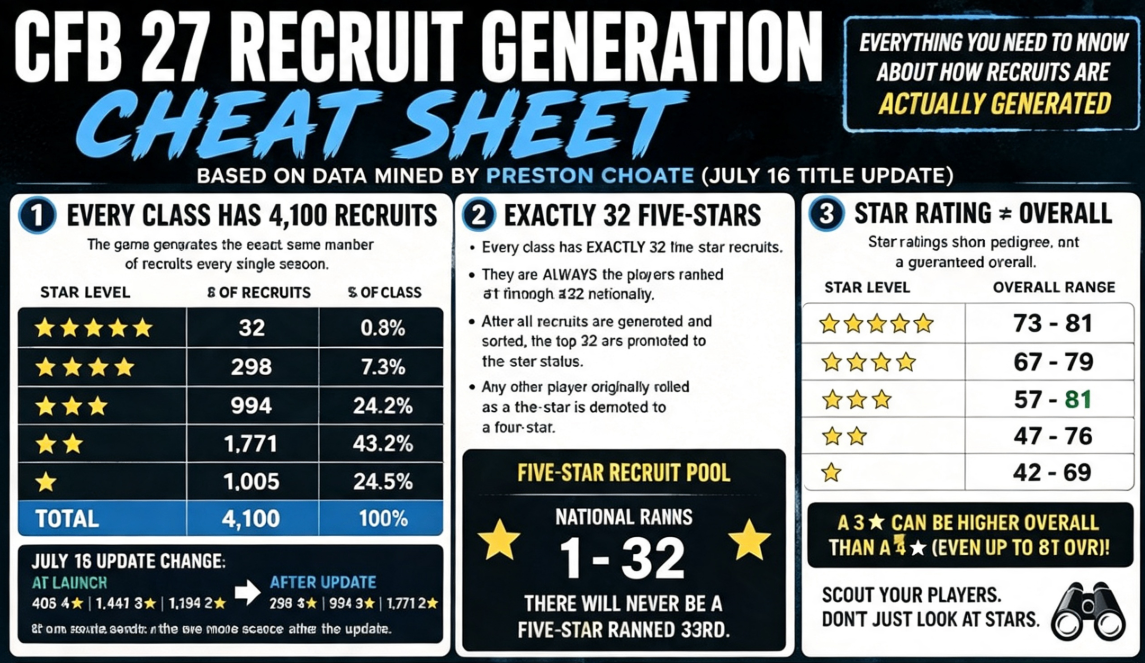
Fixed Annual Recruit Pool & Star Tier Breakdown
CFB 27 generates a static pool of approximately 4,100 recruits for every new dynasty season, with rigid population percentages for each star tier. This fixed structure completely reshapes roster planning compared to older College Football titles with variable talent spawning.
Each season contains exactly 32 five-star recruits, accounting for 8% of the total class. These top 32 ranked prospects are the only five-star players available; no recruit ranked 33rd or lower can receive five-star designation, even if internal generation rolls favor higher talent.
Four-star recruits total 298 players (7.3%), three-stars hit 994 players (24.2%), two-stars dominate the pool at 1,771 players (43.2%), and one-stars round out the class at 505 players (12.5%). Post-launch minor updates have slightly reduced elite and mid-tier recruit frequency, making efficient scouting more critical than ever.
Overlapping Overall Rating Ranges Break Traditional Star Logic
The most game-changing CFB 27 recruit mechanic is its non-linear overall rating system, where star pedigree does not equal on-paper talent. This invalidates classic recruiting strategies that prioritize star count above all else.
Five-star recruits carry a 73–81 overall range, while four-star prospects sit at 67–79 overall. Shockingly, three-star players feature a 57–81 overall range, meaning top-tier three-stars can match the game’s maximum possible recruit overall and outperform nearly all four-star talents.
Two-star recruits range from 47–76 overall, and one-stars span 42–69 overall. This system creates massive value in three-star gem hunting, a meta shift that heavily benefits mid-major and rebuild teams with limited recruiting resources.
State Talent Pipeline & Position Spawning Restrictions
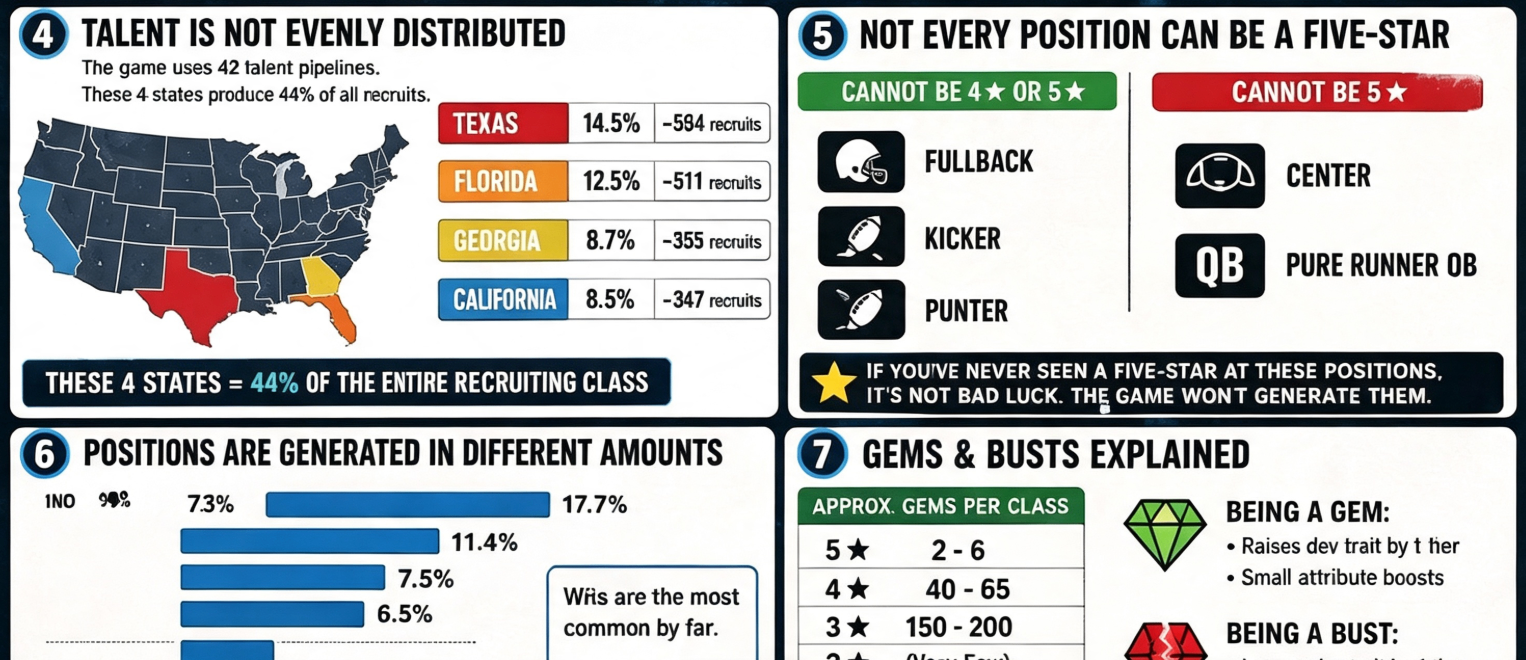
CFB 27 concentrates nearly half of all national talent in just four talent-rich states, creating massive geographical recruiting disparities across dynasty mode. Texas, Florida, Georgia, and California combine to produce 44% of every annual recruit class.
Texas leads all regions with 14.5% of total recruits (594 players), followed by Florida at 12.5% (511 players), Georgia at 8.7% (355 players), and California at 8.5% (347 players). Programs based in these states gain permanent recruiting advantages regardless of NIL or dynasty point investment.
Strict position generation rules eliminate five-star prospects entirely for specific roles. Pure running quarterbacks, centers, kickers, and punters cannot spawn as five-star recruits. Fullbacks are locked out of both four-star and five-star tiers entirely.
Position frequency also varies drastically. Wide receivers make up 17.7% of all recruits and running backs 11.4%, creating endless depth for skill positions. Defensive roles like safeties and centers are extremely scarce, making elite defensive line and secondary recruits far more valuable.
Gem, Bust & Development Trait Odds
Every recruit generates with fixed development trait rules, with gem and bust status directly altering long-term player progression. Gem traits raise a prospect’s development tier and grant small attribute boosts, while bust traits lower development tiers and apply minor attribute penalties.
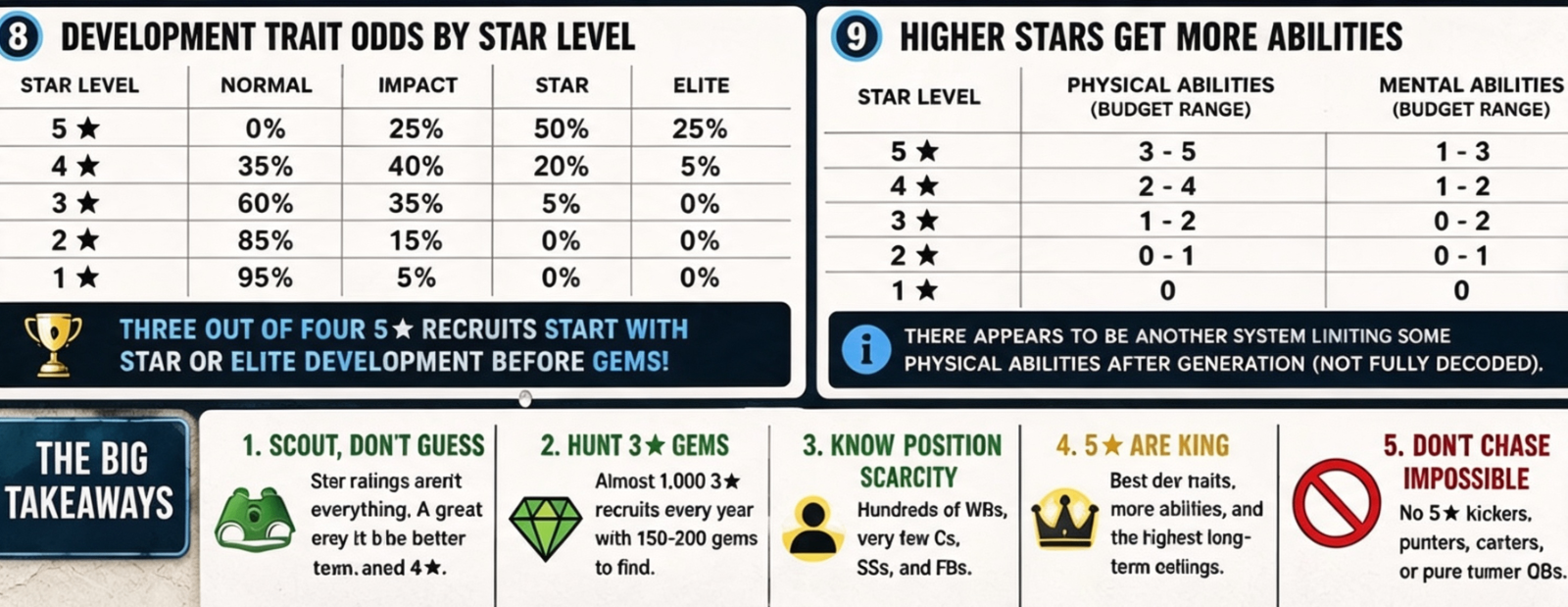
Five-star classes spawn 2–6 gems per season with a 25% elite development chance and 50% star development rate. Four-stars see 40–65 annual gems, featuring 5% elite, 20% star, 40% impact, and 35% normal development odds.
Three-stars offer 150–200 yearly gems with zero elite potential but a 5% star development chance, making them the best value recruit group for budget programs. One and two-star recruits have negligible gem spawn rates and no high-tier development traits.
Higher star tiers also unlock more ability bonuses. Five-stars gain 3–5 physical and 1–3 mental abilities, four-stars earn 2–4 physical and 1–2 mental abilities, while three-stars only unlock 1–2 physical and 0–2 mental traits.
Meta Player Recruiting Recommendations
Prioritize three-star scouting for rebuild teams. With hundreds of high-ceiling three-star gems spawning yearly, these prospects deliver four-star and five-star equivalent talent without elite recruiting competition.
Avoid chasing impossible elite positions. Never waste recruiting efforts on five-star kickers, punters, centers, or pure running quarterbacks, as these recruits cannot spawn in the game.
Leverage geographical talent advantages. Programs in Texas, Florida, Georgia, and California should prioritize in-state recruiting for consistent elite talent access, while out-of-state teams must focus on three-star gem hunting to compete.
Scout by overall rating, not star tier. Always evaluate individual player ceilings instead of star labels to uncover hidden three-star studs and avoid overrated low-ceiling four-star prospects.
Final Verdict
CFB 27’s revamped recruit generation system delivers the most balanced and strategic dynasty recruiting meta in franchise history. The overlapping rating ranges, fixed talent pools, and localized spawn rules eliminate lazy star-chasing tactics and reward detailed scouting and strategic planning. Three-star gem hunting emerges as the definitive meta for all team types, closing the gap between powerhouse programs and rebuild rosters. Mastering these hidden generation rules is essential for building dominant, sustainable rosters and outperforming opponents in every CFB 27 dynasty season. For players looking to strengthen their recruiting strategy and optimize their overall progression, knowing when to buy College Football 27 Coins can provide additional flexibility when managing resources throughout the season.