







Summary
CFB 27 completely overhauled its dynasty progression system, tying all prestige growth and dynasty point gains to six core school grade categories. Unlike previous series entries, every grade features unique weight multipliers, variable improvement difficulty, and long-term program impacts. Many players waste seasons upgrading low-impact grades while ignoring meta priorities that drive recruiting hours, budget expansion, and roster growth. This 2026 updated guide ranks all six dynasty school grades by practical value, breaks down upgrade methods, and shares optimal strategies for both online leagues and offline dynasty rebuilds. Players can also use College Football 27 Coins to support roster development and make key progression upgrades more efficiently.
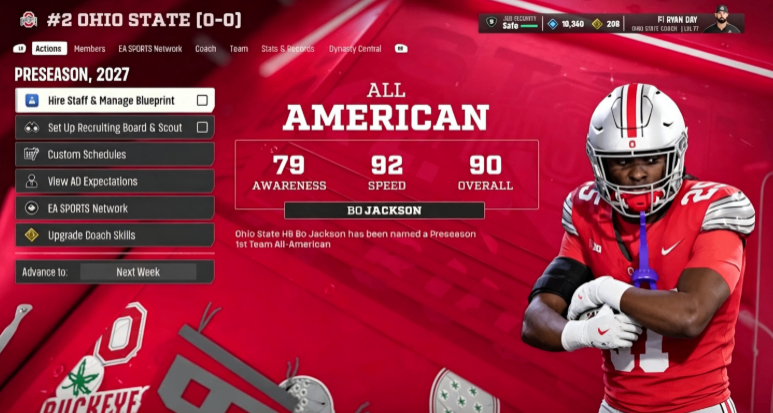
How CFB 27 Dynasty Grades Power Program Growth
All dynasty progression in CFB 27 revolves around the My School tab’s six grading categories. These grades directly determine team prestige, annual dynasty point budget, and total recruiting hours. Higher prestige unlocks better recruit pulls, improved roster quality, and faster program dominance.
Each grade carries different weight values for prestige scaling and budget gains. Some deliver instant, controllable improvements, while others require multi-season grinding with inconsistent returns. Successful dynasty builds rely on prioritizing high-reward, low-effort grades first to snowball program growth early.
Ranked Dynasty School Grades (Best to Lowest Priority)
1. Brand Exposure (Highest Priority)
Brand Exposure is the undisputed meta grade in CFB 27, offering the largest dynasty point budget boost and top-tier team prestige multiplier. It measures national program attention based on the last five seasons of gameplay.
Players can boost this grade consistently by scheduling nationally televised games, winning weekly featured matchups, and securing repeated playoff and national championship appearances. Unlike other grades, Brand Exposure decays with inactivity, meaning underperforming elite programs will slowly lose grade value over time. Consistent seasonal success guarantees permanent exponential dynasty budget growth.
2. Program Tradition
Program Tradition ranks second due to its long-term dynasty stability and controllable growth paths. It evaluates historical program success through national championships, playoff appearances, Heisman winners, conference titles, and bowl game participation.
While legacy powerhouse schools start with higher baseline grades, new rebuilds can steadily improve by prioritizing annual bowl eligibility, frequent conference championship runs, and consistent playoff berths. Heisman trophy wins add substantial value, though voting mechanics are inconsistent and harder to manipulate through stat padding in CFB 27.
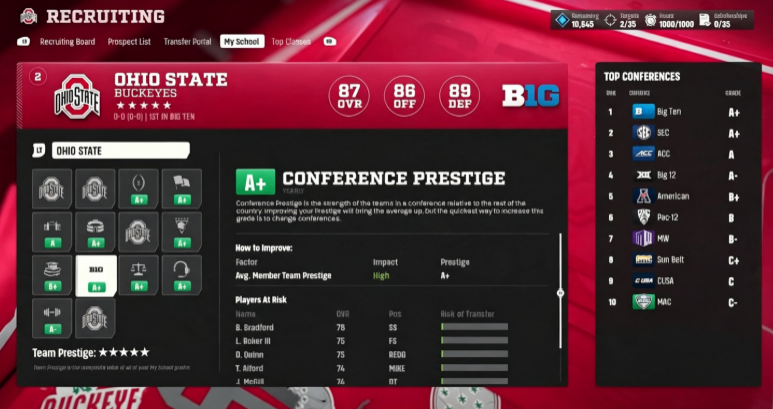
3. Conference Prestige
Conference Prestige delivers maximum prestige multiplier benefits and defines a program’s ceiling. It measures the overall strength of a school’s conference compared to national competitors.
The fastest upgrade method is transferring to Power 5 conferences including the SEC, Big 10, ACC, and Big 12. Lower-tier conferences like the MAC require 10+ perfect seasons to see minor grade improvements, making conference switching the most practical strategy for online league players. Filling user rosters in major conferences creates permanent high-prestige environments for all teams.
4. Championship Contender
Championship Contender rating tracks a program’s national title odds via poll rankings and blue-chip roster ratio. This grade is extremely easy to manipulate for quick early-season gains.
Players can instantly boost their blue-chip ratio by cutting 2-star and 3-star depth players while retaining all 4-star and 5-star recruits. Consistent match wins and top-25 poll placements further elevate this grade. Its only limitation is partial external control, as tough online league competition can hinder win totals and poll progression.
5. Pro Potential
Pro Potential shares top-tier prestige weighting but ranks lower due to its four-year rolling rotation system. It evaluates draft talent across eight positional groups, excluding special teams.
Past draft success expires annually, causing unpredictable grade fluctuations even with strong current roster talent. The pre-order Pro Pipeline package stabilizes this grade significantly, but vanilla game players will struggle to maintain consistent ratings year-over-year.
6. Stadium Atmosphere (Lowest Priority)
Stadium Atmosphere is the least efficient dynasty grade to upgrade. It boosts home-field advantage and minor dynasty budget gains but requires incremental home winning percentage improvements.
Online league players face uncontrollable schedule difficulty and opponent variance, while offline rebuilds require seasons of perfect home play. Its slow growth and low reward make it the last grade players should invest in.
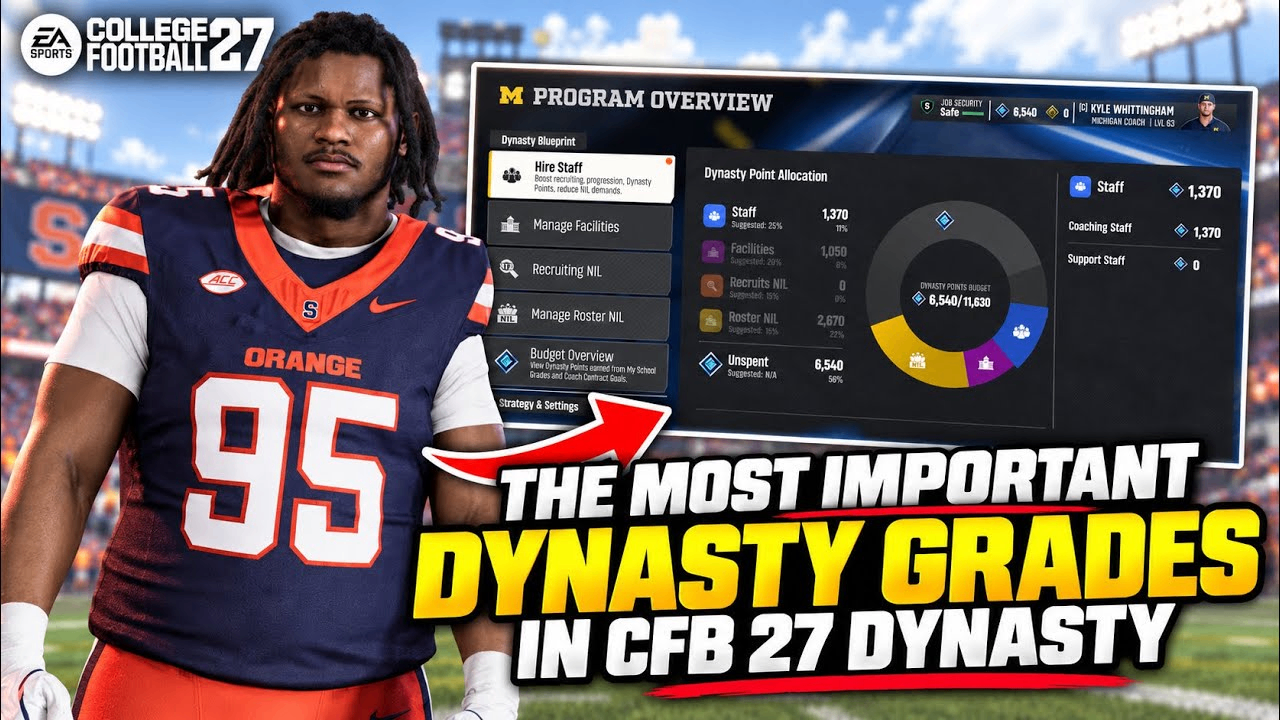
Pro Player Optimization Tips
New dynasty players should focus on Brand Exposure and Championship Contender first for fast early prestige spikes. Mid-game progression should prioritize conference upgrades and Program Tradition stacking. Avoid grinding Stadium Atmosphere early, as it wastes critical developmental seasons.
Maintain high blue-chip ratios annually and schedule premium televised matchups to sustain exponential grade growth. For long-term dominance, stabilize Pro Potential with consistent recruiting and draft development.
Final Verdict
CFB 27’s reworked dynasty grading system rewards strategic, targeted progression over random seasonal grinding. Brand Exposure and Program Tradition form the backbone of elite program growth, while Conference Prestige and Championship Contender deliver fast, reliable boosts. Pro Potential and Stadium Atmosphere are secondary priorities best improved passively. Following this 2026 meta ranking maximizes dynasty points, recruiting hours, and team prestige for any rebuild or powerhouse program. Players looking to accelerate their team’s progression can also buy College Football 27 Coins to support roster development and other in-game upgrades.