Weekend Drop -













Summary
College Football 27 can feel overwhelming for new players, but mastering a few core mechanics can dramatically improve your performance. This beginner guide covers passing techniques, running fundamentals, offensive play reads, defensive schemes, and the best settings to help players build confidence, avoid common mistakes, College Football 27 Coins, and start winning more games.
Step 1: Master the Basics of Passing in College Football 27
Passing is one of the most important skills in College Football 27. Many beginners struggle because they throw the wrong type of pass at the wrong time. Understanding when to use bullet passes, lob passes, and different catch techniques is the foundation of a successful offense.
The two primary passing styles are bullet passes and lob passes.
A bullet pass is performed by holding the receiver’s button icon. This creates a fast, direct throw that reaches the receiver quickly. In most situations, this should be your default passing option because it allows your receiver to catch the ball in stride and maximize yards after the catch.
A lob pass is performed by quickly tapping the receiver’s button icon. This creates a higher-arcing throw that gives the receiver more time to adjust. Lob passes are mainly useful when a receiver has beaten the defense on deep routes, such as streaks or vertical routes, where you want to place the ball ahead of the defender for a potential touchdown.
However, beginners often make the mistake of throwing too many lob passes. Unless you have a clear advantage downfield, a bullet pass is usually safer and more effective.
Step 2: Learn the Different Catch Types
College Football 27 also gives players multiple catching options, and knowing when to use each one can completely change your offensive efficiency.
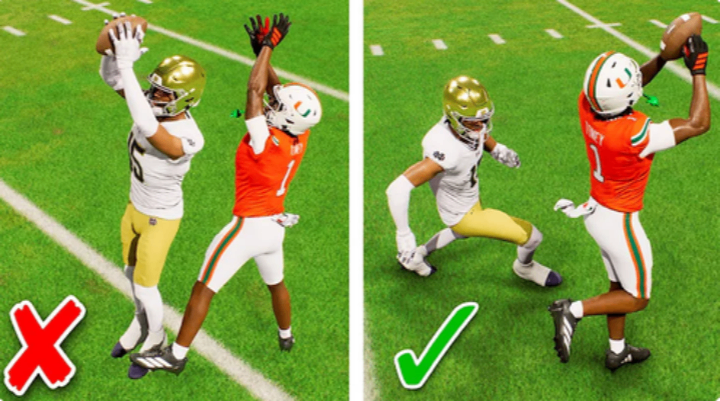
The first important catch type is the RAC catch (Run After Catch).
A RAC catch allows your receiver to catch the ball while maintaining momentum and immediately continue running. On Xbox, this is done by holding the X button, while PlayStation players use the Square button.
This is ideal when:
The receiver has open space after the catch
You are throwing short routes
You want extra yards after completing a pass
The second important catch type is the possession catch.
A possession catch focuses on securing the football rather than gaining extra yards. Xbox players use the A button, while PlayStation players use the X button.
This catch is extremely useful when:
Catching near the sideline
Protecting the ball from defenders
Making important third-down conversions
Avoiding big hits over the middle
A smart College Football 27 player does not use the same catch type every time. Choosing the right catch animation can prevent turnovers and create more successful drives.
Step 3: Use Pass Leading to Improve Accuracy
Another key passing mechanic in College Football 27 is pass leading.
Pass leading allows you to control where the ball is placed by using the left analog stick while throwing.
For example, if a receiver is running toward the right side of the field, holding the left stick to the right while throwing will lead the receiver into open space. This allows the receiver to catch the ball without slowing down.
Combining:
Bullet passes
Proper pass leading
RAC catches
creates much more dangerous offensive plays.
Instead of simply throwing directly at receivers, experienced players place the ball where only their teammate can make a play.
Step 4: Stop Holding Sprint Too Early When Running the Ball
Running the football is another area where beginners struggle in College Football 27.
The biggest mistake new players make is immediately holding the sprint button after receiving the handoff.
The sprint button, which is the Right Trigger on Xbox or R2 on PlayStation, should not be used behind the line of scrimmage.
Instead, allow your offensive line to create blocks first.
Use the left analog stick to:
Find running lanes
Follow blockers
Make small adjustments
Avoid defenders
Only activate sprint once you reach open space.
Many players try to hit a home run every run play, but successful rushing attacks are built on consistently gaining positive yards. Taking four or five yards repeatedly is often more valuable than forcing a big play and losing yardage.
Step 5: Use Beginner-Friendly Offensive Plays
Once you understand passing and running mechanics, the next step is learning how to move the ball with actual plays.
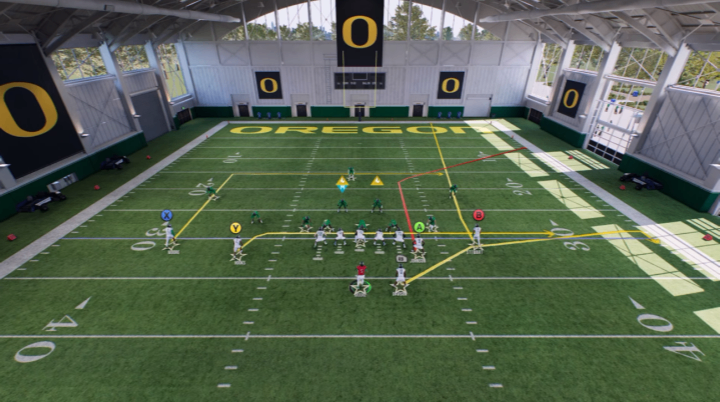
One excellent beginner formation is Gun Normal Y Off Close.
The play Y Sail is especially effective because it works well against both man coverage and zone defense.
The key is using simple reads.
The first read should be the running back route to the flat.
If the running back is open, immediately throw the ball. Do not wait for deeper routes to develop.
If the running back is covered, move to the drag route.
If both are unavailable, check the tight end route.
The final option is the backside receiver crossing the middle late in the play.
This progression teaches beginners an important lesson:
Do not always look for the big play.
Many interceptions happen because players immediately look deep instead of taking easy yards underneath.
Good offense in College Football 27 is about:
Quick decisions
Efficient throws
Protecting the football
Staying patient
Step 6: Build a Strong Defensive Foundation
After learning offense, defense becomes the next major challenge.
For beginners, the best place to start is the Nickel formation because it provides balance against both passing and rushing attacks.
Three defensive concepts are especially important:
Cover 2 Man
Tampa 2
Cover 3 Sky
Step 7: Use Cover 2 Man for Safe Defense
Cover 2 Man is one of the easiest defensive schemes for beginners.
This defense places defenders in man coverage while keeping two safeties deep.
The advantage is simple:
Receivers are closely covered
Deep passes are harder to complete
Every offensive player has defensive attention
When running Cover 2 Man, control the defender covering the running back.
If the running back runs a route, follow him.
If the running back stays in pass protection, you become a free defender who can help cover the middle of the field.
This makes Cover 2 Man a reliable defense against many common offensive strategies.
Step 8: Use Tampa 2 to Force Mistakes
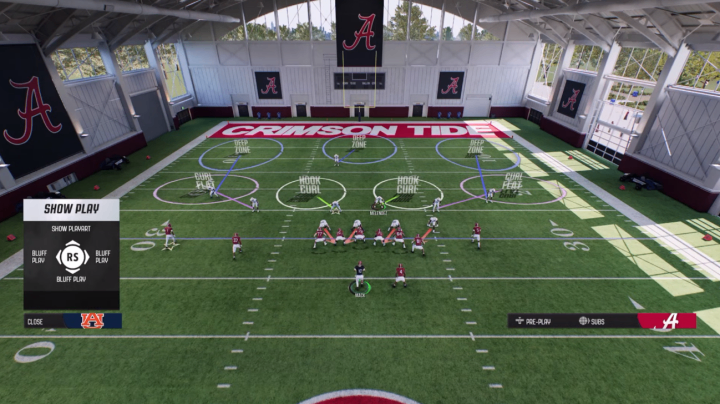
Tampa 2 is designed to keep everything in front of the defense.
Instead of allowing explosive plays, Tampa 2 forces opponents to throw shorter routes repeatedly.
This strategy works because many players become impatient.
They start forcing passes into coverage, creating interception opportunities.
When playing Tampa 2, avoid abandoning your assigned zone too quickly.
Stay disciplined.
If a receiver enters your area, react aggressively. Otherwise, protect your zone and wait for the quarterback to make a mistake.
Step 9: Use Cover 3 Sky and Aggressive Zones
Cover 3 Sky provides another defensive option, especially against players who rely heavily on short passes.
College Football 27 introduces aggressive zone adjustments that allow underneath defenders to attack shorter routes more effectively.
By using defensive adjustments, you can make your zones react faster and limit easy completions.
The key is mixing defensive calls.
A strong defensive player should rotate between:
Cover 2 Man
Tampa 2
Cover 3 Sky
Keeping opponents guessing makes your defense much harder to exploit.
Step 10: Optimize Your College Football 27 Settings
The right settings can give beginners a major advantage.
Recommended gameplay helper settings include:
Defensive Ball Hawk: On
Defensive Heat Seeker Assist: On
Heat Seeker Window: Maximum
Switch Stick Delay: Slight
Defensive Switch Assist: On
These options improve tackling, interceptions, and defender switching.
For coaching adjustments:
Auto Pass Protection: Base
This provides more consistent blocking.
On Target User Defender: On
This helps prevent certain defensive exploits.
Auto Flip Defensive Play Call: On
This ensures your defense aligns correctly.
Cornerback Matchups: Balance
This prevents strange defensive alignments.
For option defense:
Read Key: Conservative
Pitch Key: Aggressive
For RPO defense:
RPO Read Key: Conservative
RPO Pass Key: Conservative
These settings give beginners a stronger foundation and reduce common mistakes.
Final Thoughts: Build Fundamentals Before Advanced Strategies
College Football 27 rewards players who understand fundamentals. New players often lose because they chase big plays, ignore basic mechanics cheap College Football 27 Coins, and use complicated strategies before mastering the basics.
Focus first on:
Accurate bullet passing
Proper catching techniques
Patient running
Simple offensive reads
Reliable defensive formations
Optimized settings
Once these fundamentals become automatic, advanced schemes and competitive strategies become much easier to learn.
Whether you are playing online matches, Dynasty mode, or competing against friends, mastering these beginner techniques will help you win more games and improve faster in College Football 27.