









Summary:
Recruiting in College Football 27 is not about chasing the highest-rated prospects. The best dynasty players prioritize scarce positions, organize recruits into smart target tiers, exploit pipelines, and scout for speed, power, College Football 27 Coins, development potential, and valuable abilities. This approach can save recruiting hours while building a stronger roster year after year.
1. Identify Position Scarcity Before Recruiting
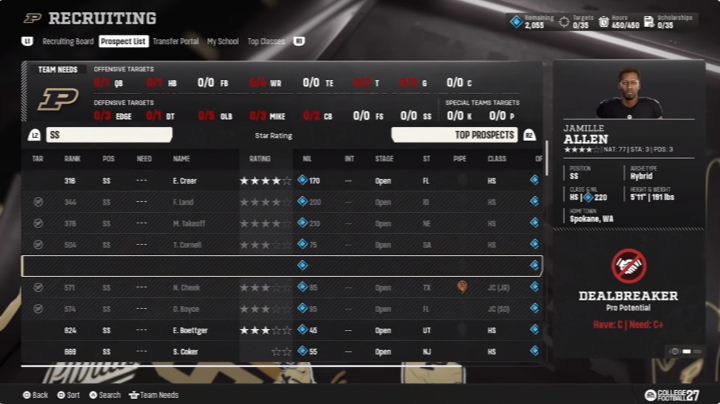
The first step in College Football 27 recruiting is understanding which positions are difficult to find. Not every position deserves the same level of urgency.
Safety is one of the clearest examples. There are relatively few quality safeties in a typical recruiting class, with roughly 22 three-star-or-better prospects at the position on average. Center, guard, defensive tackle, and cornerback can also be difficult positions to fill.
Quarterback, wide receiver, and halfback are much easier to find. Their larger prospect pools mean that quality players can remain available deep into the season. The transfer portal also provides additional opportunities.
This creates a simple rule: attack scarce positions early and remain patient at deep positions.
Quarterback is especially interesting because it can be expensive to recruit due to NIL demands. If a good quarterback still has little or no interest from other schools several weeks into the season, you may be able to land him with recruiting hours alone.
Halfback can be even easier to replace because the transfer portal frequently provides strong options.
2. Build Your Recruiting Board Around Three Tiers
Once you know which positions need attention, avoid simply adding the highest-rated prospects to your board. Instead, divide recruits into three categories: long shots, priority targets, and foundational pieces.
Long shots are players you would love to sign but have a limited chance of landing. These might be elite five-star prospects at a smaller school or players heavily targeted by stronger programs. Keep this group small, usually two to four players, and abandon the pursuit quickly if you fall behind.
Priority targets should receive most of your recruiting hours. These are players who fit your program and have a realistic chance of committing.
Foundational players are the recruits you expect to land. They provide roster depth and help guarantee that your recruiting class remains productive.
Your school level should determine how you define each category. A three-star program might view five-stars as long shots, four-stars as priority targets, and three-stars as foundation pieces. A powerhouse can shift that scale upward, making five-stars priority targets and four-stars foundational recruits.
For one- or two-star rebuilds, the opposite approach makes more sense. Four-stars may be long shots, three-stars become priority targets, and two-stars provide the foundation.
3. Use the Transfer Portal During a Rebuild
If you are rebuilding a struggling program, don't try to solve every roster problem through high school recruiting.
Transfer portal players can make an immediate impact, while freshmen often need multiple seasons to develop. During the early stages of a rebuild, keeping your high school board relatively small can be much more efficient.
Target around five to ten high school prospects you genuinely want, then use the transfer portal to fill immediate roster holes.
As your program improves, your recruiting strategy can expand. Better school grades, stronger coaching upgrades, and more wins will make it easier to compete for elite high school prospects.
4. Find the Cheapest Recruits to Sign
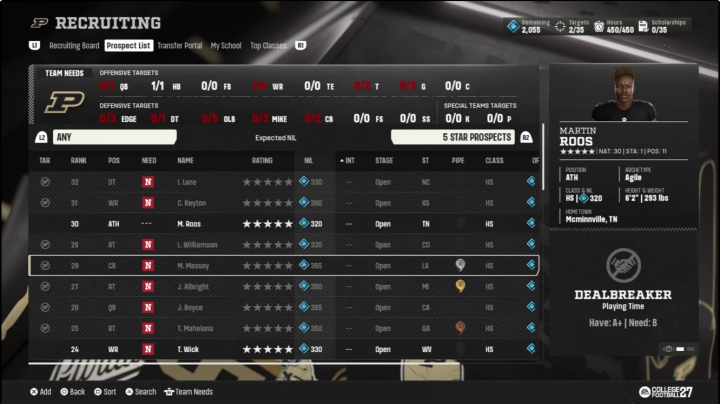
There are three filters that can dramatically improve recruiting efficiency.
First, prioritize your pipeline. Strong pipeline advantages can provide recruiting benefits throughout the season, making these prospects easier to pursue.
Second, look for recruits who already have interest in your school. Starting with an advantage means you have less ground to make up and may need fewer hours to reach a competitive position.
Third, consider regions where major programs do not have strong pipeline advantages. Areas such as New Mexico, Nebraska, Colorado, and parts of the Big Sky region can sometimes provide opportunities because fewer schools have a major recruiting advantage there.
The ideal recruiting target is therefore not necessarily the highest-rated prospect. It is often the high-quality player you can sign efficiently.
5. Recruit the Best Archetypes, Not Just Your Scheme
One of the biggest mistakes in College Football 27 recruiting is forcing every prospect to fit your existing scheme.
Instead, consider recruiting valuable archetypes and adjusting your roster around them.
With man coverage remaining highly effective, bump-and-run and field corners are attractive defensive options. On offense, route runners are valuable because they can help counter man coverage.
For running backs, elusive bruisers and east-west playmakers can provide explosive movement, while contact-oriented backs offer stronger downhill running.
Against the run, prioritize defensive linemen with strength and block shedding. Pure power defensive tackles and edge setters are particularly useful. At linebacker, signal callers and thumpers can be strong choices, while box specialists and hybrid safeties can help against physical rushing attacks.
Thumpers deserve special attention because their starting strength can make them useful even after moving them to another defensive position.
6. Scout Priority Targets First
Recruiting hours are limited, so scouting every player is inefficient.
Start with your priority targets and foundational prospects. Long shots generally don't deserve extensive scouting because you are already taking a calculated gamble on them.
When scouting, the first thing to check is whether a prospect is a gem or bust. A gem indicates additional development potential, while a bust can signal a player who may not develop as well as expected.
However, gem and bust indicators only appear on a portion of recruits. That means you need additional criteria.
7. Speed and Power Are the Most Important Attributes
Speed and power should be two of the biggest factors when evaluating prospects.
The reason is simple: they are expensive and difficult to fix later.
A player who arrives slow or physically weak may require a large number of upgrade points to become competitive. Other attributes can often be improved more efficiently.
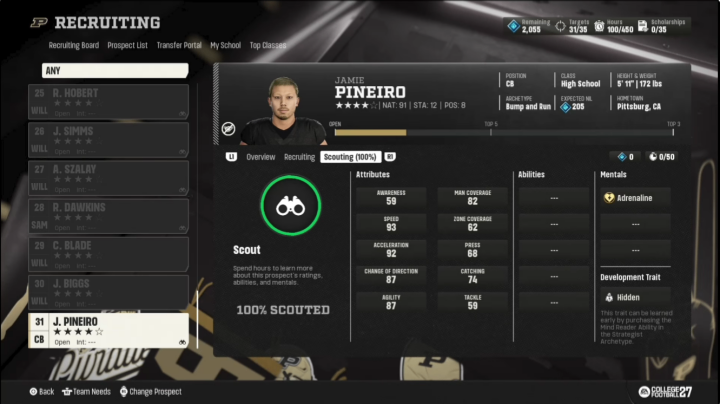
When comparing prospects, consider their speed, acceleration, agility, and strength relative to their archetype and star rating.
For example, a four-star bump-and-run corner with above-average athleticism can be a better long-term investment than a highly rated prospect whose physical attributes are below the archetype's normal range.
8. Look for Abilities and Upgrade Thresholds
Finally, examine the mental and physical abilities a recruit already possesses—or is close to unlocking.
A linebacker with high acceleration may be especially valuable if he is close to unlocking an ability such as Robber. Similarly, defensive tackles with high strength can be attractive because strength contributes to abilities such as Grip Breaker.
Archetype-specific thresholds matter. A power-rusher defensive tackle may reach certain ability thresholds with considerably less strength than other defensive tackle archetypes.
That means you should not judge every recruit using the same attribute standards. Compare prospects against other players within the same archetype.
Conclusion: Recruit Smarter, Not Harder
The best College Football 27 recruiting strategy is not simply chasing five-star prospects. Build your board around position scarcity, divide prospects into realistic tiers, prioritize pipelines and existing interest, cheap College Football 27 Coins, and use the transfer portal when appropriate.
When scouting, focus heavily on speed, power, archetype value, and ability thresholds. A less famous recruit with elite physical traits and a useful archetype can ultimately become much more valuable than a higher-rated prospect who requires too many resources to develop.
If you consistently recruit players who are both valuable and affordable, your dynasty can build sustainable depth instead of relying on a few superstar classes.