










Summary
College Football 27 Road to Glory delivers a deeper recruiting journey, tougher quarterback battles, and more realistic career progression. After becoming a five-star high school sensation, Trevor Martin must choose between powerhouse programs and his hometown dream. With Illinois selected, College Football 27 Coins, the challenge shifts from dominating high school games to earning a starting role.

Step 1: The Rise of a Five-Star Quarterback Prospect
The Road to Glory journey in College Football 27 begins with an incredible transformation. Trevor Martin, once viewed as only a three-star recruit, quickly becomes one of the most talked-about players in the country after dominating his first half of the high school season.
His performances completely changed his recruiting outlook. Instead of choosing between smaller programs, Trevor suddenly finds himself receiving attention from elite schools across the nation. Programs like Alabama, Georgia, LSU, Miami, Oregon, Nebraska, and many others begin competing for his commitment.
The biggest decision is no longer whether he can play at the next level. It is where he wants to build his legacy.
For Trevor, the hometown connection remains extremely important. Growing up near Champaign and attending Illinois games created a special bond with the program. While other schools offer bigger national recognition, Illinois represents something different: the opportunity to become a hometown hero and rebuild a program.
Step 2: College Football 27 Recruiting Feels More Personal
One of the strongest aspects of Road to Glory in College Football 27 is the recruiting decision process.
Instead of simply picking the highest-rated school, players must consider scholarship bonuses, depth charts, playing time opportunities, and long-term development.
Trevor receives impressive offers from multiple programs:
Georgia provides championship-level competition.
Nebraska offers strong development opportunities.
Indiana keeps him close to home.
Illinois delivers the emotional hometown storyline.
The final top three schools become Illinois, Georgia, and Indiana.
Georgia might provide the easiest path toward national success, but Illinois offers something more meaningful. Trevor does not want to simply join a stacked roster. He wants to become the player who changes the future of a team.
That decision creates one of the most interesting career paths in Road to Glory.
Step 3: Senior Night Becomes the Final High School Test
Before leaving high school, Trevor must complete his final games and prove he deserves his five-star status.
The difficulty at the high school level is noticeably lower compared to college football. Receivers consistently create separation, running lanes are available, and dual-threat quarterbacks can dominate with both passing and rushing ability.
Trevor uses his athletic ability to control games:
Completing key passes under pressure
Extending plays outside the pocket
Using quarterback runs to gain crucial yards
Leading scoring drives in important moments
The final high school performance becomes a celebration of everything he accomplished. By the end of his career, Trevor is ranked among the best players nationally:
Top 15 overall recruit
First in his state
Second-ranked quarterback in his class
Every major program wants him.
But Trevor already knows where he belongs.
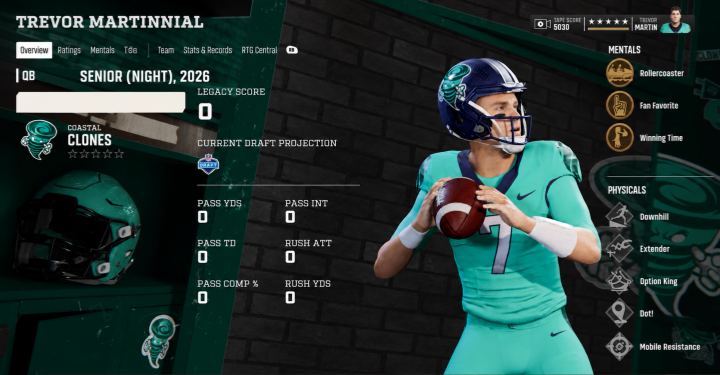
Step 4: Choosing Illinois and Becoming a Hometown Hero
On signing day, Trevor makes the decision that defines his career.
Instead of choosing a powerhouse like Georgia, he commits to the University of Illinois.
The decision is based on loyalty, family, and the opportunity to create something special.
Illinois has not been one of college football’s dominant programs in recent years. Trevor wants to change that narrative.
The goal is clear:
Become the quarterback who brings Illinois back into national relevance.
However, choosing Illinois does not mean an easy path.
College football immediately introduces a much bigger challenge.
Step 5: The Reality Check Begins in College Football 27
After arriving on campus, Trevor discovers that being a five-star recruit does not guarantee immediate success.
His starting overall rating is 74, placing him behind several experienced quarterbacks on the depth chart.
The competition includes:
A 77-rated redshirt freshman
A 76-rated redshirt sophomore
Trevor Martin at 74 overall
Suddenly, the superstar high school quarterback becomes a player fighting for recognition.
This is where College Football 27’s progression system becomes more interesting.
Players must manage:
Practice performance
Academics
Leadership development
Fitness
Weekly preparation
The journey is no longer about dominating opponents. It is about improving every week.
Step 6: Practice and Position Battles Test Your Skills
The biggest challenge for Trevor is earning the trust of his coaches.
Practice drills become essential because they directly impact confidence and depth-chart movement.
Passing skeleton drills require precision, decision-making, and consistency. Players must:
Read defenses quickly
Complete accurate throws
Avoid turnovers
Build practice multipliers
The scoring system rewards aggressive but smart quarterback play.
However, mistakes are costly.
A missed read or forced throw can quickly destroy a strong performance.
This creates a realistic quarterback development experience. Even elite recruits must prove themselves every day.

Step 7: Microtransactions Create Community Concerns
While College Football 27 introduces many exciting career features, the game also faces criticism surrounding microtransactions.
Many players feel frustrated by the idea of locking certain progression advantages or content behind additional purchases.
The discussion has become one of the biggest community debates surrounding sports games.
Many fans understand that modern games require ongoing support, updates, and additional revenue. However, they believe developers should be careful about removing traditional progression systems and placing them behind extra payments.
For a mode like Road to Glory, where players expect a personal career experience, monetization choices can heavily impact player enjoyment.
The community hopes future updates focus on improving the experience rather than increasing paid advantages.
Step 8: The Road Ahead for Trevor Martin
Trevor’s first challenge at Illinois ends with a difficult position battle.
Despite showing flashes of brilliance, he loses the initial competition for the backup quarterback role.
However, the journey is far from over.
College Football 27’s Road to Glory is designed around development, patience, and improvement.
Trevor must continue:
Training harder
Increasing his overall rating
Building coach trust
Improving decision-making
Preparing for his next opportunity
The dream of becoming Illinois’ next great quarterback remains alive.
Final Thoughts: College Football 27 Makes the Journey Matter
College Football 27 Road to Glory is not just about becoming a superstar immediately. The mode creates a realistic football career where every decision matters.
From a three-star recruit to a five-star quarterback, from choosing a college to fighting for playing time, cheap College Football 27 Coins, Trevor Martin’s story shows the challenges of becoming an elite athlete.
Choosing Illinois may not be the easiest path, but it creates the most meaningful one.
The next chapter begins with hard work, competition, and the pursuit of becoming a legend. For Trevor Martin, the journey from hometown recruit to college football star has only just started.