Weekend Drop -
















Summary
Are you following a build guide but not hitting the same damage numbers? Stuck pushing pits and can't seem to break through that next tier? Understanding how damage works in Diablo 4 is crucial for endgame progression, especially when you've invested time and diablo 4 max roll items for sale into gearing up only to see underwhelming results. This guide breaks down the fundamentals of damage building and shows you exactly where you might be missing out on significant damage increases, so you can make every piece of gear and every point of currency count toward real, noticeable improvement.

Understanding the Two Types of Damage
Additive Damage
Additive damage bonuses all get added together into one large pool before being multiplied by other factors. You can identify additive damage by looking for the plus sign (+) in the description.
Key sources include Paragon boards (your primary source), glyphs, and some gear affixes. Examples include Increased Critical Strike Damage, Increased Damage to Vulnerable Enemies, and element-specific damage like Physical or Fire.
Important: All additive damage bonuses are grouped together. There's no distinction between critical strike damage and vulnerable damage additive numbers - they all go into the same massive pool.
Multiplicative Damage
Multiplicative damage is indicated by an X in the description. These bonuses multiply your damage after all additive calculations. Key sources include glyph secondary bonuses, Legendary Aspects, Paragon board legendary nodes, set bonuses, and talismans.
Why this matters: Multiplicative damage multiplies ALL your additive damage. If you have 1,000 additive damage and a 20% multiplicative bonus, you get 1,200 damage. With 2,000 additive damage, that same 20% bonus gives you 2,400 damage.
The Big Three Damage Mechanics
Critical Strike Damage: You always have 50% increased critical strike damage regardless of gear, but you need Critical Strike Chance to actually crit.
Vulnerable Damage: You always deal 20% more damage to vulnerable enemies regardless of gear. You need a reliable way to make enemies vulnerable to benefit.
Main Stat: Every point of main stat increases your skill damage. Higher Paragon levels mean more main stat and more base damage to multiply.
Common Damage Pitfalls
Neglecting Vulnerable Damage
Many players focus heavily on Critical Strike Damage Bonus because numbers appear higher. However, the real secret to big damage is spreading multipliers across categories.
In testing, a setup with high Critical Strike and Physical Damage produced 11,300 damage. Adding Vulnerable Damage while reducing Physical Damage produced 14,200 damage - a 26% increase despite having less total additive damage. Even a low Vulnerable Damage setup outperformed the high Critical Strike setup with only 2% more total multipliers.
Putting All Eggs in One Basket
Concentrating all multipliers into one category gives diminishing returns. Diversifying yields much better results. With 870% total Critical Strike Damage, you'd deal 163 damage. Spread those multipliers across categories at 750% total, and you'd deal 461 damage - nearly three times the damage with 120% less total investment.
Ignoring Paragon Levels
At level 265, you're not even halfway to the experience needed for level 300. That's a massive amount of additive damage and main stat you're missing. The difference between Paragon 225 and 300 is substantial.
Low Roll and Non-Greater Affix Gear
Greater Affixes provide a 25% increase to base stat value. A 50% roll becomes 62.5%. Combined with Masterworking, each rank gives a 1% increase, and critical hits can push stats from 34% to 100%. Without Greater Affixes, you might deal 2.17 million damage. With them, that jumps to 2.65 million.
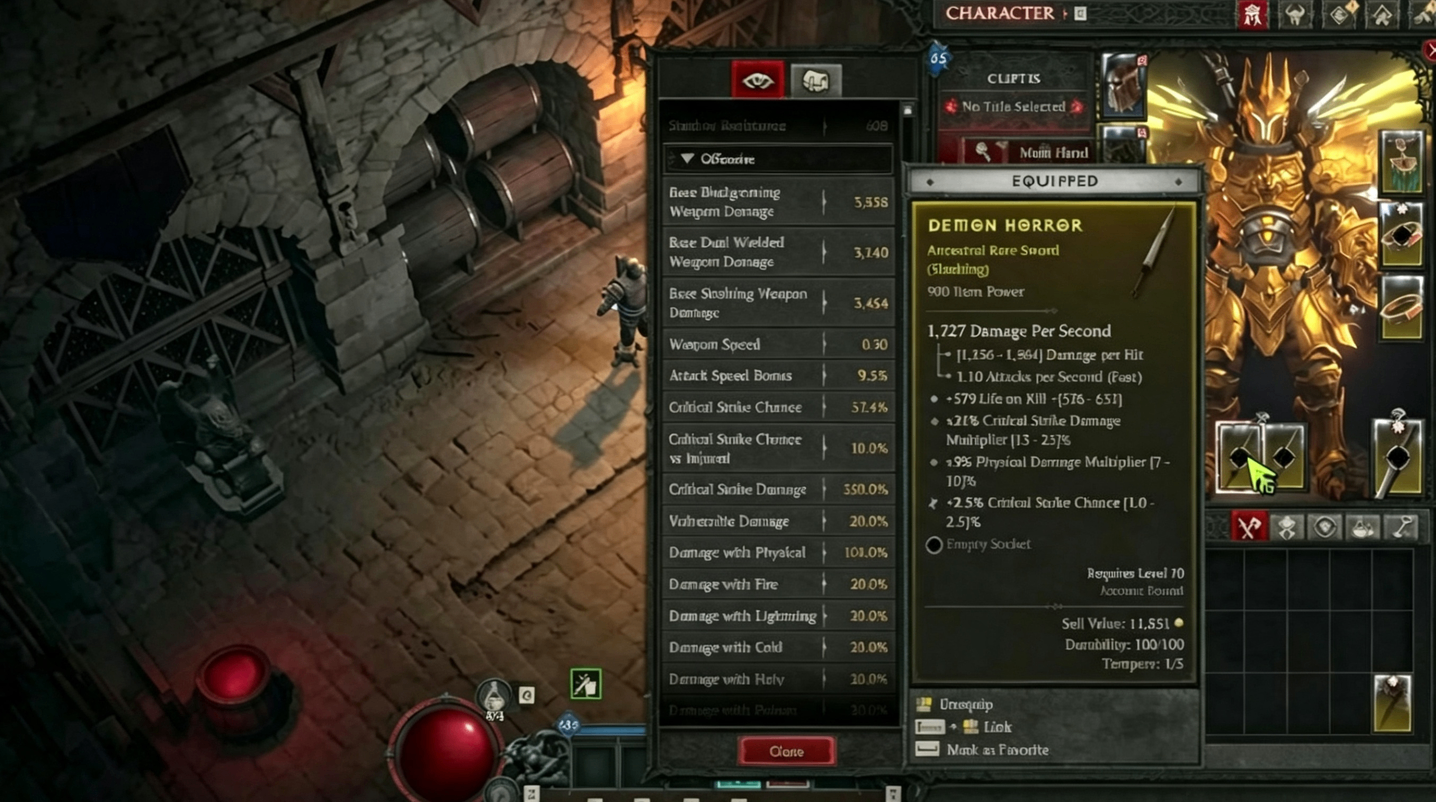
Step-by-Step Damage Audit
Check Your Paragon Level
Accept that leveling Paragon is essential. Focus on defensive nodes first - they're non-negotiable for survival. Collect all additive damage nodes as you expand.
Audit Your Affixes
Check each gear slot for Vulnerable Damage where possible. Spread multipliers across categories. Prioritize Vulnerable Damage if your build can apply it, Critical Strike Damage Bonus, and element-specific damage. Let go of the idea that bigger Critical Strike numbers mean bigger damage.
Check Your Glyph Levels
Glyph power scales dramatically. At level 51, a glyph might give 8.6%. At level 100, that same glyph gives 17%. At level 150, it reaches 20%.
Base damage of 2.17 million becomes 2.45 million with a level 51 glyph, 2.57 million with level 100, and 2.67 million with level 150. That's just one glyph - you have five slots, so the difference is massive.
Review Your Aspects
Check whether all your aspects are as high as possible. Use the Occultist to upgrade them - it's much easier to get perfect rolls now.
Look for Greater Affixes
Craft your starter set at the Occultist (you can't craft Greater Affix gear there). Use that as your baseline, then farm for Greater Affix gear to upgrade. Use Helltides for materials since they're the best farming location. The crafted gear gives you the foundation to start farming.
Practical Testing Tips
Enable Damage Variance in your settings to remove weapon damage range. Use the same skill rotation every time. Test without temporary buffs when comparing gear. Record the hits you see.
Test the same gear with different affix combinations, different skill rotations, before and after glyph upgrades, and before and after Masterworking. This is how you'll discover that a "lower" stat often yields "higher" damage.
Damage Checklist
Use this to troubleshoot your damage:
Do I have reliable Vulnerable application?
Have I spread damage multipliers across categories?
Are my Paragon levels high enough?
Have I collected all important nodes in my Paragon board?
Are my glyphs leveled to at least 100?
Are my aspects as high as possible?
Do I have Greater Affixes on my gear?
Have I Masterworked my gear?
Did I hit good Masterworking crits?

Final Thoughts
Building damage in Diablo 4 isn't about stacking the highest numbers in one category. It's about understanding additive versus multiplicative math, spreading multipliers across categories, maximizing every source from Paragon to glyphs to aspects, and testing your gear choices.
The difference between a good build and a great build often comes down to small optimizations - 5% here, 10% there, spreading damage types correctly. These incremental gains add up to massive increases.
The golden rule: If you're not hitting expected numbers, start with your Paragon levels, then check glyphs, then audit affix distribution, then look at aspects and Masterworking.
Join a community - Discord servers are invaluable for build help, trading, theorycrafting, and finding groups. If you're looking to accelerate your progress, many players choose to buy diablo 4 best roll items to skip the grind and afford high-roll gear or rare materials more quickly. For a reliable and trusted source, we highly recommend checking out MMOEXP - they offer competitive prices and fast delivery, so you can get back to pushing those pit tiers without delay. Every upgrade is a step forward, so don't get discouraged, and remember that smart investments, whether in time or resources, will eventually pay off.