







Summary
Diablo 4 Season 15 introduces Soul Splinters—new socketable items for jewelry that offer massive bonuses with significant drawbacks. The standout options include the Splinter of Hellfire (100% multiplicative damage for non-crit builds), Splinter of Anguish (35% crit chance and attack speed at the cost of resource cost), Splinter of Pain (40% damage reduction with a movement speed penalty), and Splinter of the Black Soulstone (stacking damage buff from kills). This guide breaks down every Splinter type, their best use cases, and how they will reshape the Season 15 meta. To test these items quickly, buy Diablo 4 Gold and gear up without the grind.
What Are Soul Splinters?
Soul Splinters are socketable items that go into jewelry slots in Season 15. They come in five rarities—Common, Magic, Rare, Legendary, and Unique—with higher rarities providing stronger bonuses while keeping the same drawback. The design philosophy is "kiss-curse": every powerful benefit comes with a meaningful downside that requires build adjustments.
Splinter of Hellfire: 100% Damage for Non-Crit Builds
What It Does
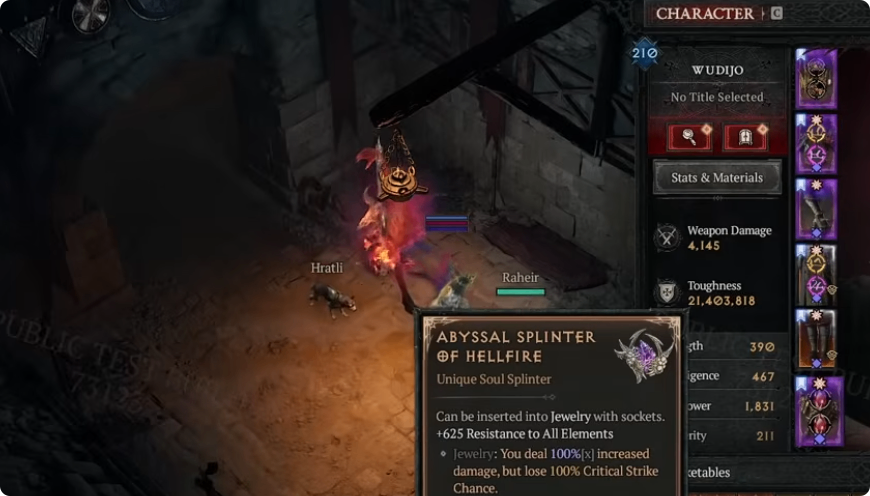
The Splinter of Hellfire grants up to 100% multiplicative increased damage at Unique quality. The drawback: you lose 100% Critical Strike Chance, making critical hits impossible. This is multiplicative damage, not additive, making it far more powerful than ordinary bonuses.
Best Use Cases
This Splinter is designed for builds that don't rely on critical hits. Damage over time setups are natural candidates, as their sustained damage comes from other multipliers. Overpower-focused builds, minion builds, and thorns builds may also benefit significantly. A build using Splinter of Hellfire should completely re-evaluate item priorities—Critical Strike Chance and Critical Strike Damage become wasted stats.
Why It Matters
For conventional critical builds, Splinter of Hellfire is a trap. But for builds that can abandon crits completely, it may become the foundation of Season 15's strongest setups. It offers one of the cleanest deals in Diablo 4: double your damage, lose every crit.
Splinter of Anguish: Crit Chance and Attack Speed
What It Does
The Splinter of Anguish provides 35% Critical Strike Chance and 35% Attack Speed, but increases Primary Resource Costs by 30%. This is a massive offensive boost for crit-based builds that can sustain the resource penalty.
Best Use Cases
This Splinter is ideal for rapid-hit builds that gain value from both attack speed and critical consistency. It works best when resource generation is already solved through skills, aspects, or equipment. Builds that can generate resources quickly—such as those using Tibault's Will or resource generation on helms—can effectively negate the downside.
Impact on the Meta
For builds that previously struggled to reach 100% crit chance, this Splinter can be a massive damage upgrade. In some cases, the Splinter of Anguish alone can provide a 130% DPS increase because it transforms previous non-crits into crits. This is a major reason why crit builds will be significantly stronger in Season 15.
Splinter of Pain: Damage Reduction at the Cost of Speed
What It Does
The Splinter of Pain provides 40% Damage Reduction but reduces Movement Speed by 30%. This is one of the most universally useful Splinters, as 40% DR is a massive defensive boost.
Best Use Cases
This is a straightforward choice for any build that needs more survivability. The movement speed penalty can be offset by high-quality boots with Greater Affix movement speed and masterworking. Typical builds can reach 200% movement speed (the cap) relatively easily, so losing 30% is manageable. Players can also use movement speed tempers on amulets to compensate.
Combo Potential
Splinter of Pain is particularly valuable when combined with Squirt's Necklace (which increases damage taken by 50%). The 40% DR from Splinter of Pain effectively counters the Squirt's Necklace downside, creating a net defensive benefit while gaining a significant offensive boost.
Splinter of the Black Soulstone: Stacking Damage from Kills
What It Does
Killing enemies absorbs a soul for 15 seconds. Each soul increases damage by up to 5% (multiplicative) but increases damage taken by 0.5%. This stacks without refreshing individual durations—each soul has its own 15-second timer.
Best Use Cases
The Black Soulstone rewards fast-clearing characters that can maintain a steady stream of kills. In dense enemy groups, you can achieve 100+ kills in 15 seconds, resulting in over 1000% damage increase. It's most effective in:
Helltides
Infernal Hordes
The Pit
Large open-world events
Challenge Dungeons with frequent enemy waves
The Risk
Each absorbed soul also increases damage taken by 0.5%. The penalty remains the same across all qualities . An additional 10-15% incoming damage can turn A survivable attack becomes a lethal one. Hardcore players should be especially cautious. The souls also expire individually, so the bonus naturally falls off during pauses, travel, and long boss phases.
Splinter of Sin: Maximum Life
What It Does
The Splinter of Sin provides 40% maximum life but reduces maximum primary resources by 30%. However, this life bonus is additive, not multiplicative, reducing its effective value to roughly a 20% multiplier for most builds.
Best Use Cases
This is a solid third-slot option for builds that don't care about maximum resource. Builds that stack maximum resource for scaling—such as those using Ramaladni, Beastfall Boots, or similar mechanics—should avoid this Splinter. For everyone else, it's a free toughness boost with minimal downside.
Splinter of Lies: Farming Tool
What It Does
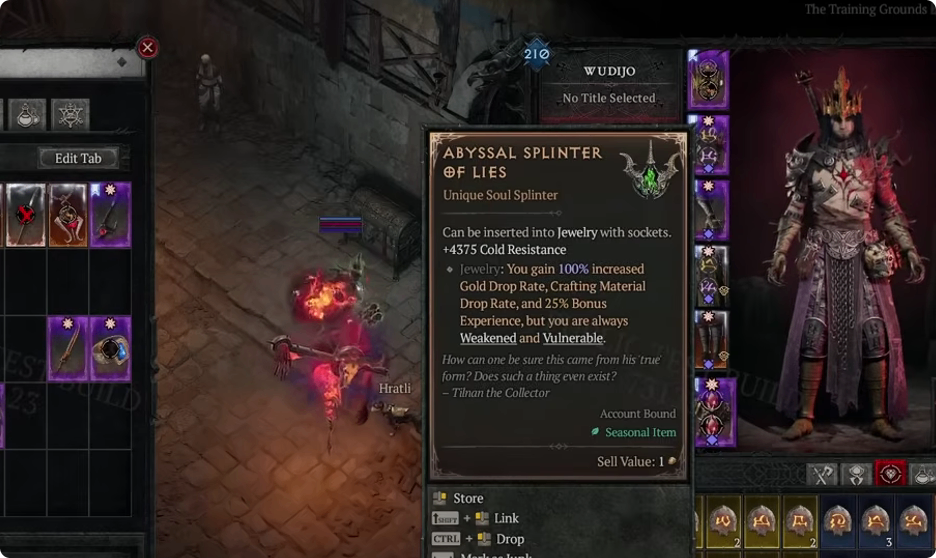
The Splinter of Lies provides increased gold drop rate, crafting material drop rate, and bonus experience, but inflicts permanent Weakened and Vulnerable. It's exclusively a farming tool that doesn't make a character more powerful in combat.
Best Use Cases
This is best used in comfortable Torment 12 farming where the defensive penalty is manageable. It's not suitable for pushing pits or towers. The bonus XP likely only works for kill experience, not for quest rewards or XP globes. The material drop rate could be valuable for nightmare dungeon escalations and gem fragment farming, but this needs further testing.
Splinter of the Mother: Unhindered and Vulnerable
What It Does
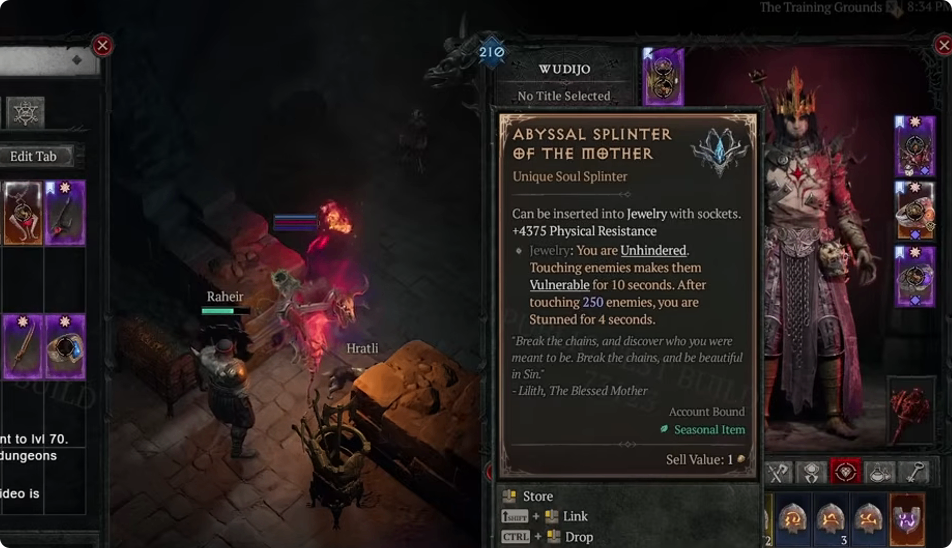
You are unhindered, and touching enemies makes them vulnerable for 10 seconds. After touching enemies 250 times, you are stunned for 4 seconds.
Best Use Cases
This Splinter is largely unusable. Unhindered is not impactful since most builds already have mobility sources. The vulnerability requires walking through enemies, not hitting them with skills. The stun is difficult to outplay. This is likely the weakest Splinter option.
Leoric's Crown Bug Warning
Early PTR testing shows Soul Splinters do not get amplified by Leoric's Crown—only resistances are affected. The 92% damage reduction combo some theorycrafters feared is not happening (at least not yet).
Important PTR Bug: Ring Order Affects Splinter Priority
When two equipped rings contain the same Soul Splinter at different quality levels, the game may use the weaker effect instead of the stronger one. The active effect can depend on the order in which the rings were equipped. Blizzard has acknowledged this as a known PTR issue.
Workaround: Avoid equipping two copies of the same Soul Splinter, or test equipment order to ensure the stronger version is active.
Which Splinter Should You Choose?
For non-crit and DoT builds: Splinter of Hellfire provides 100% multiplicative damage.
For crit builds: Splinter of Anguish offers 35% crit chance and attack speed.
For survivability: Splinter of Pain grants 40% damage reduction.
For farming: Splinter of Lies boosts gold, materials, and XP.
For stacking damage in dense content: Splinter of the Black Soulstone provides huge burst damage.
The smartest Season 15 players won't chase the highest number in isolation. They'll choose the drawback their build can absorb, then use the resulting power to cover a specific weakness.
Final Thoughts
Soul Splinters represent a major power increase for Season 15. Most builds will gain 50-150% extra damage and 50-100% more toughness. Builds that previously struggled in Torment 11 will now comfortably enter Torment 12 farming. The core decision is choosing the right drawback for your build—Hellfire for non-crits, Anguish for crits, Pain for defense, or Black Soulstone for burst damage. To fully test these options, buy D4 Gold and quickly gear up different builds to find the best Soul Splinter fit for your playstyle.