






Summary
Cap Breakers are the most strategically deep mechanic in NBA 2K27's builder system. Used well, you can push key attributes to 99 without sacrificing defense or shooting. Used poorly, you'll watch your 99 dunk dream quietly vanish after one or two attribute tweaks. Before you invest real money, it also helps to know where to Buy NBA 2K27 VC so you can fund those expensive attribute upgrades without wasting cash. This guide breaks down cap breaker configurations by height, based on widely verified community build data.
1. Three Hard Rules to Learn First
Before you touch a single breakpoint, burn these three rules into your brain:
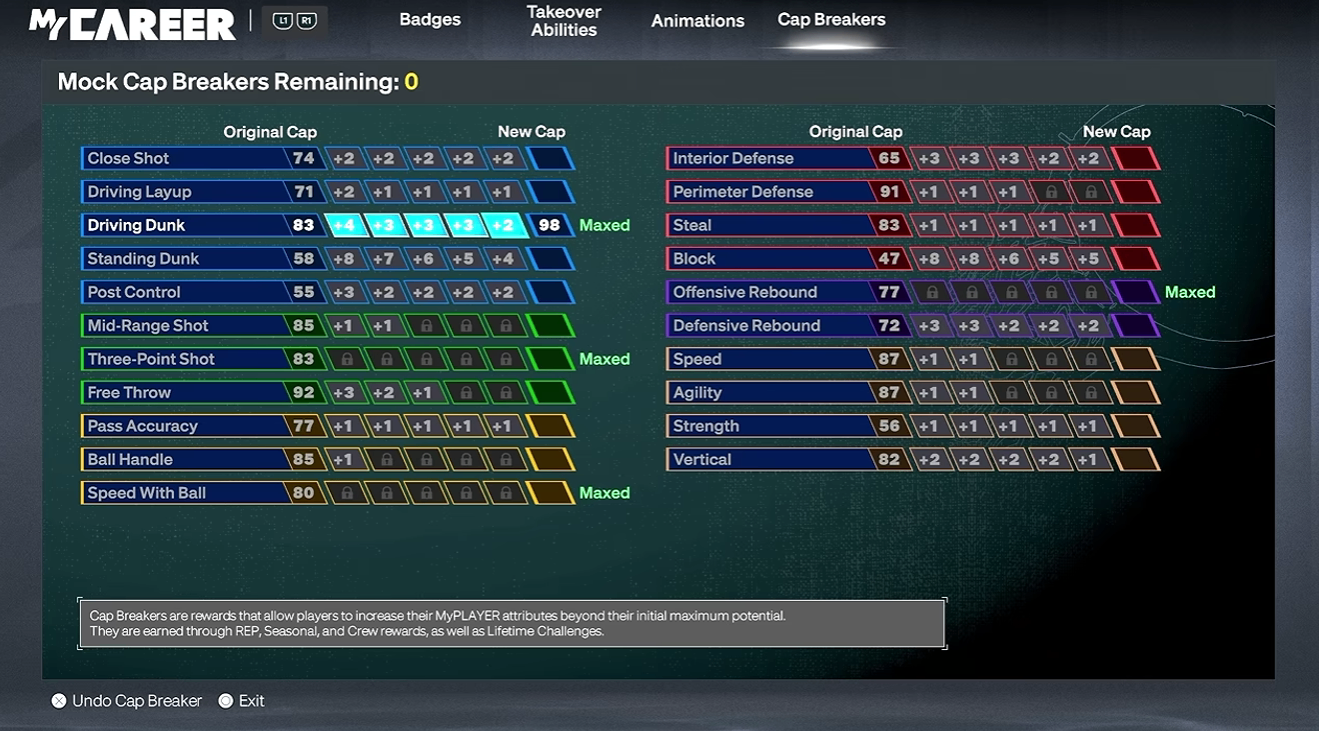
Rule One: You can only put 5 cap breakers into any single attribute. Even if you've earned all 15 cap breakers through high reputation levels, you can't dump 10 into dunk.
Rule Two: You cannot exceed the builder's "hard cap." Every height, weight, and wingspan combination has an untouchable attribute ceiling set at creation. Cap breakers help you approach it—they don't break through it. This means your build-phase numbers matter more than the breakpoint phase itself. You need to know in advance which attributes have hard caps worth chasing.
Rule Three: The attribute must be fully upgraded before cap breakers apply. You can't use a breakpoint on an 85 dunk to push it to 90. You must spend VC to upgrade to the current maximum first, then cap breakers take effect.
The core value of cap breakers is saving money. In the builder, upgrading from 98 to 99 is extraordinarily expensive. But pushing from 98 to 99 with a cap breaker costs exactly the same as going from 25 to 26. Leave your most expensive attributes for cap breakers, use the saved attribute points to patch weaknesses elsewhere—this is the shared logic behind every efficient build.
2. 6'4": Four Breakpoints to Unlock 99 Dunk
6'4" is currently the most efficient dunking guard height in the game. The core reason: you only need 4 cap breakers to push Driving Dunk to 99.
Builder Setup
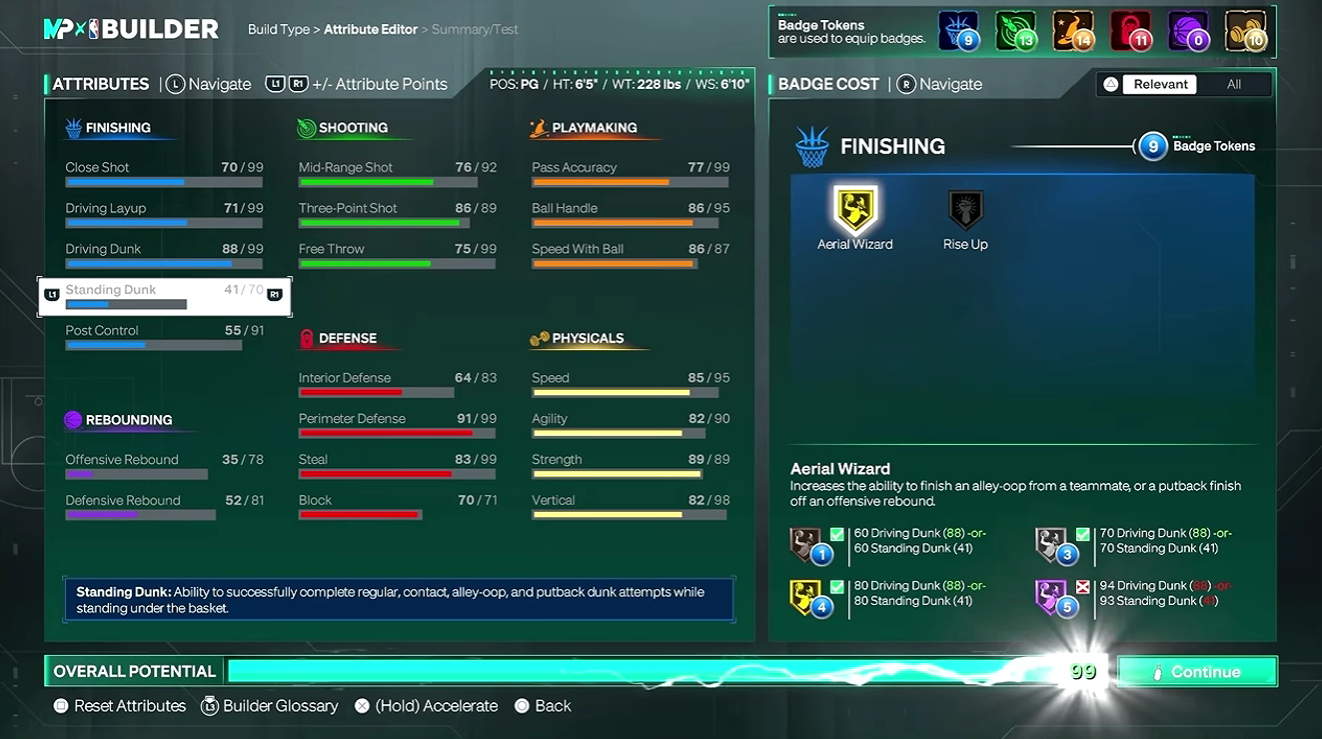
Select 6'4" with wingspan around 6'5". This wingspan allows a 96 three-point ceiling while retaining a 93 Driving Dunk hard cap.
Key initial attribute allocation:
Driving Dunk: 89 (builder starting value)
Vertical: 77
Three-Point: 94 (paving the way for Hall of Fame shooting badges)
Breakpoint Allocation Order
The first step is spending 1 cap breaker to push Vertical from 77 to 80. This alone won't directly unlock 99 dunk, but it opens the "elite one-foot contact dunk" animation threshold.
Then use your remaining breakpoints to push Driving Dunk to 99. Why only 4 instead of 5? Because 6'4"'s hard cap is 93 Driving Dunk, and 93 + 5 = 98, not 99. The "99" here is actually achieved through the combination of Vertical and Driving Dunk meeting the elite contact dunk threshold, not a literal 99 dunk attribute. In actual gameplay, this combination performs nearly identically to a 99 dunk.
Builder-level trick: If you set Vertical low enough during creation that the system thinks you "need" more breakpoints to reach the dunk threshold, the system sometimes "gifts" you extra attribute space. This is what the community calls "cap breaker manipulation."
3. 6'5": Strength Is the Interference Variable
6'5" is far more complicated than 6'4". The core conclusion: if you want to maintain high strength and 99 dunk on a 6'5", you almost certainly need to keep Perimeter Defense above a certain level.
Why Perimeter Defense Affects Dunk Ceiling
This is one of the most counterintuitive interactions in the 2K27 builder. When you lower Perimeter Defense, cap breaker allocation on Driving Dunk becomes "unstable"—attributes that could previously get +5 suddenly only get +1 or +2. Community testing has repeatedly confirmed this phenomenon, but 2K has never explained the underlying logic.
Practical advice: if you're building a 6'5" dunking guard, do not let Perimeter Defense drop below 75. Stay at or above this level, and Driving Dunk breakpoint allocation will "cooperate."
The Strength Dilemma
High-strength versions of 6'5" (90+) further compress the dunk ceiling. If you insist on strength, Driving Dunk's hard cap may drop from 99 to 96 or lower. Lowering strength to around 83 releases space, but the cost is noticeably weaker contact finishing.
Recommended approach: 6'5" works better as a "balanced" build than an "extreme dunk" build. Push Driving Dunk to around 93, use remaining breakpoints on three-point or playmaking. Overall strength will be higher than forcing 99 dunk.
4. 6'7": Ball Handle Breakthrough Is the Real Answer
Many players try to make 6'7" into a "tall dunker," but the data is clear: achieving 99 dunk on 6'7" is extremely difficult and unstable. What actually works efficiently is the ball handle breakthrough.
Ball Handle Breakthrough Configuration
The 6'7" ball handle path lets you push Ball Handle to around 86 while maintaining high defense, unlocking the Zach LaVine dribble style speed threshold.
Specific allocation: set Ball Handle's builder starting value around 80, push to 86 with breakpoints. Also watch "Speed with Ball"—LaVine style requires 83 Speed with Ball, which on 6'7" typically needs 2-3 breakpoints to supplement.
Why Not Chase Dunk
6'7"'s dunk hard cap is heavily influenced by strength. Once you invest strength for defense or rebounding, the Driving Dunk ceiling shrinks. In community testing, the most stable 6'7" dunk breakthrough result is 93 (5 breakpoints), not 99. Spending 5 precious breakpoints on a 93 dunk is far worse value than spending them on ball handle or three-point.
5. 6'8" and 6'9": The Realistic Dunk Ceiling
6'8": 98 Is the Ceiling
6'8" currently has one of the highest dunk hard caps among non-center heights, but 98 appears to be the ceiling, not 99. The community has repeatedly failed to break this threshold—the system starts allocating +1 instead of +5 breakpoint returns after 98.
Better approach: Push 6'8" Driving Dunk to around 96, invest remaining breakpoints in Block or Rebounding. 6'8"'s Block hard cap reaches around 79, and combined with 96 Driving Dunk, you get a "big forward" with both rim protection and finishing.
6'9": You Need to "Slow Down" to Break Through
6'9" dunk breakthroughs follow a counterintuitive pattern: when you lower speed attributes, dunk breakpoint allocation actually becomes easier. In community testing, one player lowered speed and watched a dunk stuck at 87 suddenly jump to 89, then push to 96.
The logic may relate to attribute "budget": the builder considers your overall attribute distribution when allocating breakpoint returns. When speed consumes too much "hidden budget," dunk returns are limited.
Recommended 6'9" path: Accept 96 dunk instead of chasing 99. Use saved breakpoints on passing or rebounding to make a true "point forward." 6'9"'s 96 dunk is completely sufficient in gameplay, and with the right dunk package (like Zion Williamson, requiring 86 Dunk + 60 Vertical), you can already trigger the vast majority of elite contact dunks.
6. 6'11": Three-Point and Rebounding Are the Breakpoint Priorities
Many players see 6'11" as a "center height," but this is the most underrated shooter height in the current version.
Three-Point Breakthrough Path
6'11"'s amazing quality: 5 cap breakers can push Three-Point from around 60 directly to 79-83, a jump of roughly 20 points. The reason is that 6'11"'s three-point hard cap is inherently high, but the builder's initial three-point cost is extremely low.
How to do it: Set both Three-Point and Mid-Range to around 60 during the build phase. This has two benefits: first, 60 in both unlocks basic shooting badges; second, it leaves maximum room for later breakpoints.
Breakpoint order: Use 5 breakpoints to push Three-Point to 79 (or 83 if you have Shooting Specialization). Invest remaining breakpoints in Defensive Rebound or Pass Accuracy. 6'11"'s Pass Accuracy hard cap reaches around 89, and combined with 79 three-point, you get a "unicorn" big who can space the floor, facilitate, and protect the rim.
Why Not Chase Dunk
6'11"'s dunk ceiling is far lower than 6'8" or 6'9". Spending breakpoints on dunk is the biggest waste for this height. 6'11"'s standing dunk already has natural advantages and doesn't need breakpoints to reinforce.
7. Universal Principle: Who Should Get Breakpoints First
First priority: Attributes whose hard cap far exceeds the builder's starting value. 6'11" three-point (60→79, a 19-point jump) is the classic example. These attributes give the highest "per-breakpoint return."
Second priority: Attributes at badge thresholds. For example, 6'4" Driving Dunk, where 89 + 4 breakpoints triggers elite contact dunks. Badge thresholds matter far more than "final number looks good."
Third priority: The most expensive attributes. Builder upgrade costs for 90+ attributes grow exponentially. Pushing an already-high attribute to its limit with breakpoints saves more VC than pushing 60 to 70.
Never do this: Spend breakpoints on strength. Strength interferes with other attributes' breakpoint allocation in unpredictable ways, especially on 6'5" and 6'7". If your build needs high strength, set it during the build phase—don't expect breakpoints to patch it.
8. Final Reminder
Cap breakers are irreversible once used. Before investing any breakpoint, always preview the exact returns in the MyPLAYER builder—the system shows how much each breakpoint will raise each attribute. If a preview shows +1 instead of +5, your build configuration has a conflict, and you need to return to the builder and adjust other attributes. Fully upgrading an attribute before applying cap breakers requires a significant amount of VC NBA 2K27, so plan carefully. MMOEXP offers a reliable way to buy NBA 2K27 VC safely.