






Summary
The Acolyte of Chayula is one of the lowest pick-rate ascendancies in Path of Exile 2, but its Volatility mechanic offers one of the highest damage ceilings in the entire game. For players willing to invest POE2 Currency into optimizing this setup, the payoff is enormous. This guide breaks down how the system works, how to build the engine, and how to apply it to any skill.

1. Core Mechanic: Why Volatility Is So Strong
How Volatility Works
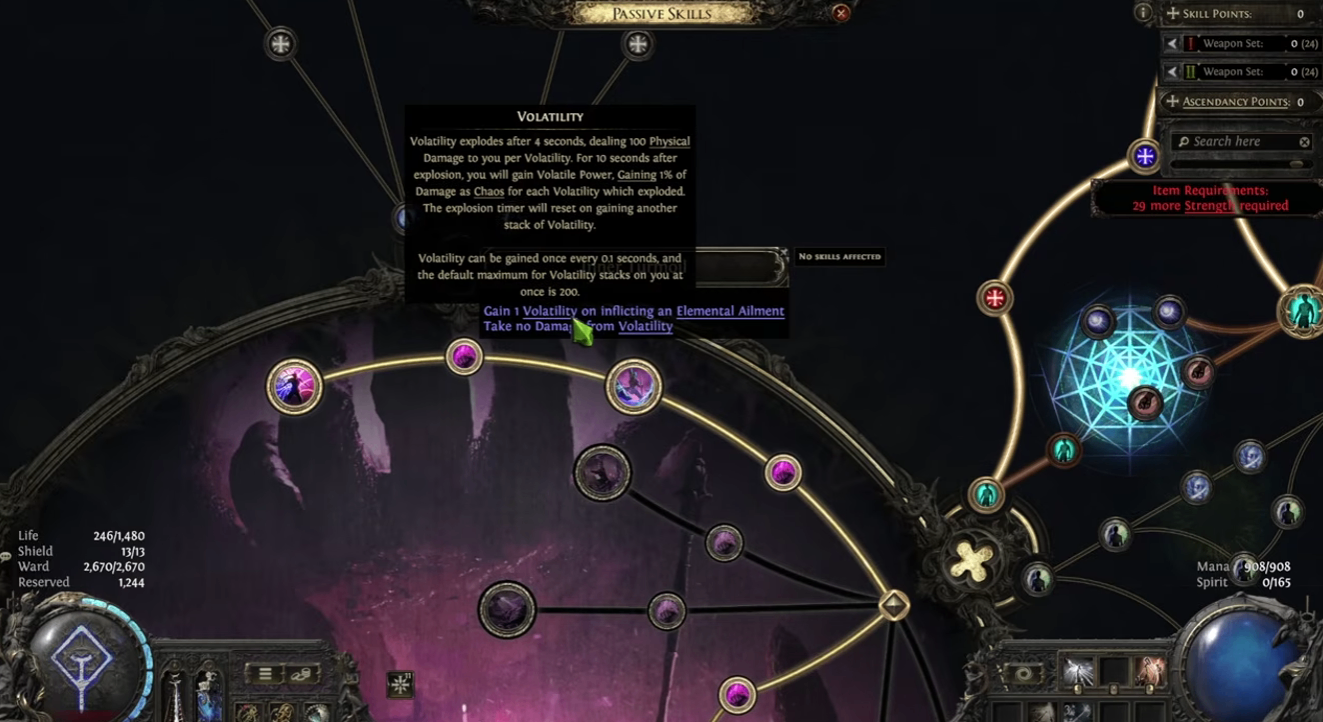
Volatility is a Chayula-exclusive debuff system. When you inflict an elemental ailment, you gain a stack of Volatility. Each stack detonates after 4 seconds by default, and each detonated stack gives you 1% of damage as extra Chaos damage for 10 seconds.
The critical limitation: Volatility can only be gained once every 0.1 seconds. No matter how many enemies you kill instantly, there is a hard frequency cap on acquisition.
Chayula's Unique Advantage
Other characters can also gain Volatility, but each stack deals 100 physical damage to you when it detonates. Stack to 200 and that's 20,000 physical damage—nearly impossible to mitigate reliably with armor.
Chayula's Inner Turmoil ascendancy node solves this directly: you take no damage from Volatility. This is the foundation that makes the entire build possible. Other classes attempting to stack Volatility simply kill themselves.
Damage Amplification
In practice, Volatility multiplies your tooltip damage by 4x to 10x. An Ice Shot with a 270k base tooltip can exceed 4 million after stacking. 91% crit chance and 460%+ increased crit chance (from the Precise Volatility node) are standard.
2. The Volatility Engine: How to Generate Stacks Continuously
Unstable Bond + Wolf Pack
The engine's core is the Unstable Bond notable: when a persistent minion is killed, you gain 3 Volatility.
The implementation:
Place Wolf Pack on Weapon Set 1, linked to Minion Pact II. Minion Pact drains life from the wolves equal to 150% of your total life.
The wolves must have more total life than you for Minion Pact to function.
Once drained to low life, Minion Instability causes them to explode and die.
Each wolf death grants 3 Volatility via Unstable Bond. With 7 wolves, that's a theoretical 21 stacks.
Why Boneshatter, Not Whirling Assault
This is the most counterintuitive part of the entire engine. Whirling Assault has higher attack speed (8.93 APS) than Boneshatter (7.3 APS), so it looks like it should generate more Volatility.
The opposite is true. Because Volatility acquisition has a 0.1-second internal cooldown, Whirling Assault attacks too frequently—only 4 of the 7 wolf deaths get "credited." You end up with 12 stacks instead of 21. Boneshatter's slower attack rhythm aligns perfectly with the Volatility cooldown window.
Conclusion: Never use Whirling Assault to trigger Unstable Bond.
Critical Weapon Set Rules
Wolf Pack and Unstable Bond must be on Weapon Set 1 only. When the wolves die, they take 6 seconds to respawn. At that point you simply weapon swap, which instantly refreshes the wolves, then swap back to continue killing them. If the wolves are on both weapon sets, this tech is unavailable.
3. Detonating Volatility: Catharsis and Burst Windows
Why Manual Detonation Is Necessary
Volatility's default behavior is to explode after 4 seconds, but each new stack resets that timer. In sustained combat, if you keep gaining Volatility, it may never detonate.
The solution is the Catharsis support gem. Socket it into a skill you use frequently, and that skill will detonate a random number of Volatility stacks—anywhere from 1 to your current total—instantly converting them into damage.