Weekend Drop -















Summary:
Path of Exile 3.29 has significantly changed Atlas progression compared to previous leagues. By rushing Tier 14+ maps, utilizing Red Altars, prioritizing Voidstones, and following an optimized Atlas tree POE currency, players can complete their Atlas faster while earning substantial early-league currency.

Step 1: Understand Why Atlas Progression Is Different in PoE 3.29
Path of Exile 3.29 continues the Atlas improvements introduced in 3.28, making efficient Atlas progression more rewarding than ever. Instead of simply rushing map completion for Atlas Passive Points, players now have an excellent opportunity to generate meaningful currency throughout the journey.
Previously, many experienced players ignored profit during Atlas completion because rushing maps offered little immediate return. In 3.29, however, Exarch Red Altars completely change the equation. They provide a steady stream of valuable rewards while you're naturally progressing toward full Atlas completion.
If your goal is reaching 120-138 Atlas Passive Points as quickly as possible while staying financially ahead of the market, this strategy is one of the strongest league-start approaches available.
Step 2: Rush Tier 14 Maps as Soon as Possible
The single biggest optimization in PoE 3.29 Atlas progression is reaching Tier 14 maps quickly.
Why?
Because Red Altars only become permanently available in Tier 14+ maps after finishing the Exarch questline.
This changes everything.
Once you unlock Tier 14 maps, every map you complete can generate:
Lesser Eldritch Embers
Greater Eldritch Embers
Chaos Orbs
Valuable altar rewards
Additional currency drops
During the first few league days:
Lesser Embers often sell for multiple Chaos Orbs.
Greater Embers become even more valuable.
Raw Chaos Orbs help you purchase Divine Orbs before inflation increases their price.
Instead of waiting until your Atlas is complete to make money, you're earning currency every step of the way.
Step 3: Finish Low-Tier Maps with High-Tier Versions
One of the smartest mechanics many players overlook is that Atlas completion depends on the map tier you're running, not the original tier displayed on the Atlas.
For example:
A Tier 1 Atlas map can be completed by running its Tier 15 version.
The map only needs to satisfy the Atlas completion requirement.
Magic rarity is sufficient for most early completions.
This means after reaching Tier 14+, you can return to your unfinished white and yellow maps while still benefiting from:
Red Altars
High-tier monster drops
Better currency rewards
Instead of completing low-value maps first, you're turning every unfinished map into a profitable farming opportunity.
This dramatically increases overall efficiency.
Step 4: Prioritize the Exarch Questline and First Voidstone
Among all four Voidstones, the Exarch (Eater/Exarch) Voidstone should always be your first objective.
Its bonus significantly improves Red Altars by increasing their upside, resulting in:
More Eldritch Embers
More Chaos Orbs
Better altar rewards
Faster early-league profits
The recommended Voidstone progression is:
Exarch/Eater Voidstone
Elder Guardian questline
Shaper and Elder
Maven
The Maven encounter remains the most difficult for many builds and doesn't need to be rushed unless your character is already powerful enough.
Step 5: Use Kirac to Maintain Map Progression
Kirac has become much more valuable in PoE 3.29.
His shop allows players to purchase missing maps using Gold instead of relying entirely on random drops.
This offers several advantages:
Fill missing Atlas completion quickly
Access higher-tier maps sooner
Maintain map sustain
Avoid progression bottlenecks
However, Gold is also useful for gambling gear upgrades, so avoid constantly refreshing Kirac's inventory unless absolutely necessary.
Buying maps is usually worth the investment.
Step 6: Upgrade Maps Using the Three-for-One Vendor Recipe
Another excellent progression trick is the classic 3-to-1 vendor recipe.
Selling three maps of the same tier gives one map of the next higher tier.
Examples include:
Three Tier 5 maps become one Tier 6 map.
Three Tier 15 maps become one Tier 16 map.
Combined with Kirac purchases, this allows players to:
Skip difficult progression gaps
Reach Tier 14 faster
Sustain red maps more consistently
Many experienced players rely on this recipe during the first several league days.
Step 7: Choose League Mechanics That Help Early Progression
While completing your Atlas, not every mechanic is worth your time.
Jun
Jun is excellent during white and yellow maps because she provides:
Early crafting options
Experience
Gear improvements
Once your character reaches red maps, Jun becomes much less important unless your build specifically benefits from Syndicate rewards.
Essence
Essence remains one of the strongest early-game mechanics.
It's especially valuable for:
Bow builds
Wand builds
Claw builds
Attack-based characters
Essences such as Anger, Hatred, and Wrath can quickly craft competitive weapons that dramatically improve league-start performance.
If your build struggles with tougher Essence monsters in red maps, simply remove those Atlas points later.
Skip Slow Mechanics
During Atlas completion, efficiency matters more than maximum loot.
Generally, you should ignore slower mechanics unless you've invested Atlas Passive Points into them.
Mechanics worth stopping for include:
Essence
Strongboxes
Heist Cache
Rogue Exiles
Quick encounters with minimal time investment
Everything else usually slows Atlas progression too much.
Step 8: Build Your Atlas Tree Around Map Sustain
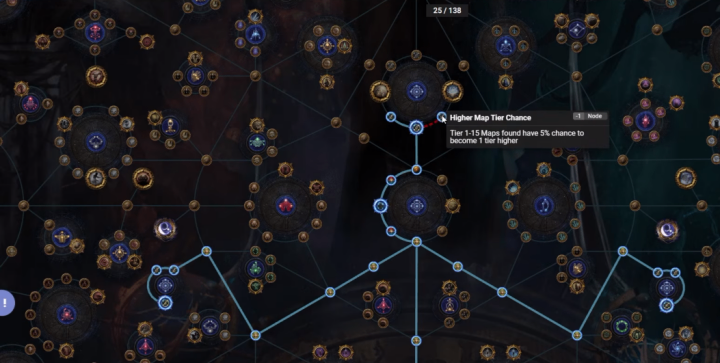
Your first Atlas Passive Points should focus on increasing map drops.
The priority looks like this:
Shaping the Mountains
Shaping the Skies
Shaping the World
These nodes greatly increase the chance of dropping higher-tier maps, helping you reach Tier 14 significantly earlier.
After securing map sustain, invest in Shrine nodes.
Shrines provide:
Massive temporary player power
Faster clear speed
Improved survivability
Faster boss rushing
Early league characters benefit enormously from Shrine buffs.
Step 9: Transition Into Red Altars
Once Tier 14 maps become comfortable, immediately allocate the Red Altar cluster.
Only select altar options that buff monsters rather than your own character's penalties.
Monster buffs are usually manageable, while player debuffs can drastically reduce map speed.
With proper Atlas investment, Red Altars become one of the best consistent currency generators during early progression.
Every map can produce:
Eldritch Embers
Chaos Orbs
Valuable altar rewards
Additional monsters
Increased profit
This strategy allows Atlas completion and currency farming to happen simultaneously.
Step 10: Finish Your Atlas and Transition Into Endgame Farming
After reaching roughly 120 Atlas Passive Points, your Atlas is essentially complete.
At this stage, you can begin specializing.
Popular farming strategies include:
Essence farming
Strongbox farming
Heist Cache farming
Conqueror Maps
Shaper Maps
Elder Maps
Synthesis Maps
Many players also begin investing in additional quantity nodes, increased pack size, and map effect modifiers for higher long-term returns.
Your Atlas tree can then evolve depending on your preferred endgame strategy.
Final Thoughts
Path of Exile 3.29 rewards players who combine efficient Atlas progression with intelligent currency generation. Rather than rushing map completion without profit, the modern strategy focuses on unlocking Tier 14 maps early, taking advantage of Red Altars, securing the first Voidstone quickly, cheap Path of exile currency, and using Kirac alongside map upgrade recipes to maintain momentum.
By prioritizing map sustain, Shrine buffs, and Exarch Altars while skipping low-value encounters, players can finish their Atlas faster than ever while accumulating a healthy supply of Chaos Orbs and Eldritch Embers during the crucial opening days of a new league. Once your Atlas is complete, transitioning into dedicated farming strategies becomes significantly easier, giving your character a strong economic foundation for the rest of the league.