









Summary
Looking for one of the most profitable PoE 2 Currency farming methods? This calculated Adonia Wand crafting strategy combines market analysis, Omen of Chance mechanics, Path of Exile 2 Currency, and probability math to generate massive profits. Instead of relying on traditional crafting, players can capitalize on market inefficiencies and potentially earn over 1,000 Divine Orbs per hour when executed correctly.
Step 1: Understand the Concept Behind Calculated Gamba
Most Path of Exile 2 players earn currency through mapping, boss farming, or profit crafting. However, another highly profitable method exists: calculated gambling.
Unlike random gambling, this strategy is built around probability, expected value (EV), and market pricing. The idea is simple:
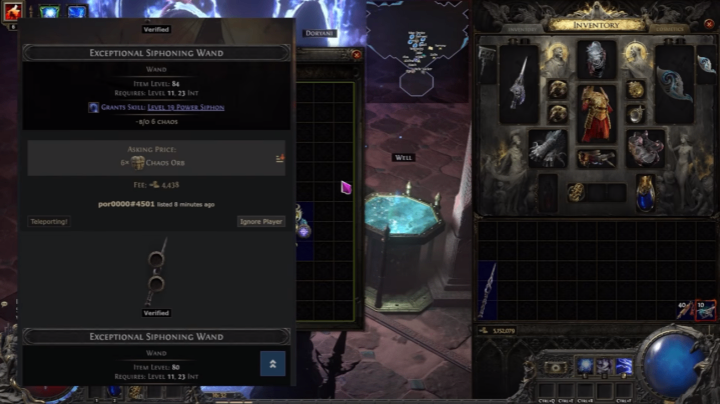
Purchase cheap Exceptional Siphoning Wand bases.
Upgrade them to 30% Quality.
Use an Omen of Chance to guarantee they become an Adonia Wand.
Sell the finished product for a significant profit.
The key isn't luck alone—it's ensuring that your average cost remains far below the market value of the finished item.
Step 2: Gather the Required Materials
Before starting, you'll need several important crafting materials.
Required Items
Exceptional Siphoning Wand (Normal, White)
Two Socket Base
Not Corrupted
Not Sanctified
Archonist Etchers
Vaal Infusers
Omen of Chance
The process begins by buying clean wand bases from the trade market.
Experienced crafters recommend purchasing these in bulk whenever prices are low. Market fluctuations can dramatically affect profitability, so patience often pays off.
Step 3: Increase the Wand to 30% Quality
Never attempt to improve the quality of an already-created Adonia Wand.
Instead:
Purchase a normal Exceptional Siphoning Wand.
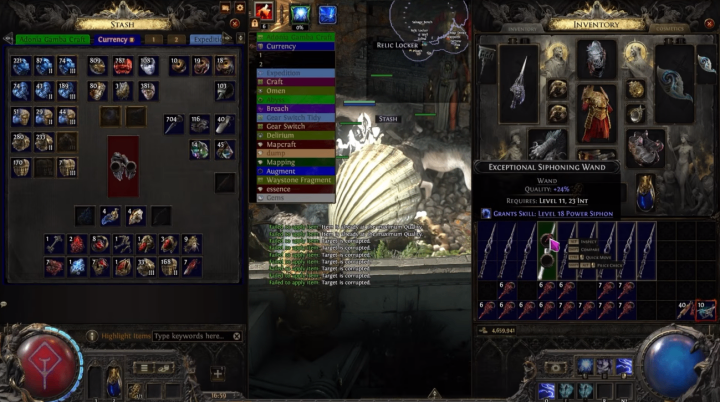
Increase it to 20% quality.
Use Archonist Etchers to push maximum quality higher.
Continue using Vaal Infusers until reaching 30% Quality.
This step carries the biggest risk because every use increases the chance that the item becomes corrupted.
Community testing suggests the overall success rate of reaching 30% Quality is roughly 17%, although individual attempts vary considerably.
That means, statistically, only about one in every six attempts succeeds.
Step 4: Use Omen of Chance for a Guaranteed Adonia
Once your wand successfully reaches 30% Quality, activate an Omen of Chance.
Normally, using an Orb of Chance can destroy valuable bases.
However, with Omen of Chance active, your next Orb of Chance guarantees the Exceptional Siphoning Wand transforms into an Adonia Wand instead of being destroyed.
This is where the profit comes from.
Since most players don't want to risk the quality crafting process themselves, perfectly prepared Adonia Wands command extremely high prices on the trade market.
Step 5: Calculate Profit Before Crafting
Never begin crafting without checking current market prices.
Three numbers matter most:
Base Wand cost
Crafting material cost
Finished Adonia selling price
For example:
Wand Base: 3 Divine Orbs
Omen of Chance: 23 Divines
Other crafting materials: approximately 18 Divines
Average crafting cost becomes roughly 45 Divine Orbs per successful Adonia.
If the market price is:
90 Divines → Around 45 Divine profit
144 Divines → Nearly 100 Divine profit
180 Divines → More than 130 Divine profit
Always calculate expected value before investing.
If margins shrink too much, simply wait for the market to stabilize.
Step 6: Craft in Large Batches
Variance is the biggest enemy.
One crafting session might produce several successful Adonia Wands.
Another might produce almost none.
That's why experienced players recommend crafting 50 to 150 bases at once.
A larger sample size naturally approaches the expected success rate.
For example:
First test
58 Wands
Only 5 successes
Success rate: 8.6%
Despite terrible luck, the project still generated over 120 Divine Orbs profit because market prices remained favorable.
Later testing produced:
152 Wands
24 successful Adonias
Success rate: 15.7%
This closely matched the expected 17% probability.
Bulk crafting dramatically reduces risk.
Step 7: Optimize Every Finished Adonia
Creating an Adonia isn't the final step.
Before listing it for sale, inspect its modifiers.
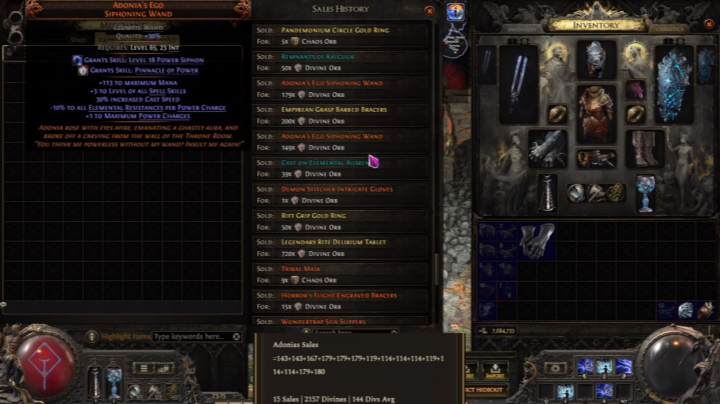
Buyers especially value:
+1 Maximum Power Charges
High Cast Speed
Maximum Mana rolls
+4 Level of All Spell Skills (Corrupted versions)
If necessary, spend several Divine Orbs rerolling modifiers.
A better-rolled Adonia often sells far faster while commanding substantially higher prices.
Even relatively small upgrades can increase profit margins significantly.
Step 8: Decide Whether to Corrupt the Wand
Many experienced crafters don't stop after creating a perfect 30% Adonia.
Instead, they intentionally corrupt it.
Possible valuable corruption outcomes include:
+4 Level of All Spell Skills
Third Socket
Other premium modifiers
Of course, corruption introduces another layer of risk.
Some corruptions produce almost no value.
Others create mirror-tier weapons worth several times more than the original item.
Whether corruption is worthwhile depends entirely on current market prices.
Always compare expected profit before taking additional risks.
Step 9: Manage Your Bankroll
Even mathematically profitable strategies require enough capital.
Because variance exists, unlucky streaks happen.
A recommended bankroll includes:
Minimum: 90 Divine Orbs
Comfortable: 120 Divines
Recommended: 200–300+ Divines
Having a larger bankroll allows you to survive unlucky runs without being forced to stop crafting before probability balances out.
Treat this strategy like an investment rather than a lottery ticket.
Step 10: Scale the Strategy for Massive Currency
After several days of testing, the long-term results became even more impressive.
Final statistics included:
152 Exceptional Siphoning Wands crafted
24 successful Adonias
Average selling price: 144 Divine Orbs
Total revenue: over 3,400 Divines
Net profit: approximately 2,300 Divine Orbs
Even after base wand prices increased dramatically—from 3 Divines to 10 Divines—the strategy remained profitable because finished Adonias retained strong market demand.
The average profit still exceeded 57 Divine Orbs per successful craft, making it one of the strongest crafting arbitrage methods available.
Final Thoughts
This Adonia Wand strategy demonstrates that some of the best PoE 2 Currency farming methods don't involve endless mapping or boss farming. Instead, they rely on understanding market demand, probability, and crafting economics.
The most important lesson isn't simply how to craft Adonia Wands—it's learning to identify profitable market gaps. Whenever the value of a finished item greatly exceeds the cost of its components, opportunities like this emerge.
As prices shift throughout each league, today's best crafting strategy may eventually become less profitable. However, the underlying principle remains the same: calculate expected value, buy efficiently, craft in bulk cheap Path of Exile 2 Currency, and manage your bankroll wisely.
For players looking to maximize their wealth in Path of Exile 2, mastering calculated crafting investments like the Adonia Wand strategy can be one of the fastest and most consistent ways to build an enormous stash of Divine Orbs while staying ahead of the market.