






Summary
Athletes are some of the most valuable recruits in College Football 27 Dynasty, but only if you use their flexibility correctly. The overall rating shown on the position-change screen can be misleading, and simply choosing the highest number can turn a promising recruit into a wasted scholarship.
The key is to look beyond overall rating and consider the attributes that actually matter at each position. Some athletes become elite starters after a position change, while others should stay exactly where they were recruited. To find these hidden gems, buy CUT 27 Coins and unlock premium scouting tools.
How to Evaluate an Athlete Before Changing Positions
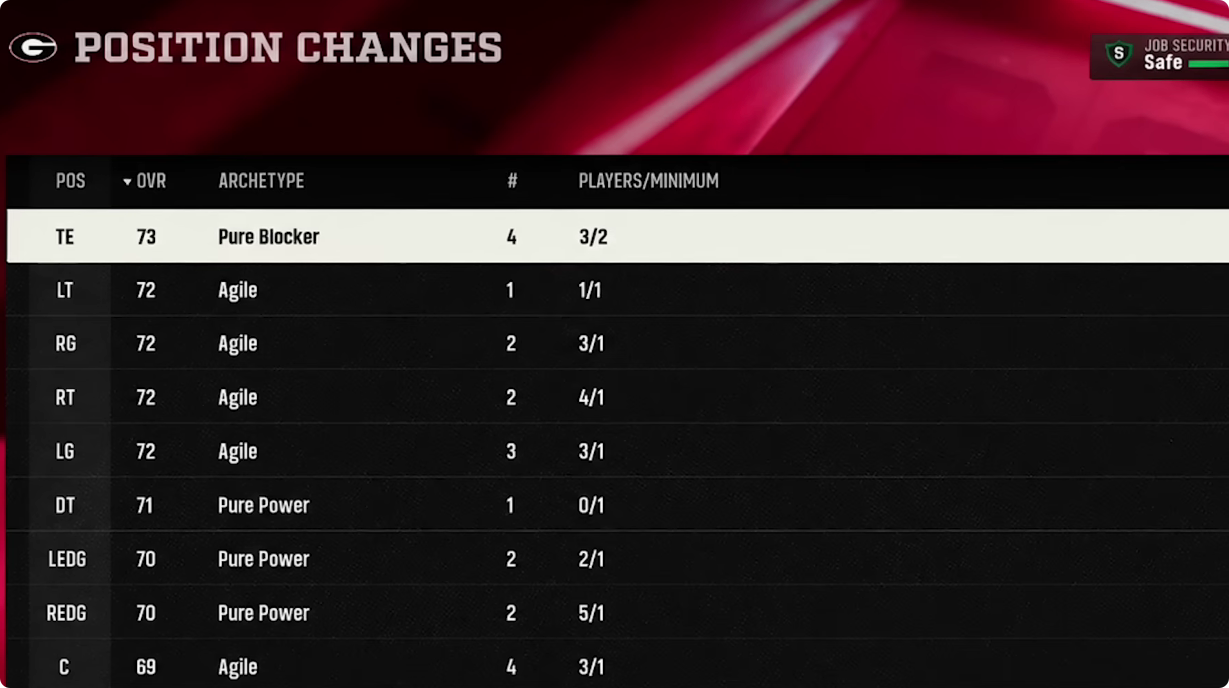
Before moving an athlete, compare his ratings at every possible position instead of immediately choosing the highest overall.
Don't Rely Only on Overall Rating
The position-change screen gives you an overall rating for each position, but that number doesn't tell the whole story. A player may have a high overall at tight end, for example, while having poor catching and route-running attributes that make him ineffective as a receiver.
Look at the traits that define the position:
QB: Throwing, speed, agility, change of direction, and athleticism
RB: Carrying, catching, route running, speed, and break tackle
WR: Speed, acceleration, catching, and route running
TE: Catching, route running, speed, and blocking
CB: Coverage, speed, press, awareness, and catching
LB: Tackling, block shedding, hit power, pursuit, and awareness
S: Coverage, tackling, speed, catching, and hit power
EDGE/DT: Strength, block shedding, power moves, finesse moves, and tackling
This approach prevents you from making a position change that looks good on paper but creates a poor player on the field.
Best Position Changes for Each Athlete Archetype
Not every athlete has the same strengths. Some are excellent offensive conversions, while others are much better defensive prospects.
Athlete Dual Threat QB
Athlete dual-threat quarterbacks are among the most flexible recruits. Compared with normal dual-threat quarterbacks, they generally have stronger athletic attributes, including speed, acceleration, agility, change of direction, jumping, trucking, and throwing under pressure.
Their main weaknesses are break sack and play action.
Best options:
1. Keep at QB
2. Move to WR
3. Consider RB for a receiving-focused role
At running back, they tend to have better catching and route running but weaker trucking, stiff arm, and break tackle. At wide receiver, their short- and medium-route running can be particularly useful.
They can also become receiving-focused tight ends, but their blocking is a major weakness.
Athlete Pure Runner QB
Pure runner athletes are similar to normal pure runner quarterbacks, with some improvements in throw under pressure, trucking, and break sack.
They can also work at running back, where they generally offer good route running and receiving ability but weaker power-running attributes.
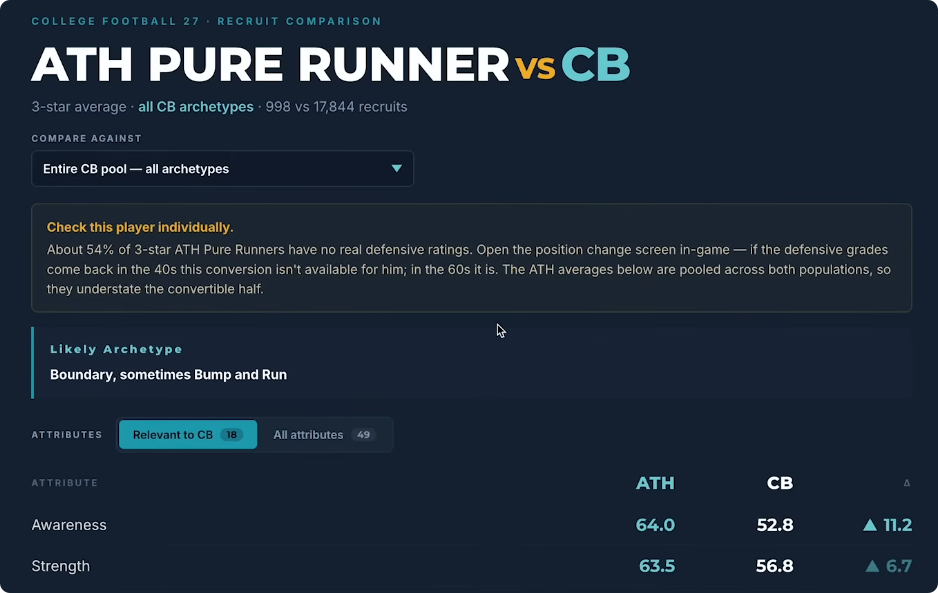
Some pure runner athletes are also two-way athletes, meaning they possess meaningful defensive ratings. During position-change week, check their defensive ratings:
Ratings around the 60s can indicate a viable defensive conversion.
Ratings in the 30s or 40s generally mean the player is primarily an offensive athlete.
Two-way athletes can potentially become useful safeties or cornerbacks.
Athlete Backfield Threat
Backfield threats are one of the most common athlete archetypes.
At running back, their offensive attributes are generally similar to normal backfield threats, so there isn't necessarily a major reason to move them.
Cornerback is much more interesting. They commonly become boundary corners and can have stronger press, catching, and strength than comparable cornerbacks.
However, check their defensive ratings first. Some backfield threats lack meaningful defensive attributes and should remain on offense.
Best options: RB, QB, or CB depending on their individual ratings and physical profile.
Athlete Elusive Bruiser
Elusive bruisers are another excellent defensive conversion.
Their offensive ratings are similar to comparable running backs, but they can become very useful cornerbacks. At CB, they can offer strong press, awareness, block shedding, strength, and pursuit.
They can also work at safety, although their size and defensive attributes make cornerback the more attractive conversion in many cases.
Avoid moving them to linebacker or EDGE unless the individual recruit has unusually strong defensive ratings. Their typical hit power, tackling, and size aren't ideal for those positions.
Best option: CB.
Athlete Contact Seeker
Contact seekers are among the best athletes to move to defense.
At running back, their offensive ratings are generally comparable to normal contact seekers. Their real value comes when you move them to linebacker.
As a lurker linebacker, they can have strong block shedding, finesse moves, play recognition, hit power, power moves, pursuit, and toughness.
They can also become box-oriented safeties, where they provide useful tackling, strength, zone coverage, and run-stopping ability.
Best option: LB.
If you need a physical safety who can help against the run, safety is another option.
Athlete Contested Specialist
Contested specialists can become excellent cornerbacks.
They tend to have strong athletic attributes, including change of direction, agility, juke, and spin move. At cornerback, they can offer better awareness, catching, and hit power than comparable bump-and-run corners.
Their biggest advantage is physical size. They can be roughly 3.5 inches taller and 17 pounds heavier than comparable cornerbacks.
That makes a 6'3" or 6'4" athlete contested specialist particularly interesting as a CB.
Avoid linebacker conversions because their strength, tackling, block shedding, and defensive-line attributes aren't strong enough.
Best option: CB.
Athlete Physical Route Runner
Physical route runners are more situational.
They have solid athleticism and can work at linebacker, but they don't have many major attribute advantages over normal linebackers. Their speed is also a concern, particularly if you're considering using them in the secondary.
If you recruit one, pay close attention to his speed before deciding where he belongs.
Best option: LB, although the individual recruit's speed should determine whether the conversion is worthwhile.
Athlete Agile Offensive Tackle
Agile offensive tackles are a perfect example of why you shouldn't trust the position-change overall rating.
The game may show a very high overall when you move them to tight end, but their receiving attributes can be dramatically worse. Their catching, catching in traffic, route running, and carrying can all be poor.
Unless you specifically want a blocking-only tight end, keep these athletes on the offensive line.
They are also interesting candidates for defensive tackle, where they can become power-oriented players.
Best options: OL or DT.
Athlete Speed Rusher
Speed rusher athletes are a newer archetype and require more careful evaluation.
They can have useful athletic traits and may work as EDGE players, but their strength can be lower than traditional speed rushers. Moving them to defensive tackle is generally questionable because of the strength requirement.
They can also become linebackers, but lower awareness, tackling, play recognition, and strength make that conversion less appealing.
Best option: Keep at EDGE unless the recruit's individual attributes strongly support another position.
Athlete Lurker
Athlete lurkers are another strong linebacker archetype.
At linebacker, they can provide excellent power moves, finesse moves, and block shedding while maintaining competitive athleticism. Their slightly lower catching and hit power usually aren't enough to outweigh those advantages.
They can also become safeties, especially if they have excellent speed. For a safety conversion, look for recruits with at least mid-80s speed, with higher ratings being preferable.
Avoid moving them to EDGE because their size and block-shedding profile can become limiting.
Best options: LB or athletic S.
Best Athlete Position Changes to Remember
You don't need to memorize every attribute comparison. The most useful conversions from the source data are:
| Athlete Archetype | Best Position Change |
|---|---|
| Dual Threat QB | QB / WR |
| Pure Runner QB | QB / RB / S if two-way |
| Backfield Threat | RB / CB |
| Elusive Bruiser | CB |
| Contact Seeker | LB |
| Contested Specialist | CB |
| Physical Route Runner | LB |
| Agile Offensive Tackle | OL / DT |
| Speed Rusher | EDGE |
| Lurker | LB / S |
The biggest lesson is simple: don't position-change an athlete just because the game shows a higher overall rating. Check the underlying attributes, physical profile, and whether the athlete actually has usable ratings at the new position.
For Dynasty programs with limited recruiting resources, finding the right athlete and putting him in the right spot can be one of the easiest ways to turn an overlooked recruit into a major contributor. To maximize your scouting efficiency, CUT 27 Coins can unlock premium tools that help you identify these hidden gems faster and build a stronger roster on a budget.