Weekend Drop -














Summary
Recruiting in College Football 27 is not about putting the highest-rated prospects on your board and hoping for the best. Every scholarship, recruiting hour, and scouting decision has an opportunity cost. If you spend too many resources chasing recruits you are unlikely to sign, your class can fall apart before you realize it.
The most effective approach is to evaluate position scarcity, program fit, recruiting cost, archetypes, and player attributes before investing heavily in a prospect. To make smarter investments, buy CUT 27 Coins and unlock premium recruiting tools for deeper player insights.
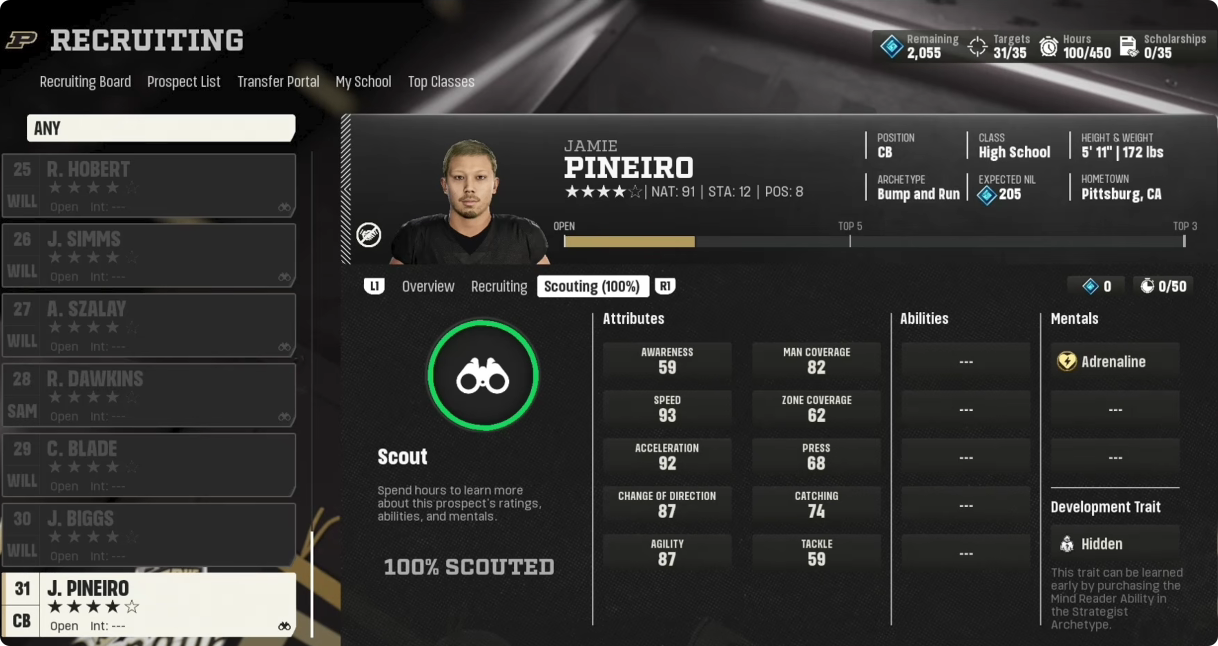
Step 1: Identify Which Positions Need Early Attention
Not every position should be recruited with the same urgency. The size and quality of each position's recruiting pool should determine how aggressive you need to be.
Prioritize Scarce Positions
Positions with fewer quality prospects should be attacked early. Safety is one of the clearest examples. Strong safety, in particular, can have a relatively small number of three-star-or-better prospects in a typical class.
Other positions that can become difficult to fill include:
Safety
Cornerback
Defensive tackle
Center
Guard
When the player pool is small, waiting for a better prospect later can leave you with no realistic alternatives.
Be Patient With Deep Positions
Quarterback, wide receiver, and halfback generally offer much larger pools of prospects. That gives you more freedom to wait.
Quarterback is especially interesting because it can be expensive to recruit early. If a quality quarterback still has little or no competing interest several weeks into the season, you may be able to pursue him later with fewer resources.
Halfback can be even easier to replace because the transfer portal can provide plenty of options.
The key principle is simple:
Scarce positions require early action. Deep positions reward patience.
Position flexibility also matters. A shortage at center, for example, can sometimes be solved by recruiting guards or tackles and moving them to center later. Safety is harder to replace because converting another position may create significant athletic limitations.
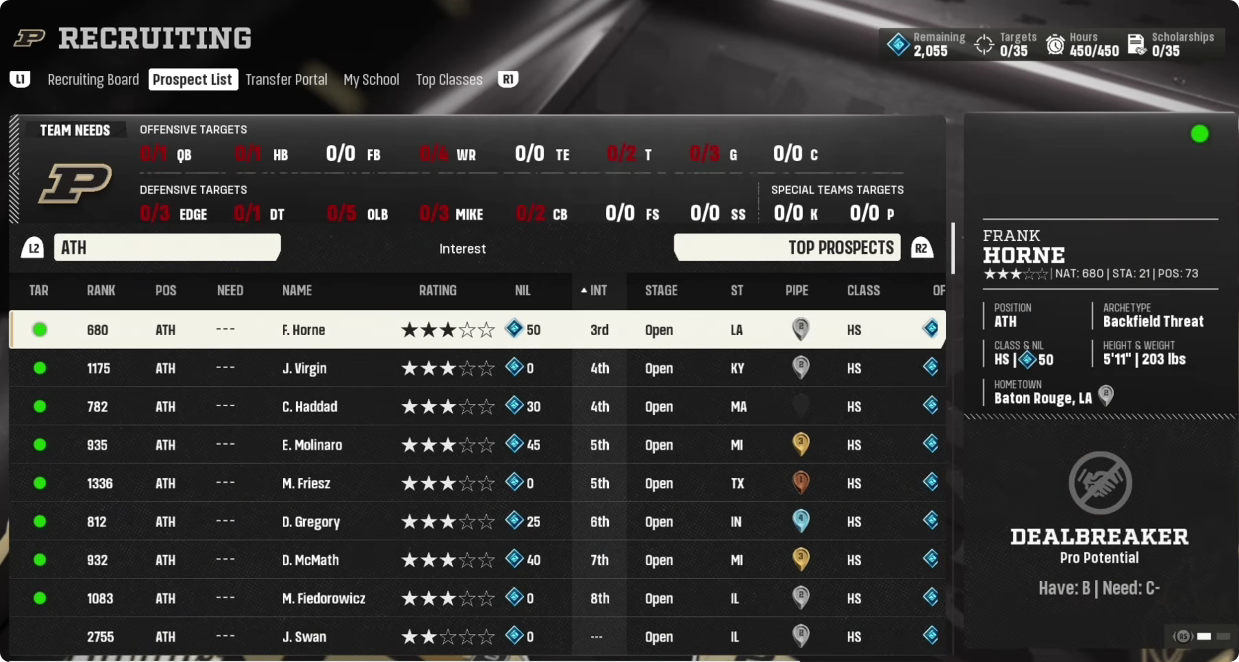
Athletes are particularly valuable because their versatility can solve roster problems at positions where natural prospects are scarce.
Step 2: Put Every Recruit Into a Target Bucket
Once you know which positions you need, don't simply select the highest-rated prospects. Divide your board into three categories.
Long Shots
These are elite recruits you would love to sign but have a limited chance of landing.
You should keep this group small—usually around two to four players. Pipeline advantages can make a highly rated recruit worth pursuing, but don't allow one long shot to consume your entire recruiting budget.
If you fall significantly behind early, move on.
Priority Targets
These are the recruits you are genuinely trying to sign. They should receive the majority of your recruiting hours.
Your priority targets should balance talent with realistic chances of winning the recruiting battle.
Foundation Pieces
Foundation recruits are prospects you feel confident you can land. They provide stability and help ensure that your class still has enough players even if several priority targets choose other schools.
Your program's prestige should determine how these categories shift.
A rebuilding program might view:
Four-stars as long shots
Three-stars as priority targets
Two-stars as foundation pieces
A three-star program might instead target five-stars as long shots, four-stars as priorities, and three-stars as foundations.
A powerhouse can move the entire scale upward, making five-stars priority targets and four-stars foundation pieces.
Step 3: Build the Board as Cheaply as Possible
After establishing your target buckets, compare prospects based on how expensive they will be to recruit.
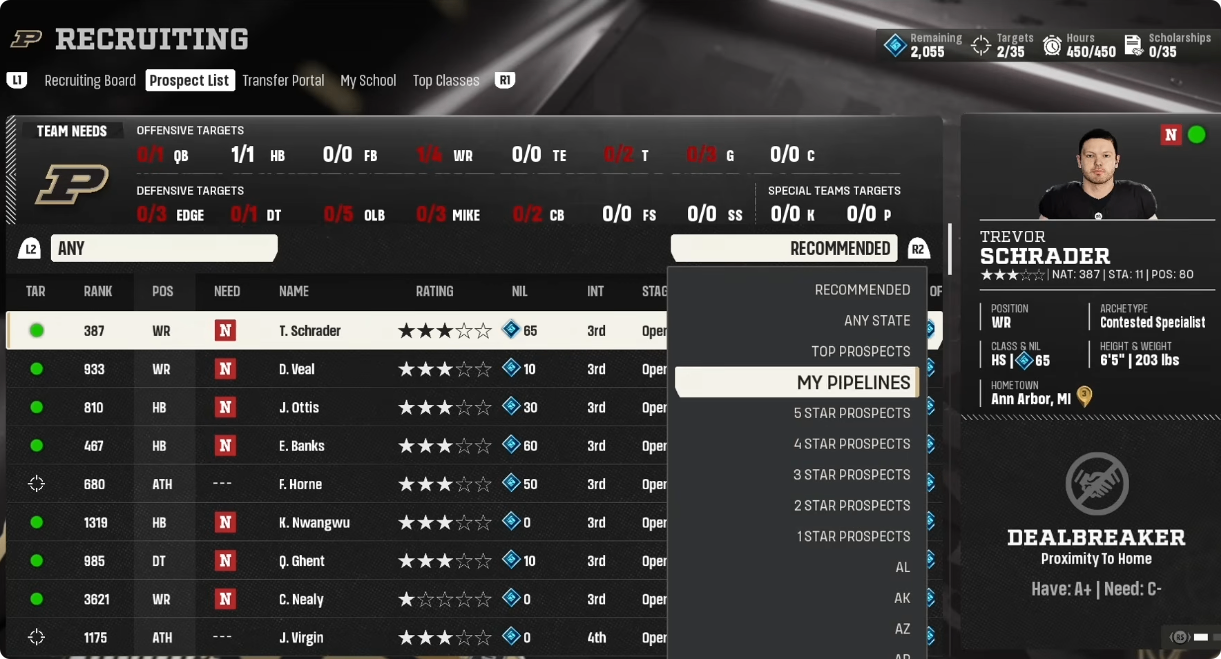
Start With Pipeline Advantage
Your first filter should be pipeline strength.
Pipeline advantages can give you a recruiting multiplier throughout the season, meaning prospects in your strongest recruiting regions can require fewer resources to win.
When several prospects are similar, prioritize the one where you already have the strongest pipeline.
Look for Existing Interest
A recruit who already likes your school is another excellent target.
Existing interest means you have less ground to make up, which can translate into fewer recruiting hours. It can also indicate that your school already matches some of the recruit's preferences.
Instead of fighting an uphill battle for an equally talented prospect, take advantage of recruits who are already leaning toward your program.
Target Underclaimed Regions
You should also look for areas where competing schools don't have strong pipeline advantages.
Regions such as Nebraska, Colorado, New Mexico, and parts of the Big Sky area can sometimes provide opportunities because fewer major programs have overwhelming recruiting advantages there.
The basic priority is:
1. Strong pipeline advantage
2. Existing recruit interest
3. Weak competition in the recruit's region
Use these filters to fill your board before spending heavily on individual prospects.
Step 4: Recruit Archetypes, Not Just Scheme Fits
One of the biggest mistakes is forcing every recruit to fit your current scheme.
In CFB 27, some archetypes can enter your program with better starting attributes or more efficient upgrade paths. Instead of completely building your recruiting board around your scheme, consider building around valuable archetypes and adapting your roster accordingly.
Target Man-Coverage Corners
If you rely heavily on man coverage, Bump and Run and Field Corner prospects are attractive options.
These archetypes can be particularly valuable because of their ability to develop important man-coverage abilities.
On offense, prioritize receivers who can consistently defeat man coverage. Route Runner archetypes, especially physical route runners, can provide strong development potential.
Build Around the Run Game
At running back, look for archetypes that give you either explosive movement or reliable contact ability.
Depending on your preferred style, Elusive Bruiser, East-West Playmaker, and Contact Seeker prospects can all be valuable.
Defensively, a run-heavy meta makes strength and block shedding particularly important.
At defensive tackle, Pure Power prospects can be excellent targets. At edge, Edge Setter prospects can provide the physical attributes needed to fight through blocks.
At linebacker, Signal Caller and Thumper archetypes deserve attention. At safety, Box Specialist and Hybrid prospects can be useful against the run.
Mental abilities such as Instinct can also be valuable when evaluating linebackers and safeties.
Step 5: Scout the Players Who Actually Matter
You don't have enough recruiting hours to fully scout everyone on your board.
Scout your priority targets first, followed by your foundation players. Long shots generally shouldn't receive extensive scouting investment because you are already taking a gamble on signing them.
Check for Gems and Busts
When scouting, the first thing to check is whether the prospect is a Gem or Bust.
A Gem indicates significant upside, while a Bust is a warning that the player may not develop as well as expected. However, this information does not appear on every recruit, so you cannot build your entire evaluation process around it.
When no Gem or Bust information appears, move on to the attributes that are hardest to fix.
Step 6: Prioritize Speed and Power
Two of the most important scouting categories are Quickness and Power.
These attributes can be extremely expensive to improve later. If a recruit arrives slow or physically weak, correcting that weakness can consume a large portion of his development resources.
Other attributes are often easier to improve.
For example, a cornerback with slightly weaker coverage ratings may still be worth recruiting if his athletic profile is excellent. You can develop coverage later, but turning a naturally slow player into an elite athlete is much harder.
Compare Prospects to Their Archetype
Don't evaluate speed or strength using one universal number.
A good athletic profile depends on the player's position, archetype, and star rating. A speed rating that is excellent for one archetype may be average for another.
Therefore, compare a prospect against similar players rather than simply asking whether his overall attributes look good.
Step 7: Look for Abilities and Unlockable Thresholds
Attributes aren't the only things worth scouting. Pay attention to the mental and physical abilities a prospect already possesses—or is close to unlocking.
For example, a linebacker with acceleration in the mid-to-high 80s may be particularly attractive if a valuable ability requires a higher acceleration threshold. You are not just recruiting the player he is today; you're evaluating how cheaply you can turn him into the player you want.
The same principle applies to defensive tackles.
A prospect with excellent strength can be valuable not only because he is difficult to block, but because strength can unlock important abilities. Archetype-specific thresholds matter, so always consider how close a recruit is to an ability rather than looking at the attribute in isolation.
Final Recruiting Strategy
Start by identifying positions where the player pool is limited. Divide prospects into long shots, priority targets, and foundation pieces. Favor pipeline advantages and existing interest when choosing between similar players. Then evaluate archetypes and prioritize recruits with strong Quickness and Power attributes.
Most importantly, spend your scouting hours where they have the greatest impact.
A great recruiting class comes from consistently making small advantages work in your favor—not from wasting hours chasing every highly rated prospect on the board. CUT 27 Coins unlocks premium scouting tools to help you build a winning class efficiently.