







Summary
Late in a league, the community usually argues on the forums and waits for the next announcement. This time, players reverse-engineered Memory Strands from tens of thousands of test rolls and published the first real model of how they work. The result is the biggest crafting discovery of the year: strands quietly ban the lowest modifier tiers on an item, Falborne currency adds a hidden +30 strands, and Orbs of Unraveling roll upgrades independently on every mod with a strong bias toward tier-2 to tier-1 jumps. This guide breaks down what matters for your crafting and how POE Currency fits into the process, without the spreadsheet.
What Memory Strands Actually Do
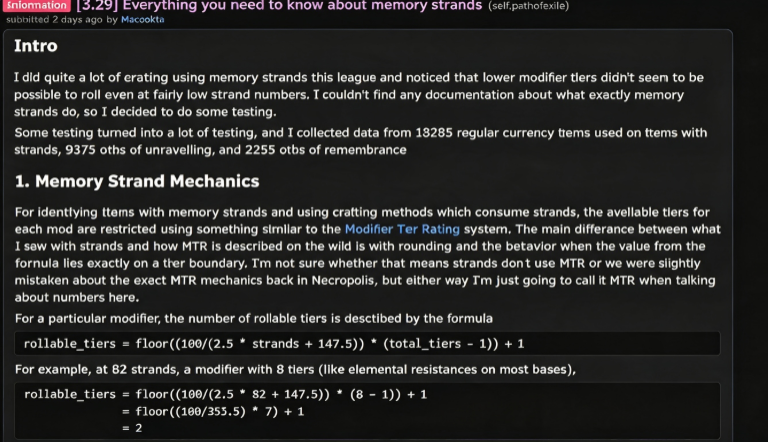
Strands cap which modifier tiers can roll on an item. The most surprising finding is how aggressively the first strand works. A normal Transmutation orb on a plain amulet dumps you into the bottom of the mod pool — tier-13 resistance, tier-12 or 13 mana, the kind of roll you vend. Even one or two strands already culls those bottom tiers.
The math behind it: the first strand you apply is worth roughly twenty normal strands. That means going from zero to one is by far the biggest jump on the entire strand curve. Every additional strand after that buys smaller and smaller improvements, which is why the breakpoint table below matters more than stacking as many strands as possible.
The Strand Breakpoint Table
For a modifier family that has 13 possible tiers (the classic example is mana on amulets), the allowed tiers collapse as strands climb:
Memory strands on item | Tiers still allowed (of 13) |
0 | All 13 |
1 | 9 |
2+ | 8 |
10+ | 7 |
22+ | 6 |
38+ | 5 |
62+ | 4 |
102+ | 3 |
Two practical notes. First, the banned bottom tiers do not disappear from the economy — they either reroll within the same mod family until they land on a legal tier, or they reroll across the whole item. The community is still debating which, and it only matters if a craft is underperforming. Second, 102 strands is unreachable on a normal item, but Falborne currency closes that gap.
Falborne Currency Is a Hidden +30 Strands
Falborne Exalted, Falborne Regal, and Falborne Augmentation all behave as if the item has thirty extra strands when you apply them. That sounds huge, but it only matters at a breakpoint boundary.
Worked example: a 77-strand amulet you want to Regal for flat energy shield. With 11 possible ES tiers, 77 strands already bans everything below tier 3. A Falborne Regal pushes you to 107 strands — still not enough to ban tier 3. So the Falborne version does nothing extra here. The +30 bonus only changes the outcome when you sit just below a breakpoint, for example at 8 strands versus the 10-strand cutoff. Check the table before you spend the premium currency.
Orbs of Unraveling: How Upgrades Are Rolled
Each modifier on the item is rolled independently. One mod upgrading does not reduce the chance of another mod upgrading. The chance a given mod upgrades is:
strands × total weight of higher-tier versions of that mod ÷ (2 × total prefix or suffix weight).
Worked example: a tier-6 "Pulsing" flat ES mod on an intelligence chest, with five higher tiers each at 1,000 weight. Candidate weight is 5,000; total side weight is 61,000. The chance becomes strands × 5,000 ÷ 122,000. At 25 strands or more, the upgrade is guaranteed; below that, it is a straight roll. This is not a PoE2-style surpassing chance — 100% is a hard cap, no overflow.
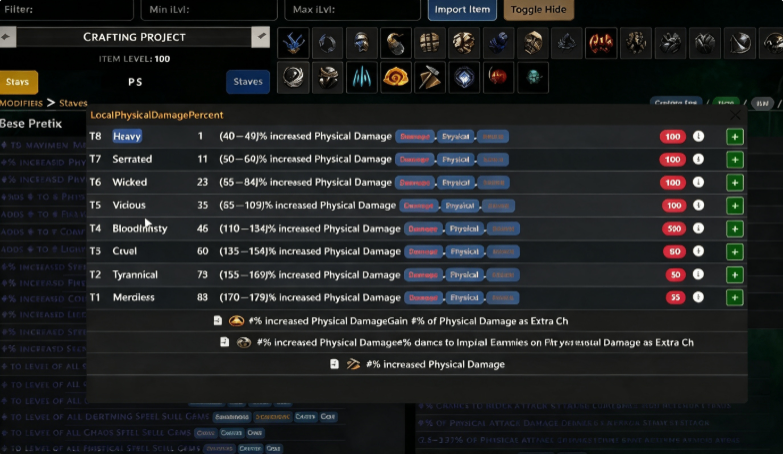
When an upgrade does happen, it is biased toward the smallest jump. A tier-2 mod upgrading is guaranteed to land on tier 1. A tier-4 or lower mod upgrading usually only climbs one tier, with a small chance to jump further. The available weights cascade: climbing from "Heavy" to "Serrated" dominates the raffle, while all the way to "Merciless" is a long shot.
When to Actually Use an Unraveling Orb
The best targets are items with several tier-2 mods, not items with one perfect tier-1 and a pile of junk. A tier-2 mod that upgrades to tier 1 is a clean win; a low-tier mod upgrading usually only creeps up one rung.
The sweet spot is a mod family where tier 2 is common but tier 1 is rare. The classic example is fire spell skill gem levels: the +4 version is tier 1 at 125 weight (rare), while +3 is tier 2 at 1,000 weight (common). Unraveling a +3 gives you a modest upgrade chance, but if it fires, the prize is the +4 — because the only step up is tier 1. By contrast, unraveling a mid-tier mod with several common steps above it usually just buys you one small bump.

Player Recommendations
Always apply at least one strand before your final crafting step — the 0-to-1 jump is worth twenty strands.
Check the breakpoint table before spending Falborne currency; the +30 bonus only matters near a cutoff.
Save Orbs of Unraveling for items with multiple tier-2 mods on a tight item — that is where they shine.
On trade league, unraveling orbs are cheap; use them on anything worth finishing. In SSF, bank them until your character is otherwise done.
Use the community strand calculator rather than hand-math the odds when you are about to spend premium currency.
Final Verdict
Memory Strands looked like a vague quality-of-life affix until the community reverse-engineered the breakpoint table. Now they read as a deliberate crafting lever: the first strand does the heavy lifting, Falborne currency is a conditional +30, and Orbs of Unraveling reward you for leaving your best mods at tier 2 rather than forcing them to tier 1 early.
The practical takeaway is not to over-stack strands. Hit the breakpoint that bans the tiers you hate, leave the good mods at tier 2, and let an unraveling orb do the last step. With patch 3.30 still unannounced and the release window shrinking, this is the kind of deep mechanic that will shape crafting for the rest of the league — worth understanding now, not when you are staring at a half-finished amulet at 3 a.m. Players who want to optimize their crafting resources can also buy POE Currency when preparing for high-value crafting attempts.