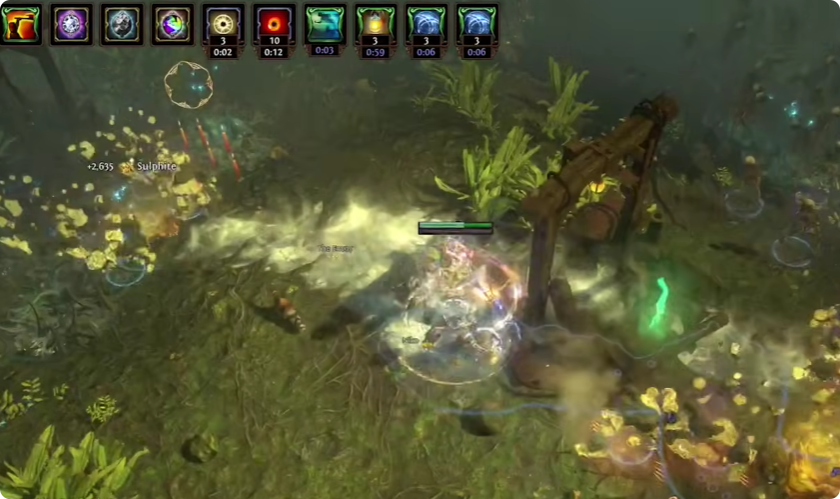







Summary
Abyss farming has become one of the most profitable ways to generate currency in Path of Exile when you combine Abyss mechanics with powerful rare monsters and scarab-focused Atlas investment. A recent testing session showed a particularly strong version of this strategy, generating roughly 63 Divines worth of loot in one hour and around 36 Divines per hour after investment.
The strategy revolves around Abyss, rare monsters, Allflame mechanics, scarabs, and high-scarab map rolls. It is expensive to run, however, and works best with a powerful build capable of handling heavily modified rare monsters. To cover the upfront costs, buy POE Currency and invest in the scarabs and map rolls you need.

How the Abyssal Shrine Farming Strategy Works
The basic idea is to create maps containing a large number of rare monsters, then use Allflame and scarab mechanics to make those rares significantly more rewarding.
Core Strategy
The tested setup uses:
Tier 16+ Jungle Valley maps
Abyssal Astrolabe
Two Nemesis Scarabs
Allflame of Propagation
Betrayal Scarab of the Allflame
Red Altars
Heavy Abyss and Scarab Atlas investment
Maps with roughly 80%+ increased Scarabs found
High-value map modifiers that your build can safely handle
The two Nemesis Scarabs increase the number of rare monsters. Allflame of Propagation then allows modifiers from powerful rare monsters to spread to other rares, creating groups of highly rewarding enemies.
The result is a map packed with rare monsters carrying multiple modifiers, producing large amounts of scarabs, fragments, currency, and other valuable drops.
Why Rare Monsters Matter
This strategy is not simply about spawning as many Abyss monsters as possible. The important part is creating high-value rare monsters and multiplying their rewards.
Propagation is especially useful because it spreads modifiers between rare monsters. This can make packs considerably more dangerous, but it also increases their potential loot.
For that reason, this farming method favors strong characters that can kill heavily modified rares without losing too much time.
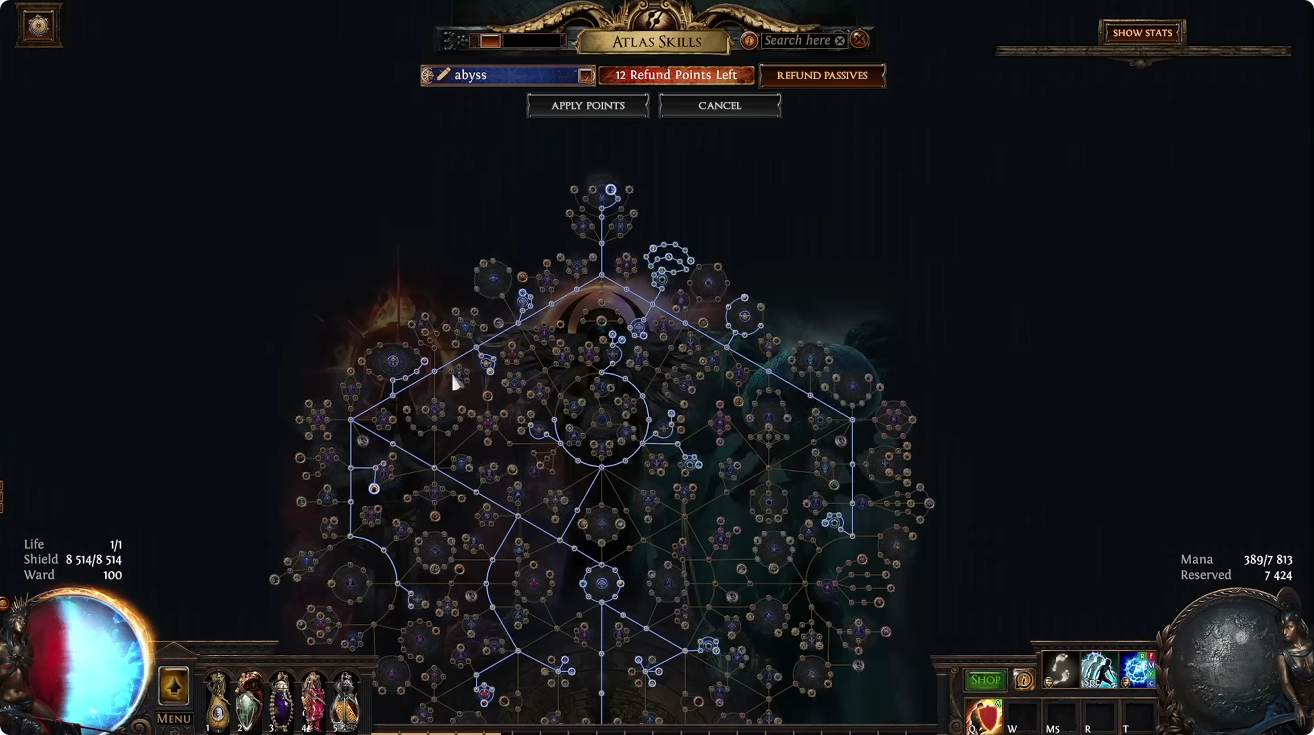
Atlas Tree Setup
The Atlas tree should prioritize Abyss, Scarabs, and mechanics that increase valuable scarab drops.
Instead of copying a standard Abyss tree exactly, the tested setup replaces some Kalguur-related nodes with Hernoth and additional Ultimatum investment to improve the chance of obtaining valuable Ultimatum Scarabs.
Key Atlas Priorities
Focus your Atlas investment on:
1. Abyss passives
2. Scarab quantity and quality
3. Blocking unwanted or low-value mechanics
4. Red Altar bonuses
5. Ultimatum-related scarab opportunities
6. Additional mechanics that increase monster density
The goal is to turn the Atlas into a scarab-generation engine while maintaining enough Abyss investment to support the core strategy.
Map Choice and Map Rolling
Jungle Valley is the preferred map for this strategy because its layout is convenient for fast farming and it works well with the overall setup.
What Maps Should You Run?
Use Tier 16+ Jungle Valley and roll maps with high Scarab modifiers.
The testing described approximately 60.5 maps in one hour, with each map costing around 0.9 Divines before additional rolling costs.
Look for maps with approximately 75–80% or more increased Scarabs found. You do not need to force every possible modifier if it makes the map dangerous or inefficient.
The most important rule is simple:
Only run modifiers your build can comfortably handle.
A theoretically higher-value map is not profitable if it dramatically slows your clear speed or causes frequent deaths.
Scrying and Map Value
If you are using a scryable Jungle Valley setup, you can consider scrying the map for valuable divination-card outcomes such as The Apothecary, depending on your overall farming plan.
However, the core profit of this strategy comes from the monster and scarab setup rather than relying on an expensive jackpot drop.
Scarab Setup
The scarabs are the heart of the strategy.
Two Nemesis Scarabs
Two Nemesis Scarabs are used to increase the number of rare monsters inside the map.
More rares mean more opportunities for propagated modifiers and more valuable drops.
Allflame of Propagation
Allflame of Propagation is one of the most important components.
It allows rare-monster modifiers to spread, creating groups of significantly stronger enemies. Those monsters can become extremely dangerous, but their increased reward potential is what makes the strategy attractive.
Betrayal Scarab of the Allflame
The Betrayal Scarab of the Allflame increases monster presence associated with the Allflame mechanic, further supporting the high-density rare-monster setup.
What About Wisp Scarabs?
The original testing used a Wisp Scarab, but this is not necessarily recommended.
When Wisp Scarabs become expensive, their additional investment can significantly reduce the strategy's profit margin. If the objective is consistent currency generation, compare the scarab's market price against the additional loot it realistically produces.
In other words, do not automatically copy every scarab from someone else's test. Recalculate the investment whenever scarab prices change.
Profit Calculation
The reported test produced approximately:
60.5 maps completed
63 Divines in loot
Approximately 0.9 Divine investment per map
Roughly 27 Divines in total map investment
Around 36 Divines/hour profit
The reported loot consisted primarily of Scarabs, fragments, currency, and other valuable drops.
Importantly, an additional extremely valuable drop was excluded from the calculation. That makes the result more useful as a baseline rather than assuming every farming session will contain a jackpot item.
Actual profit will vary considerably depending on market prices, map speed, scarab prices, character power, and valuable random drops.
Build Requirements
This is not a beginner-friendly farming strategy.
Headhunter vs. Mageblood
A build using Headhunter is particularly well suited to this strategy because the map contains a large number of rare monsters with multiple modifiers.
As rare modifiers accumulate, Headhunter can turn the character into an increasingly powerful monster-killing machine.
Mageblood can also work extremely well, particularly for builds that need consistent defenses, movement speed, or flask-based scaling.
The most important requirement is not the belt itself, though. Your build must be able to:
Kill heavily modified rare monsters quickly
Survive dangerous rare combinations
Maintain fast map clear speed
Handle high-tier map modifiers
Deal with dense Abyss encounters without constant deaths
How to Maximize Your Profit
Prioritize Map Speed
Do not spend excessive time chasing individual monsters or difficult encounters. The strategy makes money through repeated high-density maps, so efficient clears are critical.
Recalculate Your Investment
Scarabs can fluctuate heavily in price when a profitable strategy becomes popular. A setup that produces excellent returns at one price can become mediocre after demand increases.
Before starting a farming session, calculate:
Expected Profit = Total Loot Value − Map and Scarab Investment
Avoid Overinvestment
The Wisp Scarab is a good example of why you should not blindly copy another player's setup. If its price rises significantly, removing it may actually improve your profit per hour.

Final Thoughts
This Abyss farming strategy combines high rare-monster density, Allflame of Propagation, Abyss mechanics, scarab investment, and Red Altars to create a powerful endgame currency-farming setup.
The reported test reached approximately 36 Divines of profit per hour after investment, with Scarabs making up a significant portion of the returns. However, that figure should be treated as a benchmark from a specific farming session rather than a guaranteed income rate.
If you have a strong Headhunter or Mageblood build capable of destroying heavily modified rare monsters, Jungle Valley Abyss farming is a particularly attractive high-investment strategy to consider. With POE Currency, you can fund the scarabs and high-roll maps needed to maximize your returns.