






The key is understanding foundation support, pillars, material weight, and the game's different snapping modes. Blueprint-or Ghost Mode-also lets you plan an entire structure before spending valuable resources. If you're preparing a major construction project and need additional resources for progression, you can buy RS gold at MMOexp to help level up your game and support your adventures.
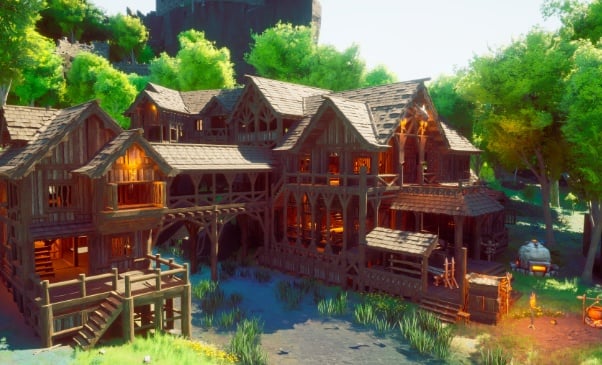
Understand Storage Range and Building Stability
One of the first mechanics builders should understand is the storage access range. When pulling materials from a chest while building, your construction area needs to remain within approximately 10 foundation spaces of the storage.
Stability is equally important. Wooden cabin pieces provide basic support, while stone offers greater stability. Using the Eye of Oculus gives you a clear visual representation of structural strength. Green indicates good stability, while the colors gradually shift toward yellow, orange, and eventually red as the structure becomes unstable.
Wooden walls can reach fewer levels when built from basic floor pieces, while foundations provide stronger support. Stone can also allow taller structures, although mixing materials affects how much height you can achieve.
Key Takeaway: Check your stability frequently and keep storage close enough that you don't constantly need to move materials.
Pillars Are Your Best Friend
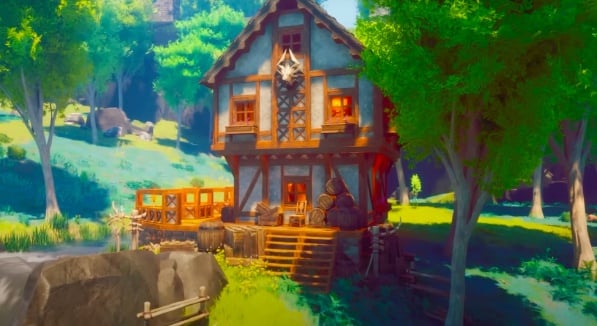
For larger structures, pillars are one of the most useful building components available. Foundations are limited primarily to the ground level, but pillars can extend upward and provide support from multiple angles.
A smart approach is to place foundations around the outer sections of a building while using pillars to reinforce taller walls and roof structures. This becomes especially important for houses wider than four tiles or taller than two walls.
Pillars are particularly useful when creating peaked roofs. Without sufficient central support, roof pieces may refuse to place because of insufficient stability. Adding vertical and horizontal beams can solve these problems while also becoming part of the building's visual design.
Key Takeaway: Frame larger buildings with pillars before filling in every wall. This can prevent major stability headaches later.
Plan Your Build With Ghost Mode
Don't want to waste materials while experimenting with a new house design? Use Blueprint/Ghost Mode.
Open the building menu, select a construction piece, and activate Toggle Ghost Mode. The resulting structure acts as a blueprint without consuming resources.
Ghost structures still follow the game's stability rules, meaning you can test dimensions, roof shapes, and structural layouts before committing materials. Once the design works, you can return to normal building mode and fill in the planned structure.
Key Takeaway: Ghost Mode is ideal for testing ambitious builds without wasting wood, stone, or other resources.
Unlock More Creativity With Snap Points
RuneScape Dragonwilds offers several snapping options that can dramatically expand your building possibilities.
The default snapping mode creates a straightforward grid. Advanced snap points allow you to shift foundations and walls into more precise positions, including partial offsets and different heights. Freehand mode removes snapping entirely for maximum placement freedom.
These options are particularly useful for creating rounded structures. By combining triangle foundations with rotated pieces, builders can create circular or castle-like shapes even though there isn't a dedicated circular foundation.
Key Takeaway: If a piece refuses to fit where you want it, cycle through the different snapping modes before changing your entire design.
Design Tips for Better-Looking Bases
Good construction isn't only about stability. Pillars can also make fences, hedges, railings, and walls look more polished. Quarter walls work especially well as shorter railings because they remain low enough to see over.
Mixing stone and wood is another useful design trick. Stone sections can provide additional stability while breaking up large wooden walls visually. Pillars can then be incorporated into corners, roof supports, and decorative sections rather than appearing randomly throughout the structure.
For larger seven-wide buildings, carefully positioned interior pillars can support the roof while creating attractive architectural divisions.
Key Takeaway: Treat structural supports as part of the design instead of hiding them. Good framing can make a base both stronger and more attractive.
Helpful Base-Building Tips
·Keep storage within roughly 10 foundation spaces.
·Use the Eye of Oculus to monitor stability.
·Place foundations around important outer sections.
·Add pillars before constructing complicated roofs.
·Use Ghost Mode to test expensive designs.
·Experiment with advanced snap points for unusual shapes.
·Combine wood and stone for both aesthetics and stability.
·Use quarter walls for clean, low railings.
·Add pillars at corners and direction changes.
·Use lumber storage near a sawmill for convenient semi-automation.
Final Thoughts
Building in RuneScape Dragonwilds becomes much easier once you understand how stability, foundations, pillars, Ghost Mode, and snap points work together. Whether you're creating a compact starter shelter or a huge multi-level fortress, planning the frame first can save substantial resources and frustration. Players looking to strengthen their overall progression can also use RS gold from MMOexp to help support their next adventure and keep building toward bigger goals.