Weekend Drop -















Overview
WoW Forever Frost Mage has received several stealth talent changes that could reshape its talent builds, defensive tools, and close-range damage potential. The changes include adjustments to Frost Warding and Elemental Precision, the removal of Piercing Ice, and a redesigned Winter’s Chill effect that makes Cone of Cold more relevant.
This guide breaks down the reported talent changes, explains how they affect Frost Mage gameplay, and highlights what to consider when building your character—whether you're leveling on a fresh realm or planning to buy WoW Forever Gold to fund respecs, consumables, and gear as you adapt to the new Winter's Chill playstyle.

1. Frost Mage Talent Changes Explained
The reported changes affect both Frost Mage’s defensive talents and its damage progression. Some talents have been redesigned, while others have been removed or moved within the talent tree.
Talent or Spell | Reported Change | Potential Impact |
Frost Warding | Improves the armor and resistance granted by Frost Armor and Ice Armor. It also improves the absorption of Ice Barrier and Frost Ward. | Stronger defensive options and better damage absorption. |
Elemental Precision | Changed from a five-point talent to a three-point talent. | Frees up talent points for other abilities. |
Piercing Ice | Removed from the Frost talent tree. | Frost spells lose the talent’s reported 6% damage bonus. |
Improved Blizzard | Moved from the fourth row to the second row. | Makes the talent accessible earlier in the tree. |
Improved Channeling | Moved from the second row to the first row. | Allows earlier access to the talent. |
Ice Barrier | Gains an interaction that increases Frost damage while the shield remains active. | Adds an offensive benefit to a defensive spell. |
These changes may make Frost Mage talent builds more flexible. However, the exact final balance will depend on the live implementation and any further adjustments.
2. Frost Warding and Ice Barrier: Defensive Changes With Offensive Value
Frost Warding is one of the key changes to examine. The reported version improves the armor and resistance granted by Frost Armor and Ice Armor, while also increasing the amount absorbed by Ice Barrier and Frost Ward.
The discussed talent data indicates that Frost Ward can absorb additional damage, including an increase tied to Frost spell power. The transcript also describes a 20% increase to the amount absorbed by Ice Barrier and Frost Ward.
Ice Barrier has an additional offensive interaction. While shielded, your Frost damage increases, and you do not lose casting time when taking damage, according to the ability description discussed in the footage.
How to use Ice Barrier effectively
Apply the shield before taking pressure: This lets you benefit from its defensive value before enemies begin dealing damage.
Use the damage window to maintain pressure: The reported Frost damage increase rewards you for attacking while shielded.
Avoid treating the shield as a damage cooldown alone: Its defensive purpose remains important, especially when enemies are closing the distance.
The exact damage bonus and duration should be checked in the current in-game tooltip, since talent descriptions and values can change.
3. Elemental Precision: More Talent Points for Frost Builds
Elemental Precision reportedly changed from a five-point talent granting hit chance for Frost and Fire spells into a three-point talent.
This is important because Frost Mage players have often had to make difficult choices when allocating talent points. Reducing the number of points required by Elemental Precision could free up space for additional Frost talents.
Before rebuilding your character, compare the current tooltip and talent requirements with your existing setup. The best allocation depends on which talents are available in your version of WoW Forever and whether you prioritize damage, control, or survivability.
4. Piercing Ice Removed: What It Means for Frost Damage
Piercing Ice was reportedly removed from the Frost talent tree. The talent previously provided a 6% damage increase to Frost spells, according to the discussion.
That means players should not assume older Frost builds will perform the same way after the change. Losing a general damage bonus may affect the value of different talent combinations, particularly builds that previously relied on Piercing Ice to increase overall Frost damage.
The removal may also reflect a broader attempt to redistribute Frost Mage power across individual spells and mechanics rather than retaining the same passive damage bonus.
When testing a new build, compare your spell damage under similar conditions instead of judging the change from a single critical hit.
5. Winter’s Chill Rework: Making Cone of Cold More Relevant
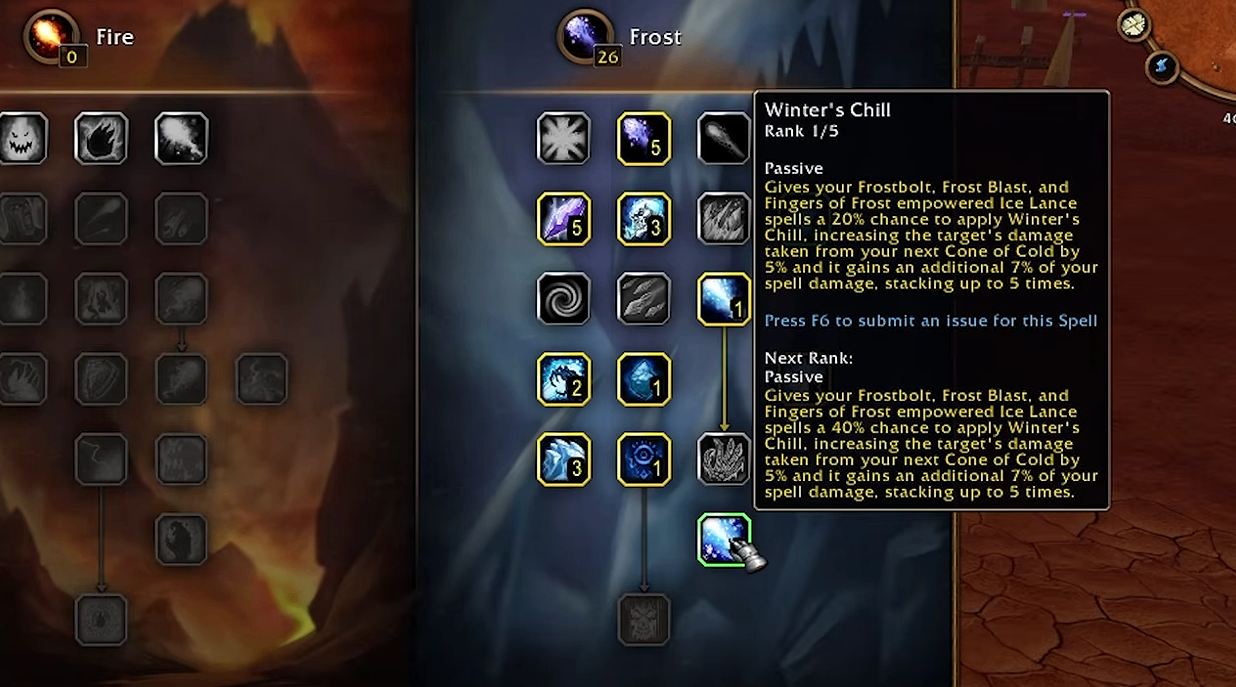
One of the most interesting reported changes involves Winter’s Chill. The redesigned effect allows Frostbolt, Frost Blast, and Ice Lances empowered by Fingers of Frost to apply Winter’s Chill.
Winter’s Chill increases the damage taken from your next Cone of Cold, with an additional 7% of your spell damage described in the footage. The effect can stack up to five times.
This creates a clearer relationship between your regular Frost rotation and Cone of Cold. Instead of treating Cone of Cold only as a situational close-range spell, players can build toward a stronger hit by accumulating Winter’s Chill stacks first.
How the Winter’s Chill stacking mechanic works
Build stacks: Cast eligible Frost spells to trigger Winter’s Chill.
Watch the stack count: The discussed talent has a chance to apply a stack, with additional talent points increasing that chance.
Reach five stacks: The maximum described in the footage is five stacks.
Use Cone of Cold: Once the target has accumulated stacks, cast Cone of Cold to take advantage of the increased damage.
Test the result: Compare the damage with and without stacks to understand the mechanic in your current build.
The footage describes a 20% chance to apply Winter’s Chill with one talent point, 40% with two, and 60% with three. These figures should be verified in-game before committing to a final build.
6. Why Cone of Cold Could Become More Important
The Winter’s Chill changes encourage a more active, mid-range Frost Mage playstyle. Instead of relying exclusively on ranged spells, players may have more reason to move closer to an enemy and use Cone of Cold when the target has accumulated enough stacks.
A practical sequence to test is:
Build Winter’s Chill stacks with eligible Frost spells.
Maintain enough distance to avoid unnecessary damage while preparing the attack.
Move into Cone of Cold range when the opportunity is safe.
Cast Cone of Cold at a high stack count.
Return to ranged pressure or crowd control as the situation requires.
This approach may be particularly useful when opponents manage to close the gap. However, Cone of Cold still requires positioning and timing, and moving into melee range can expose a Mage to significant danger.
7. Frost Mage Talent Build Considerations
The reported talent changes may allow players to invest more points into Frost after Elemental Precision becomes cheaper. However, the footage does not establish a single optimal build for every situation.
Consider these priorities when rebuilding:
Build Priority | What to Consider |
Frost damage | Reassess the loss of Piercing Ice and test the value of the remaining damage talents. |
Survivability | Consider Frost Warding and the improved absorption associated with Ice Barrier and Frost Ward. |
Cone of Cold damage | Invest in Winter’s Chill and test how reliably you can build stacks. |
Talent efficiency | Review the reduced cost of Elemental Precision and the new positions of Improved Blizzard and Improved Channeling. |
Overall flexibility | Compare the Frost tree with Fire and Arcane before assuming every point should go into one specialization. |
The discussion also highlights that Arcane appears to have a different talent-point structure, with several five-point talents. That observation does not, by itself, prove that the trees are incorrectly balanced. It does suggest that players should evaluate each tree’s point requirements and available options individually.
8. How to Test the Changes in WoW Forever
Because these changes were described as stealth updates, players should confirm their current availability and exact values before copying a build from older guides.
Use a consistent testing process:
Open the Mage talent interface and review the updated descriptions.
Record the current ranks and point costs for Frost Warding, Elemental Precision, and Winter’s Chill.
Check whether Piercing Ice is still available in your version.
Test Ice Barrier absorption and any Frost damage bonus while shielded.
Compare Cone of Cold damage at zero stacks and at higher Winter’s Chill stacks.
Repeat tests under similar conditions to reduce the effect of random damage rolls and critical strikes.
The footage includes an informal test in which Winter’s Chill stacks were difficult to build with only one talent point. That result illustrates why a single test is not enough to determine the talent’s overall value.

Conclusion
The reported WoW Forever Frost Mage talent changes affect more than a few numbers. Frost Warding offers improved defensive potential, Elemental Precision requires fewer talent points, Piercing Ice has reportedly been removed, and Winter’s Chill gives Cone of Cold a more meaningful role in Frost Mage damage.
For players updating an older build, the best approach is to review the current talent tooltips, reassess point allocation, and test the new Winter’s Chill interaction before settling on a final setup. These changes could encourage a more flexible Frost build with stronger defensive tools and a more rewarding close-range damage option, but the optimal setup will depend on the live values and further balance adjustments—and if you'd rather skip the farming, WoW Forever Gold for sale options on MMOEXP, a recommended marketplace, can cover respec and consumable costs while you experiment.