










Summary:
College Football 27 Dynasty Mode rewards coaches who build around their roster’s strengths. A run-first offense, multiple running-back formations, smart quarterback rushing, recruiting depth, College Football 27 Coins, and effective wear-and-tear management can make the difference between a good season and a championship run.
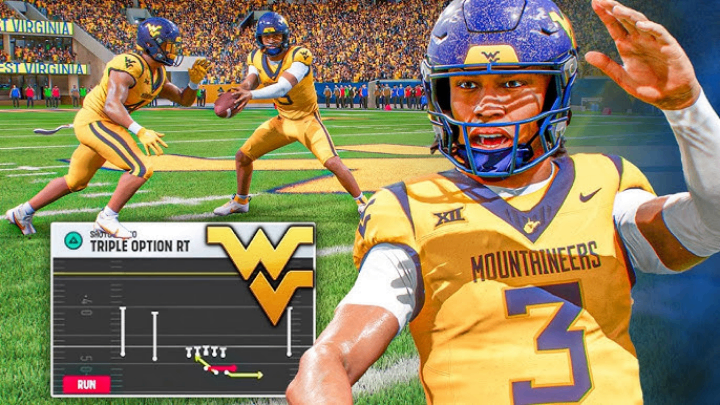
West Virginia’s Season 2 Breakthrough
West Virginia entered the final stretch of Season 2 with plenty to prove. After upsetting Colorado, the Mountaineers climbed back into the Top 25 and improved to 6-2. With bowl eligibility already secured, the focus shifted toward competing for the Big 12 title and finishing the season with momentum.
The biggest challenge, however, was the offense. Quarterback Michael Hawkins had struggled compared with his previous season. His turnovers increased, passing efficiency declined, and his rushing production dropped by nearly 20 yards per game. Rather than forcing the offense to become something it was not, the coaching staff decided to lean into its strongest identity: a run-oriented offense built around a mobile quarterback.
That philosophy became one of the most interesting parts of this College Football 27 Dynasty.
Building a Run-First Offense Around a Mobile QB
The goal was simple: create an offense where the quarterback is an active part of the rushing attack. Hawkins can threaten defenses with designed runs, scrambles, read options, and RPO concepts.
Instead of relying heavily on deep passes, the offense emphasizes quick throws and controlled decisions. This is especially important in Dynasty Mode, where elite quarterbacks, receivers, and offensive lines are not guaranteed.
A deep passing attack can be devastating when the roster has the right talent, but it becomes much less reliable when the quarterback lacks accuracy or receivers struggle to separate. A short passing game combined with a strong rushing attack provides a more sustainable offensive foundation.
The result is an offense that can adapt to different opponents instead of relying on one type of play.
Why Multiple Running Backs Matter in College Football 27
One of the biggest lessons from this Dynasty was the value of multiple-running-back formations.
West Virginia used Amari Latimer, Penny Thompson, Gordon Murray, and Michael Hawkins in different combinations. Latimer emerged as the primary ball carrier, while Thompson provided versatility and Murray offered additional speed and development potential.
The duo formation became particularly interesting. It places two running backs side-by-side in the shotgun, creating unusual blocking angles and forcing defenses to account for multiple threats.
The formation is part of the Go-Go offensive philosophy associated with Brennan Marion, and it provides more than just another running play. The alignment can create opportunities for option runs, lead blocks, misdirection, and quick passes.
For Dynasty players, this is an important lesson: formations do not need to look conventional to be effective. Sometimes an unusual alignment creates better angles and forces the defense to react differently.
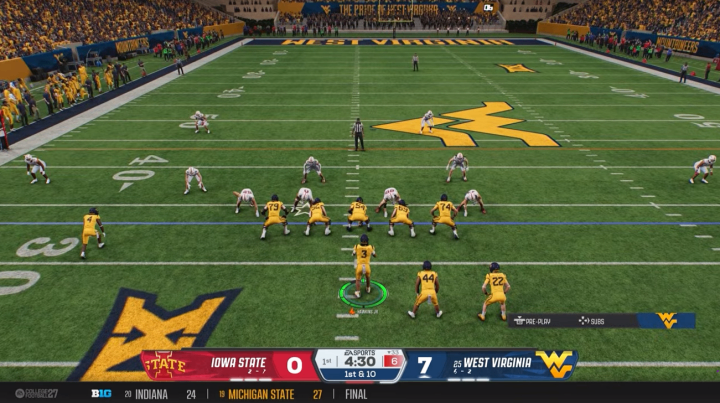
Pistol and Full-House Formations Add More Variety
West Virginia also continued experimenting with pistol and full-house formations. These packages allow several running backs to participate while maintaining the possibility of passing or option football.
This variety is important because defenses can eventually adjust to predictable tendencies. If an opponent consistently loads the box against inside runs, the offense can use outside runs, option concepts, screens, or play action.
The goal is not simply to run the ball constantly. It is to make the defense respect every player on the field.
That is one of the strengths of College Football 27 Dynasty Mode: building an offensive identity around your roster rather than blindly following the strongest meta.
The Iowa State Game Shows the Formula Working
Against Iowa State, West Virginia finally produced one of its best offensive performances of the season. The Mountaineers rushed for 5.7 yards per attempt while Iowa State managed only 1.4 yards per carry.
Latimer finished with 15 carries for 95 yards, Hawkins added 70 rushing yards and a touchdown, Thompson contributed 38 yards and another touchdown, while Murray added 25 yards.
The most important statistic was not any individual player's performance. It was the distribution of touches.
Multiple backs contributed, Hawkins remained involved as a runner, and the offense successfully created different looks throughout the game.
West Virginia eventually won 30-24, improving to 7-2 and showing that a diversified rushing attack could work.
Recruiting Is Becoming More Competitive
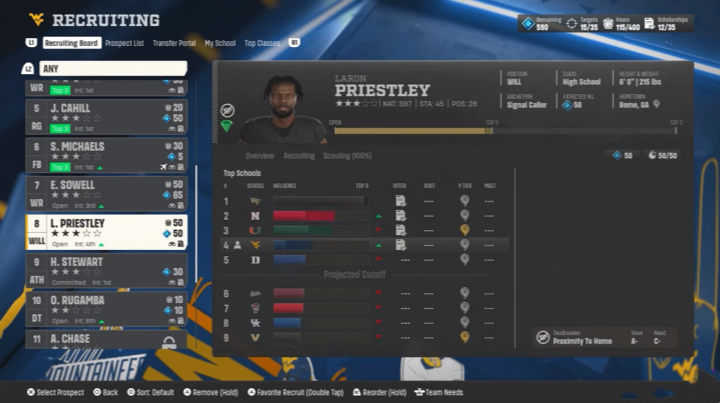
Recruiting provided another major storyline. West Virginia was finding it increasingly difficult to dominate recruiting battles, even against lower-rated prospects.
Instead of automatically winning two-star and three-star recruiting battles, the Mountaineers often had to compete with several schools. This forced the coaching staff to concentrate recruiting points on fewer prospects and scout deeper into the available player pool.
Two-star recruits also became more valuable for roster depth. Athleticism remains important, particularly speed and acceleration, because those attributes can be difficult to develop later.
For smaller programs, recruiting depth is essential. A two-star running back with 85 speed may eventually become a useful contributor if the player develops correctly.
Wear and Tear Is a Major Dynasty Consideration
One of the most interesting College Football 27 Dynasty discoveries involved the wear-and-tear system.
Testing suggested that wear-and-tear sliders may have little or no effect on CPU teams during simulated games. Adjusting recovery and wear-and-tear settings produced similar results when games were simulated, suggesting that weekly practice systems and staff upgrades may have a greater influence on CPU roster health.
However, wear and tear still matters during games controlled by the user.
Offensive linemen, defensive linemen, and running backs appeared to experience some of the most significant effects. That makes roster rotation especially important for Dynasty coaches.
Larger programs may also have an advantage because coaching packages can reduce wear and tear significantly. As a Dynasty develops, investing in staff upgrades can therefore become an important part of maintaining player health.
The Cincinnati Loss Reveals the Offense’s Weakness
The following game against Cincinnati showed the other side of the experiment.
West Virginia struggled badly through the air. Hawkins threw multiple interceptions, the passing game produced little consistency, and Cincinnati's quarterback Brooks Goodman passed for 338 yards.
Hunter Summers was particularly difficult to stop, while Cincinnati consistently found success with play action and RPO concepts.
The Mountaineers eventually lost by 20 points, proving that a run-first offense still needs a reliable passing counter.
The lesson is clear: offensive balance does not mean running and passing equally. It means having enough passing ability to punish defenses when they overcommit to the run.
Final Thoughts
West Virginia's second season demonstrates what makes College Football 27 Dynasty Mode so engaging. Building a successful program is not simply about finding the highest-rated players. It is about developing an identity, adapting formations, managing player health, recruiting intelligently cheap College Football 27 Coins, and understanding what your roster can realistically execute.
The Mountaineers' run-first approach has already produced strong results, but the Cincinnati loss exposed a major weakness in the passing game. With difficult matchups against BYU and Kansas State remaining, the offense will need to become more efficient without abandoning its identity.
For Dynasty players, the biggest takeaway is simple: build around your strengths, create multiple ways to attack defenses, and use recruiting and roster management to gradually expand what your team can do. That approach can turn a rebuilding program into a legitimate contender in College Football 27.