






Summary:
A little-known crafting strategy centered around Coward's Legacy turned a forgotten unique belt into one of the most profitable investments in Path of Exile 2. By combining smart market research, Vaal corruption, and advanced crafting orbs, Path of Exile 2 Currency, one player earned more than 300 Divine Orbs while spending only a few hours actively playing.
Why Coward's Legacy Was the Perfect Target
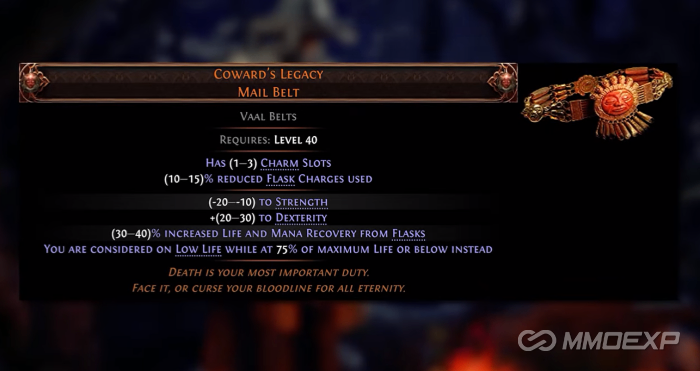
At first glance, Coward's Legacy doesn't appear particularly valuable. The unique belt is mainly used by niche Low Life builds because it changes the Low Life threshold from the standard 50% to 75% of maximum life. This allows players to gain powerful Low Life bonuses while remaining significantly healthier than usual.
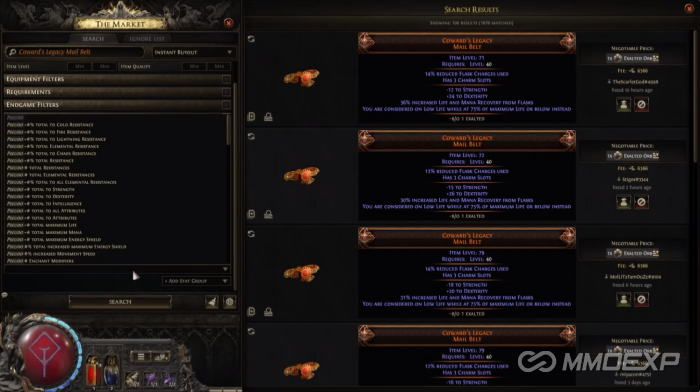
Most players simply found the belt during Ritual encounters or other league mechanics and listed it for one to three Exalted Orbs without paying attention to its rolls.
That pricing mistake created an incredible opportunity.
Not every Coward's Legacy was worth buying, however. The most desirable crafting bases shared three important characteristics:
· Uncorrupted
· Three Charm Slots
· A negative Strength roll between -10 and -13
The negative Strength modifier becomes extremely important later because removing it dramatically increases the belt's value.
Starting With Only Five Divine Orbs
The strategy began shortly after finishing the campaign with only five Divine Orbs available.
Rather than farming endlessly, the player purchased every qualifying Coward's Legacy listed cheaply on the trade market. Since most sellers ignored the belt's potential, dozens could often be purchased for only a few Exalts each.
The only real limitation wasn't currency—it was gold.
Using asynchronous trade repeatedly costs a surprising amount of gold, meaning players need to farm maps occasionally just to continue purchasing inventory after inventory of belts.
Even so, the startup investment remained relatively small compared to many crafting strategies.
The First Layer of Profit: Simple Vaal Corruptions
The first crafting step was straightforward.
Each belt received a single Vaal Orb.
Like most corruption mechanics in Path of Exile 2, this is essentially gambling. Many belts remain unchanged or become worthless. Those are simply vendored or discarded.
The valuable outcomes are the reason the strategy works.
Several corruption modifiers consistently command high prices among Low Life players:
· Increased Low Life threshold
· Additional elemental resistances
· Maximum Fire, Cold, or Lightning Resistance
· +1 Maximum Endurance Charges
Even one of these modifiers could transform a one-Exalt purchase into a belt worth several Divine Orbs.
Instead of trying to sell every corruption immediately, the crafter separated the promising belts into a dedicated stash tab while listing the smaller upgrades for quick profits.
Those overnight sales alone created a steady stream of currency.
Discovering the Real Money Maker
The breakthrough came after studying more expensive listings on the trade market.
Many premium Coward's Legacy belts displayed mysterious red Vaal modifiers that ordinary corrupted belts lacked.
These were created using the Vaal Cultivation Orb.
Although expensive—roughly one Divine Orb each—the item can remove one or two existing modifiers while replacing them with exclusive Vaal modifiers.
For Coward's Legacy, this interaction is incredibly powerful.
If the Cultivation Orb removes the belt's negative Strength penalty while adding a useful bonus, the unique effectively loses its major downside without sacrificing its powerful Low Life mechanic.
That single improvement often transformed an ordinary corruption into an item worth 10 to 20 Divine Orbs.
Even better, additional Vaal modifiers such as life regeneration, maximum life while on Low Life, or flask bonuses could significantly increase buyer interest.
Of course, there is risk.
If the Cultivation Orb removes the Low Life modifier instead of the negative Strength roll, the belt is essentially ruined.
Because of that, this stage is best reserved for players with a reasonable amount of currency already available.
Reinvesting Every Sale
Instead of cashing out profits, every successful sale funded more crafting.
The routine became surprisingly simple.
Each evening consisted of:
· Running a few maps for gold
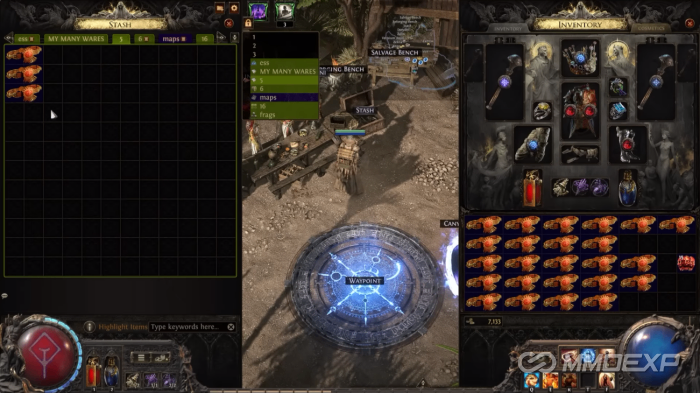
· Buying another inventory of Coward's Legacy belts
· Corrupting every belt
· Listing successful outcomes before logging off
The following morning, multiple belts had usually sold overnight.
This passive income quickly snowballed.
Within only a few days, profits exceeded 100 Divine Orbs, despite spending less than an hour actively playing each day.
The strategy worked because the market consistently demanded specialized Low Life gear while relatively few players bothered crafting these belts.
The Final Gamble: Architect's Orb
Once profits accumulated, the crafter introduced one final layer of RNG.
The Architect's Orb.
This currency item is extremely risky.
When used on a corrupted item, it has approximately a 50% chance to destroy the item entirely.
If it succeeds instead, the item gains an additional corrupted enchantment.
That extra modifier can increase a belt's value dramatically.
Belts already worth 15 or 20 Divine Orbs suddenly become premium items worth 40, 50, or even 60 Divine Orbs depending on the combination of modifiers.
Examples of successful crafting chains included:
· Perfect resistance corruption
· Removal of negative Strength through Vaal Cultivation
· Additional beneficial Vaal modifiers
· Successful Architect's Orb double corruption
When everything aligned, the profit margins became extraordinary.
Naturally, failures were painful.
Losing an expensive belt plus a costly Architect's Orb could erase multiple Divine Orbs instantly.
For that reason, this final stage is recommended only for experienced crafters comfortable with high-risk investments.
Market Knowledge Beats Endless Grinding
Perhaps the most interesting part of this strategy is that it required remarkably little actual gameplay.
The majority of time wasn't spent clearing maps.
Instead, success came from understanding:
· Which belt bases to purchase
· Which corruption outcomes players wanted
· Which belts deserved additional investment
· When to stop crafting and list an item instead
Many inventories produced several Divine Orbs in profit immediately.
Occasionally, one exceptional corruption paid for dozens of failed attempts.
This demonstrates one of Path of Exile 2's most fascinating economic principles: knowledge often generates more wealth than raw playtime.
Is the Strategy Still Worth Trying?
Like all crafting methods in Path of Exile 2, profitability depends heavily on league economies.
Prices for Coward's Legacy, Vaal Orbs, Vaal Cultivation Orbs, and Architect's Orbs fluctuate throughout a season. Increased popularity may also reduce profit margins as more players enter the market.
Nevertheless, the underlying lesson remains valuable.
Hidden opportunities often exist within overlooked unique items. Most players focus exclusively on expensive rare crafting or high-end boss farming, leaving niche markets surprisingly underserved, cheap Path of Exile 2 Currency.
Players willing to study trade listings, identify undervalued bases, and understand what specialized builds actually need can often discover lucrative crafting niches before the broader community catches on.
For aspiring traders, Coward's Legacy serves as an excellent reminder that some of Path of Exile 2's best money-making methods aren't found in massive loot explosions—they're found in recognizing value where everyone else sees vendor trash.